
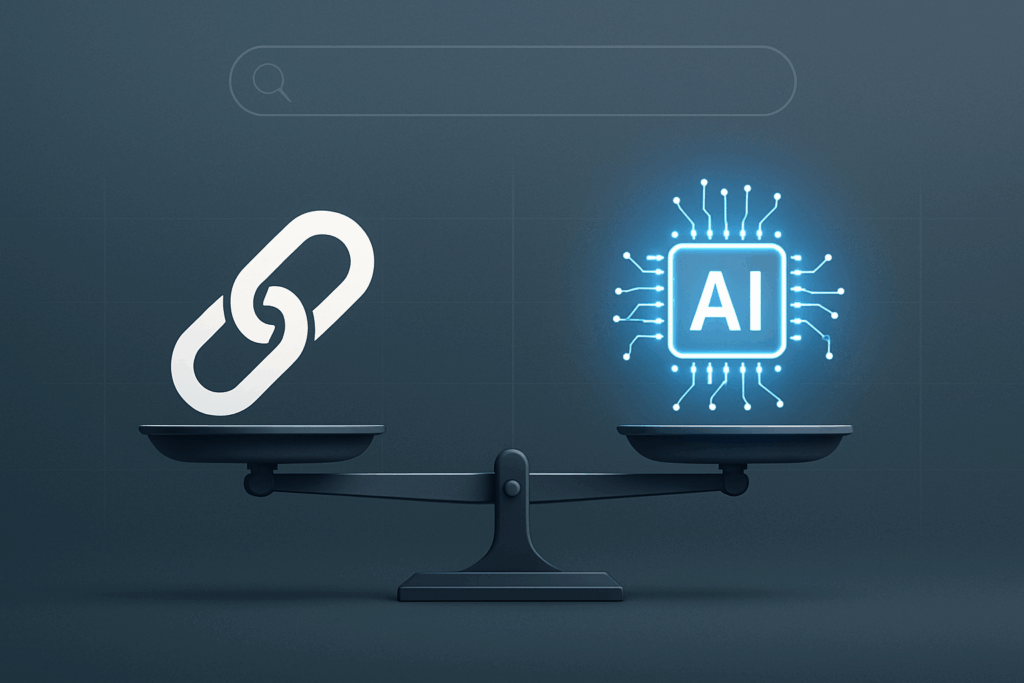
Backlinks still matter for traditional search rankings, but their importance is declining. More significantly, data from AI search platforms shows that backlinks have almost no correlation with which sites get cited by large language models. With Google pushing AI Overviews and ChatGPT gaining traffic, smart SEO strategies now focus on creating content that AI systems can easily parse and cite, rather than acquiring links at scale.
Table of Contents
ToggleHow Backlinks Built Google’s Algorithm
Google revolutionized search by using backlinks to measure authority. The original PageRank algorithm counted incoming links as votes, with each link signaling that a page was trustworthy and valuable. For years, this made backlinks the most important ranking factor.
SEOs quickly realized they could manipulate these signals. The result was a constant battle between Google and optimization tactics designed to game the system. Over time, Google’s algorithms evolved to distinguish legitimate links from those created solely for ranking purposes.
@tjrobertson52 POV: You’ve been buying backlinks for 16 years and just realized they’re dying 📉 Here’s what I’m doing instead #SEO #BacklinkStrategy #DigitalMarketing #AISearch #GoogleAlgorithm
♬ original sound – TJ Robertson – TJ Robertson
Why Traditional Link Analysis Is Declining
Google has spent years telling us that backlinks will matter less over time. John Mueller, a Google Search Relations team member, confirmed that while links help with discovery, “over time, [the weight on links] won’t be such a big factor as it is today.”
The search engine retired public PageRank scores years ago. Today’s ranking algorithm uses hundreds of signals. Link analysis remains one of Google’s core systems, but it’s no longer the dominant factor. Content quality, user experience, and brand trust now balance against raw link counts.
Barry Schwartz, a respected SEO expert, notes that links “are weighted a lot less than they were 8 years ago” and will likely continue to decline in importance.
The AI Search Data That Changes Everything
Recent research reveals a dramatic shift in AI-powered search results. Profound analyzed 10 million AI search results and presented findings at BrightonSEO 2025 that should concern anyone still focused primarily on link building.
The correlation between backlinks and AI citations measured just 0.038. In practical terms, that’s essentially zero. More than 97% of AI answer citations couldn’t be explained by a site’s backlink count.
The data gets more interesting. Sites with only 1-9 backlinks averaged approximately 2,160 AI citations. Sites with 10 or more backlinks averaged just 681 citations. The relationship isn’t just weak—it’s inverse.
What AI Search Actually Rewards
Google’s AI Overviews rely on the same sites that perform well in traditional search, but the ranking signals work differently. Rather than prioritizing sites with the most links, AI systems evaluate:
- Brand authority and reputation across the web
- Expert authorship with clear credentials
- Content structure that’s easy for AI to parse
- Answer-first formatting with concise summaries
- Schema markup that identifies entities and relationships
When someone asks ChatGPT or Google’s AI for recommendations, these systems run multiple specific searches. They examine hundreds of pages before responding, not just the top few results. A site doesn’t need to rank #1 for broad terms. It needs to appear in many relevant places for specific questions.
The Shift Toward Mention-Based Optimization
Traditional backlinks connect two sites through hyperlinks. AI search cares more about mentions—simply having your brand name appear in relevant content, even without a clickable link.
This changes the optimization strategy. Rather than focusing solely on acquiring links from high-authority domains, effective AI optimization requires:
- Creating comprehensive content that answers specific questions
- Distributing that content across multiple platforms
- Getting mentioned in contexts where AI systems look for answers
- Building topic authority through depth rather than link volume
The research shows that AI systems cite obscure blogs and niche publications regularly. They don’t limit themselves to sites with massive link profiles. If your site has the most thorough answer to a specific question, you can win the citation regardless of how many backlinks you have.
When Backlinks Still Make Sense
This doesn’t mean backlinks are worthless. For competitive traditional search terms, strategic link acquisition still provides value. The keyword is strategic.
Instead of buying dozens of generic links, focus on a few high-value placements:
- Target specific pages or terms where you need a ranking boost
- Choose authoritative sites in your niche
- Use natural anchor text that readers would actually click
- Ensure the content provides genuine value
- Use rel=”sponsored” or nofollow to stay transparent
A few well-placed, topic-relevant links can still move the needle for competitive terms. But the days of building links at scale to every page are ending.
How to Optimize for AI Search Results
The future of visibility requires a different approach:
Structure content for AI parsing. Start with clear answers. Use short sentences. Break information into sections with descriptive headings. Add schema markup to help AI systems understand your content’s structure.
Build comprehensive topic coverage. Create pages that thoroughly address specific questions, not just broad keywords. If someone asks a unique question in ChatGPT, your site should be the best answer available.
Demonstrate expertise. Include author credentials, cite data sources, and reference industry authorities. AI systems evaluate trustworthiness when selecting which sites to cite.
Get mentioned widely. Focus on distribution across multiple platforms—social media, industry publications, forums, and niche sites. The goal is to be referenced wherever AI systems look for information about your topic.
Maintain traditional SEO fundamentals. AI-ready content is still helpful, well-structured content. The same principles that worked for traditional search apply, with the added requirement that AI systems can easily digest and cite your information.
What This Means for Your SEO Strategy
If you’re spending a significant budget on link building in 2026, it’s time to reconsider the allocation. Links still have value for competitive terms in traditional search. But Google itself is shifting toward AI-powered results.
The traffic from AI search platforms will likely surpass traditional search within a year or two. More importantly, AI-sourced traffic converts at higher rates—users trust recommendations from a ChatGPT conversation more than they trust a list of blue links.
Smart agencies are already adapting. They’re creating systems to produce high-quality, AI-ready content at scale. They’re tracking where AI systems look for information. They’re ensuring their clients appear in as many relevant contexts as possible.
The fundamentals remain: helpful content, clear structure, and demonstrated expertise. But the game has changed from accumulating links to building comprehensive topical authority that AI systems can recognize and cite.
Ready to Adapt Your SEO Strategy?
TJ Digital specializes in AI optimization for small to medium businesses. We track where large language models look for information in your industry and help you show up in those places. Our approach combines traditional SEO fundamentals with cutting-edge AI optimization techniques.
Want to see where you stand? We offer free digital marketing audits that show exactly what will help you get more customers in 2025’s AI-driven landscape. Contact us to get started.