
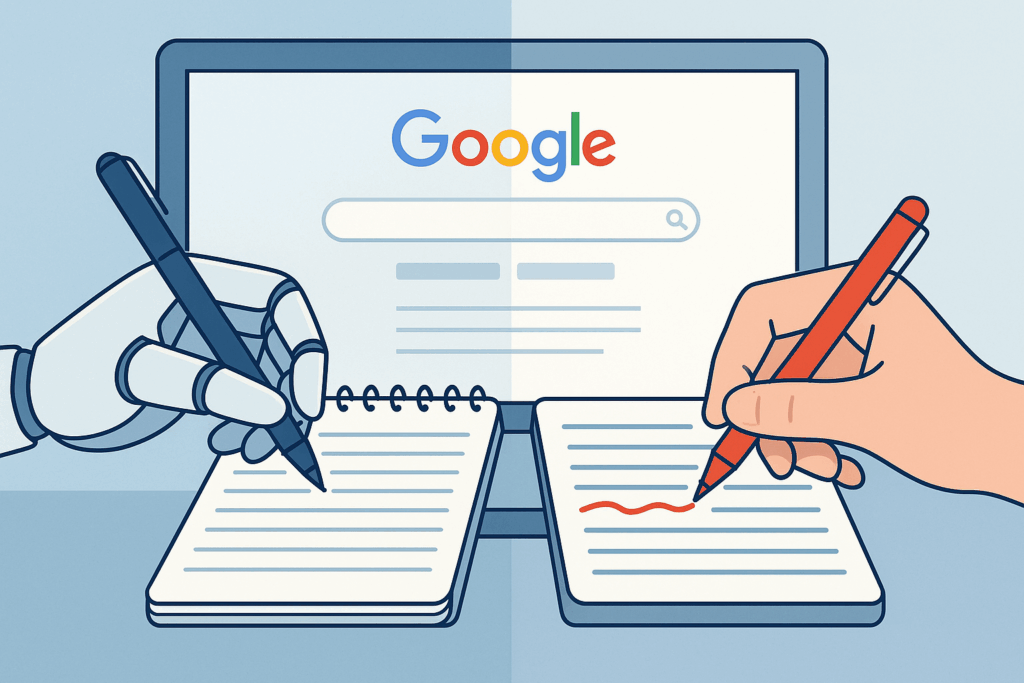
No, Google does not penalize content simply because it was created with AI. Google has repeatedly stated that it cares about content quality, not how the content was produced. However, using AI to mass-produce low-quality content at scale can result in a manual penalty called “scaled content abuse.”
The confusion around this topic stems from a misunderstanding of what Google actually penalizes. Many websites have lost rankings after publishing AI content, but not because the content was AI-generated. They were penalized for creating thousands of thin, unhelpful pages designed to manipulate search rankings.
Table of Contents
ToggleGoogle’s Official Position on AI Content
Google’s Search team has been clear: “our focus [is] on the quality of content, rather than how content is produced.” Their guidelines emphasize creating original, helpful content that demonstrates expertise, regardless of whether AI assisted in the creation process.
According to Google’s spam policies, the appropriate use of AI to assist content creation does not violate their guidelines as long as it helps users. In fact, Google treats AI-written content the same as any other content—if it provides value and meets user needs, it can rank well.
The key distinction is intent. If AI is used to churn out keyword-stuffed articles solely to manipulate rankings, that clearly violates Google’s spam policies.
@tjrobertson52 Google CAN’T detect AI content (and wouldn’t penalize it anyway) 🤯 The real reason some AI sites get hit? Quality, not tools #AIcontent #SEO #GoogleMyths #DigitalMarketing #MarketingStrategy
♬ original sound – TJ Robertson – TJ Robertson
Can Google Detect AI-Generated Text?
Google’s algorithm cannot reliably detect whether content was created by AI. Despite what some SEO tools claim, no proven “AI content detector” exists within Google’s ranking systems.
As John Mueller, Google’s Search Advocate, has repeatedly confirmed, Google does not have magic detectors for AI content. The algorithm evaluates content based on quality signals like usefulness, originality, relevance, and expertise—not by analyzing whether a bot wrote it.
What Google’s systems can detect are patterns associated with low-quality content: thin articles, duplicated information, keyword stuffing, and templated structure. These quality issues trigger penalties regardless of whether a human or AI created the content.
In fact, Google’s quality rater guidelines direct human reviewers to give pages the lowest quality rating if content is “copied, paraphrased, embedded, auto or AI generated, with little to no added value.”
What Is Scaled Content Abuse?
Scaled content abuse is Google’s term for mass-generating pages “primarily to manipulate search rankings and not help users.” This penalty applies to any site producing large quantities of low-value or unoriginal pages, whether created by AI, humans, or automated systems.
Examples of scaled content abuse include:
- Using AI to generate thousands of pages with no added user value
- Automatically scraping or translating content without improvement
- Stitching together generic content from multiple sources without offering anything unique
Google updated its spam policies in March 2024 to crack down on content produced at scale for ranking purposes. When a human reviewer identifies this behavior, Google can issue a manual action penalty.
You’ll know if you’ve been hit with this penalty because your Google Search Console will show a manual action under “Major Spam Problems,” specifically noting “scaled content abuse.”
How to Use AI for Content Without Getting Penalized
AI can be a powerful tool for content creation when used responsibly. The key is treating AI as an assistant, not a replacement for human expertise.
Use AI for Research and Outlines, Not Final Drafts
AI excels at gathering information, suggesting structure, and summarizing technical details. For example, you might use AI to compile research articles on a topic, then apply your own expertise to analyze the data and write clear, accurate content.
This approach uses AI as a research tool while keeping human judgment and expertise at the center of the content creation process.
Always Add Human Expertise and Editing
Never publish AI output without significant revision. Add first-hand knowledge, real examples, and original analysis. Fact-check every claim and piece of data that AI provides.
Content showing clear human oversight and subject-matter expertise performs better in search results. Google has specifically warned that content “primarily automated with limited human oversight” tends to be penalized.
Prioritize Originality and User Value
Don’t ask AI to regurgitate what every other website says. Add new perspectives, cite reliable sources, and include interviews or original research. The difference between content that ranks and content that gets penalized often comes down to whether you’re providing unique value or just rehashing existing information.
Follow E-E-A-T Guidelines
Google’s ranking systems reward content demonstrating Experience, Expertise, Authoritativeness, and Trustworthiness. This applies to all content, whether AI-assisted or not.
Your content should include clear author bylines, cite credible sources, and answer user questions thoroughly. AI can help draft or summarize, but the final article must meet Google’s “people-first” standards.
The Risks of Mass-Publishing AI Content
There’s no published limit on how many pages you can publish per day. Google evaluates content quality and purpose rather than counting pages. However, rapidly publishing thousands of unreviewed AI articles creates significant risks.
In the short term, you might see traffic gains as Google indexes fresh content. But the long-term consequences can be severe. Google’s algorithm updates and manual spam reviews will eventually catch mass-produced low-quality content.
Industry analyses of Google’s March 2024 updates found that sites relying on mass-produced pages suffered the steepest drops in visibility. Google’s penalties for scaled content abuse range from search ranking demotions to complete removal from results.
A smaller website with well-crafted, unique pages will outperform a bloated site with thousands of shallow AI pages every time.
Signs You’ve Been Hit With a Penalty
If your site has been penalized for scaled content abuse, you’ll see clear symptoms:
- Sudden, massive drop in organic traffic and search rankings
- Pages disappearing from Google’s index
- Manual action notification in Google Search Console
- Warning message about “aggressive spam techniques” or “scaled content abuse”
These penalties come from human reviewers who determine that your site violates Google’s spam policies. It’s not about needing better SEO—it’s about fundamental content quality issues.
How to Recover From a Penalty
If you receive a scaled content abuse penalty, you must clean up your site before appealing. Google’s guidance is straightforward:
- Audit your content. Identify all low-value pages—thin content, duplicate posts, keyword-stuffed articles. Either delete them or substantially rewrite them with original research and expert insights.
- Rewrite for humans. Make sure the remaining content is genuinely helpful and people-first. Add clear bylines where relevant. Remove obvious AI boilerplate language.
- Submit a reconsideration request. Once you’ve fixed the issues, explain what you changed in Google Search Console. Provide examples of removed bad content and new good content.
Google will re-evaluate your site. If you’ve properly addressed the problems, the manual action should eventually be lifted. The key is focusing on substantial value, not just switching to human writers.
The Bottom Line
Google isn’t hunting for the “AI-written” stamp. They’re hunting for spammy, mass-produced content that doesn’t help users. A website that uses AI to generate thousands of low-value pages will likely be flagged under Google’s scaled content abuse policy.
Conversely, using AI responsibly as a research or editing tool can actually improve your content quality without any penalty risk. The safest strategy is treating AI output as a first draft: refine it with human expertise, focus on user needs, and always prioritize helpful, original content.
After 15 years in SEO, I can tell you that the fundamentals haven’t changed. Google rewards content that genuinely helps people. Whether you use AI to create that content or not doesn’t matter—as long as the end result is high-quality, original, and valuable to your audience.
Ready to level up your content strategy?
Contact TJ Digital to create AI-powered, human-approved content that Google — and your audience — will love.