
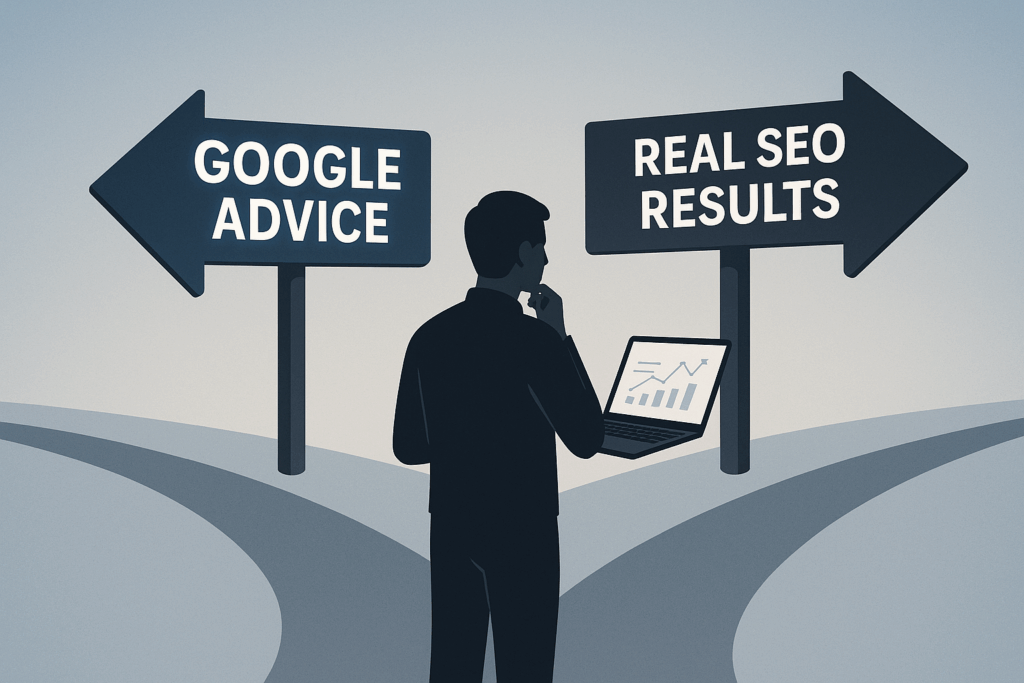
Here’s something most SEOs won’t tell you: Google’s official SEO advice often contradicts what actually works.
It makes sense when you think about it. Google doesn’t want you doing SEO. They want you to produce content that serves their users. When Google says “just write great content,” they’re not lying—but they’re leaving out the part where you need to optimize that content if you want anyone to find it.
After 16 years of doing SEO, I’ve learned to take Google’s advice with a grain of salt. Below are five pieces of common Google recommendations that you should ignore, along with what you should do instead.
Table of Contents
Toggle1. “Don’t Write for Search Engines—Just Write Helpful Content”
This is probably the worst SEO advice you could follow.
Google loves saying “write for people, not search engines.” But if your goal is to get traffic from Google, you absolutely need to write for search engines. That’s the entire point of SEO.
@tjrobertson52 Google’s SEO advice will tank your rankings 📉 Here’s what actually works instead. Which tip surprised you most? #SEO #Google #MarketingTips #DigitalMarketing #SEOSecrets
♬ original sound – TJ Robertson – TJ Robertson
What You Should Do Instead
You need to know what keywords you’re targeting before you create content. According to research on Google’s ranking factors, keywords in the page title account for roughly 14% of ranking weight—the second-largest factor after content relevance itself.
Here’s what actually matters:
- Put your target keyword in the title tag (preferably at the beginning)
- Include it in your H1 heading (Google treats this as a “secondary title tag”)
- Add it to your meta description and URL slug
- Use it naturally in the first paragraph
If your competitors are doing this and you’re not, they will outrank you. It’s that simple.
The key is balance. You want to satisfy both human readers and search algorithms. Write engaging, in-depth content that genuinely helps people, but make sure the page’s structure signals to Google what it’s about.
Google’s own data shows that “consistent publication of satisfying content” is the #1 ranking factor. But satisfying content that Google can’t understand won’t rank.
2. “Don’t Create Content at Scale”
Google has been pushing hard against “mass-produced content,” especially with AI tools making it easier than ever to generate articles. But they’re really fighting low-quality, low-effort content—not content created at scale.
There’s a huge difference.
The Reality of Scaling Content
With the right workflows, you can absolutely create high-quality content at scale. I do it for clients every week.
The secret is structured systems, not random bulk posting. Here’s what works:
Use templates and frameworks. Create outlines for different content types (how-to guides, comparison posts, service pages) so writers can fill in details efficiently without sacrificing quality.
Leverage AI as an assistant, not an autopilot. Use AI to draft ideas or suggest facts, then have humans edit heavily. According to Google’s guidance on AI content, they don’t forbid AI—they forbid using automation solely to manipulate rankings. The content still needs to provide real value.
Maintain quality control. Every piece should meet Google’s helpful-content standards. Ask yourself: does this page genuinely answer a user’s question? If the answer is no, don’t publish it.
Pace your publishing. Avoid sudden spikes of new pages. A gradual ramp-up (10 pages this month, 15 next month) keeps quality high and avoids triggering Google’s spam filters.
The bottom line: you should scale your content. Just do it smartly, with systems that prioritize quality over quantity.
3. “Only Use Your Exact Legal Business Name in Directories”
Google’s official guideline says to use your real business name only in directory listings like Google Business Profile. But in practice, adding descriptive keywords to your business name can dramatically boost your local rankings.
Why This Works (Despite What Google Says)
Your Google Business Profile name is the second-most important factor for local search rankings. Research on local SEO factors shows that including location or service terms in your profile name gives you a massive advantage.
Google rarely enforces this rule unless you’re egregiously keyword-stuffing. Most businesses that add one or two descriptive terms face no penalties.
How to Do This Right
If you’re Elite Auto Shield, a window tinting company, your common business name might become “Elite Auto Shield Window Tinting.” It still sounds natural, and you get that crucial keyword boost.
Here’s what to keep in mind:
- Keep it natural. Add one or two descriptive terms (service type or city) that fit your actual business identity
- File a DBA if needed. This makes it legal to use terms like “HVAC” or a city name
- Stay consistent. Use the exact same name across all your citations (directories, website, signage)
- Avoid obvious spam. Something like “Plumber HVAC Services Denver Colorado Inc.” will likely get flagged
The key is balance. You’re not trying to trick Google—you’re clarifying what your business does and where you serve.
4. “Backlinks Don’t Matter Anymore”
Some of Google’s representatives have suggested that links are less important now. This is misleading at best.
Backlinks Still Account for 13% of Ranking Power
According to ranking factor analysis, backlinks remain the third-largest ranking factor in Google’s algorithm. Even for AI-driven search results, links signal authority and trustworthiness.
The game has changed—mass guest-posting and link farms don’t work anymore—but earned links are more valuable than ever.
How to Build Links That Actually Work
Participate in journalist networks. Services like HARO (Help a Reporter Out) connect you with journalists looking for expert quotes. Answer their questions, and you’ll often get authoritative citations from news sites.
Focus on brand placement over link insertion. Contribute helpful articles to relevant blogs where you can naturally mention your business as a solution, not just drop a keyword link.
Create linkable assets. Original research, in-depth guides, and interactive tools give other sites a reason to reference you.
Start with relationships. Look for businesses you already work with that might link to you in exchange for a testimonial or mutual partnership mention.
Good backlinks are expensive (often $500+ each from reputable sites), but the ROI is worth it. A single editorial link from a trusted site delivers far more value than dozens of cheap, spammy links.
5. “Focus on Core Web Vitals”
Google has convinced many SEOs to obsess over Core Web Vitals—metrics like Largest Contentful Paint (LCP) and Cumulative Layout Shift (CLS). The reality? Page speed accounts for only about 3% of ranking factors.
The Truth About Page Speed
Research shows that Google treats Core Web Vitals as a threshold, not a ranking boost. If your pages fail the minimum “Good” scores, you’ll be penalized. But once you pass that threshold, additional optimization yields minimal SEO benefit.
As Google’s John Mueller has said, being faster than competitors alone won’t make poor content outrank a more relevant page.
What You Should Do Instead
Meet the baseline. Use tools like PageSpeed Insights to ensure your pages pass Core Web Vitals thresholds. Fix obvious issues like oversized images or render-blocking scripts.
Don’t obsess over perfect scores. Once your site loads reasonably fast, the returns on further optimization are minimal. A score of 90 vs. 100 makes virtually no difference to rankings.
Focus on content and authority. After basic speed fixes, spend your time on what actually moves the needle: creating helpful content and building domain authority.
Fast page load supports good user experience (which indirectly helps conversions), but Google’s algorithms reward the page that best satisfies intent—not the one that’s fractionally faster.
The Bottom Line
Google’s SEO advice serves its interests, not necessarily yours. They want high-quality content that serves users, which is great. But they also want to minimize SEO manipulation, which means they’ll downplay tactics that actually work.
The key is understanding the difference between spam and smart optimization. You can:
- Structure your content for search engines while making it genuinely helpful
- Scale content production with proper systems and quality control
- Add descriptive terms to business names (within reason)
- Build high-quality backlinks through relationships and content
- Optimize page speed to baseline, then focus on what matters
If you’re still not sure whether your current SEO strategy is working, we offer free digital marketing audits for small businesses. Contact us to get a detailed analysis of your website and what’s actually holding you back from ranking higher.