
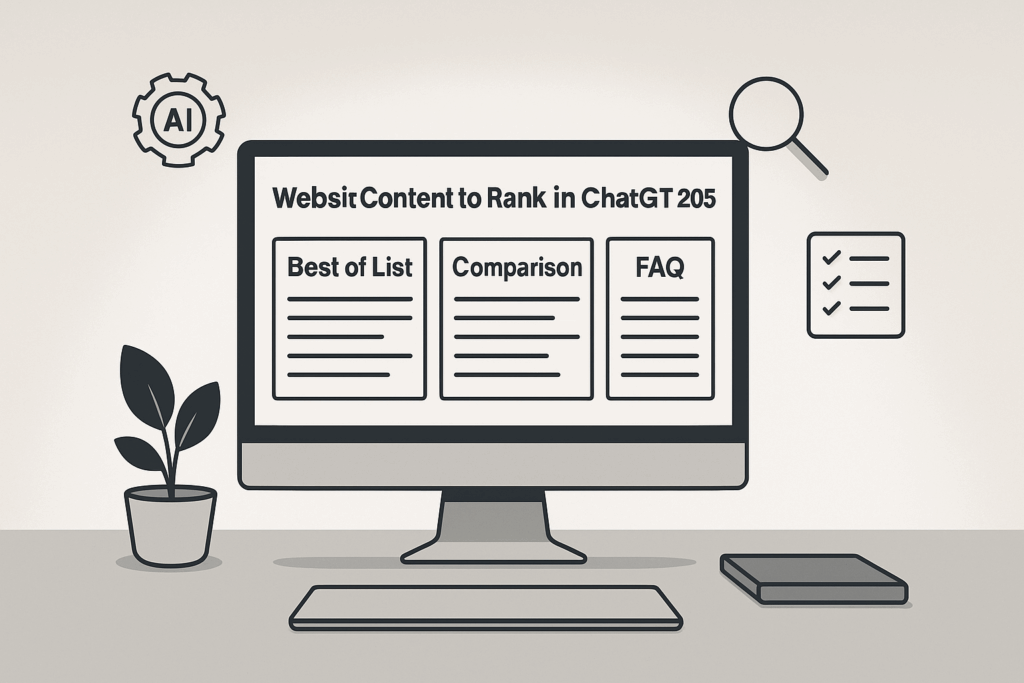
To rank in ChatGPT and other large language models (LLMs), you need three types of pages on your website: “best of” lists, comparison articles, and comprehensive FAQ pages. ChatGPT searches the internet when users ask for recommendations, and these structured pages are exactly what it looks for when compiling answers.
Table of Contents
ToggleHow ChatGPT Uses Website Content
When someone asks ChatGPT for a recommendation, it searches the internet for relevant information. In many cases, it references content directly from your website or your competitors’ websites.
The key is having the right content already published. If your pages match what ChatGPT is searching for, you significantly improve your chances of being recommended. Research shows that LLMs heavily favor decision-support content like product lists, comparisons, and alternatives when compiling their answers.
@tjrobertson52 ChatGPT recommends businesses based on 3 page types. Here’s what you need on your site to beat competitors! #ChatGPTSEO AIMarketing #ContentStrategy
♬ original sound – TJ Robertson – TJ Robertson
“Best [Product/Service]” List Pages
Create a “Best X” list page for each product or service you offer, where X is that specific offering. List yourself as the number one option with clear, objective reasons why.
For example, if you’re a window tinting company, publish an article titled “Best Ceramic Window Tint for Trucks.” List your brand first with specific advantages (UV protection percentage, warranty terms, heat rejection data), then include other options.
ChatGPT often draws directly from these lists when answering “what is the best…” queries. By positioning yourself at the top with concrete data, you control the narrative.
Structure Your Best-Of Lists
- Use clear headings: Break out each item as a numbered heading (H2 or H3 tags)
- Provide specific data: Include specs, test results, or customer feedback rather than generic claims
- Add context: Write 1-2 paragraphs explaining why each option made the list
- Include a methodology: Briefly explain your evaluation criteria to appear objective
Niche “Best X for Y” Lists
The most powerful variation is the hyper-specific list: “Best [Product] for [Specific Use Case or Audience].”
Instead of “Best Running Shoes,” write “Best Marathon Running Shoes for Flat Feet.” These niche lists target conversational, long-tail queries that people naturally ask LLMs. Long-tail queries have lower competition and clear user intent, giving well-crafted content a strong chance of being cited.
Examples of niche lists:
- “Best Project Management Tools for Nonprofits”
- “Best HVAC Systems for Florida Climate”
- “Best CRM Software for Real Estate Teams Under 10 People”
These pages face far less competition than broad keywords while directly matching how people talk to AI. If you have a system for creating dozens of these pages efficiently, they’re well worth the effort.
Comparison Pages
Comparison articles rank extremely well in ChatGPT. LLMs often echo content that compares, contrasts, or evaluates when users are deciding between options.
For Established Brands
If you’re already well-known in your industry, create “[YourBrand] vs [Competitor]” pages. Structure these as balanced comparisons with clear pros and cons for each option.
For Lesser-Known Brands
If you’re newer or smaller, focus on competitor-centered comparisons:
“Competitor A vs Competitor B vs [YourBrand]” pages: Write comparisons between two well-known competitors, then introduce your brand as a third option. This lets you piggyback on existing search volume where your brand name alone wouldn’t generate traffic.
“[Competitor] Alternatives” listicles: Target “[Competitor] alternatives” queries, which have high buying intent. List your solution first with a clear value proposition, then include other options with neutral descriptions. Users searching for alternatives are often unsatisfied customers or active comparison shoppers.
Use a friendly, informative tone. Include a brief explanation of your ranking criteria to read as objective guidance rather than a sales pitch.
Internal Product Comparisons
Don’t overlook comparisons between your own products or service tiers. LLMs don’t distinguish between competitor comparisons and internal product comparisons – they simply look for clear comparative content.
Create pages like:
- “[Your Entry-Level Plan] vs [Your Pro Plan]”
- “[Product A] vs [Product B]: Which is Right for You?”
- “Standard Service vs Premium Service Comparison”
These articles answer common customer questions and keep traffic on your site. When someone asks ChatGPT about the differences between your offerings, it can cite your own authoritative comparison rather than forcing users to piece together information from multiple pages.
Structure these with comparison tables listing capabilities side-by-side. Keep the tone neutral and focus on helping users understand which option fits their needs.
FAQ Pages
FAQ pages rank exceptionally well in ChatGPT because they provide concise, direct answers that LLMs can easily extract and cite.
Create Two Types of FAQs
Company-wide FAQ: One comprehensive page covering all general questions about your business – services offered, pricing structure, policies, contact information, and common objections.
Service-specific FAQs: Individual FAQ sections or pages for each product or service you offer. These answer questions unique to that offering, such as technical specifications, usage instructions, or compatibility information.
Structure Your FAQs Effectively
Follow these best practices to maximize your chances of being cited:
- Phrase questions conversationally: Use exact wording your customers would use (“How long does installation take?” not “Installation Duration”)
- Lead with direct answers: State the answer in the first 1-2 sentences, then elaborate with context or examples
- Cover all intent types: Include questions about definitions, comparisons, procedures, costs, and benefits
- Use proper HTML structure: Mark each question with H2 or H3 tags and consider FAQ schema markup
- Make answers stand-alone: Each answer should be complete enough to be quoted independently
Scale Content Production Without Sacrificing Quality
Creating dozens or hundreds of these pages requires a systematic approach. Here’s how to scale efficiently while maintaining uniqueness:
Use Templates with Custom Content
Set up page templates for each content type (best-of lists, comparisons, FAQs), but customize 70% or more of the content on each page. Change intros, examples, customer quotes, and specific recommendations so no two pages read the same.
Build Brand-Specific AI Workflows
The first step for any content production system is creating a comprehensive brand guide – a detailed document covering everything about your company, services, tone, and unique positioning.
Use this to train AI tools (like custom GPTs or Claude projects) that can draft content in your voice. These workflows should:
- Reference your brand guide for consistent messaging
- Include your methodology and evaluation criteria
- Incorporate your actual data and customer insights
- Generate first drafts that you then refine and personalize
This approach lets you produce content 5-10 times faster than purely manual creation while maintaining quality and uniqueness. The AI handles research and structure, while human editors add specific insights, examples, and brand personality.
Update Regularly
Programmatically generated pages shouldn’t be “set and forget.” AI tools prefer current, accurate information, so schedule quarterly reviews to refresh data, add new examples, and incorporate customer feedback.
Get Started with AI Optimization
The shift from traditional search engines to AI-powered recommendations is accelerating. Businesses that adapt their content strategy now have a significant advantage.
Start by creating your three foundational page types: a “best of” list for your main offering, a comparison against your top competitor, and a comprehensive FAQ. These pages alone will dramatically improve your visibility in ChatGPT and similar platforms.
If you need help building a systematic approach to AI optimization, TJ Digital specializes in creating content strategies that work for both traditional search engines and large language models. We start every client relationship with a comprehensive brand guide and custom AI workflows that let you produce high-quality content at scale.
Ready to see how your website ranks in ChatGPT? Contact us for a free audit of your current content and a personalized strategy for improving your AI visibility.