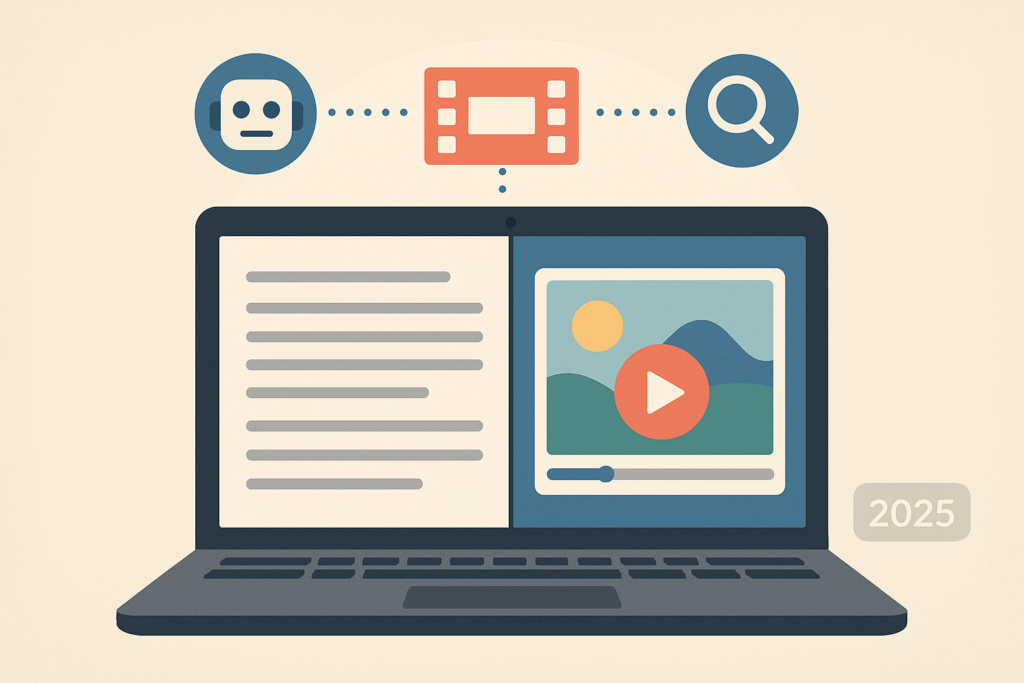
Google just made it way easier to repurpose your blog content into video, and this could be a massive marketing opportunity for any small business. With their recent integration of the Nano Banana image generation model into NotebookLM’s Video Overview feature, you can now turn any text content into a serviceable video in minutes.
Here’s why this matters: Large language models like ChatGPT and Google’s AI mode don’t just look for the website that ranks #1. They run hundreds of specific searches and recommend whichever business shows up most frequently across those results. By creating video versions of your blog posts and pages, you multiply your presence across the web and dramatically increase your chances of being cited by AI platforms.
Table of Contents
ToggleWhat Changed With NotebookLM’s Video Feature
A few months back, Google rolled out their Video Overview feature in NotebookLM. It allowed you to upload text content and automatically generate a video, but the output wasn’t great. Recently, they incorporated Nano Banana, their newest image generation model, and the quality jumped significantly.
The videos still aren’t amazing, but we’ve hit that “good enough” moment. NotebookLM now offers six new visual styles (Watercolor, Anime, Whiteboard, Retro Print, Papercraft, Heritage) and generates contextual illustrations that actually match your content. This is a huge improvement over the generic stock images it used before.
For most small brands, these videos are perfectly fine to put out into the world as a representation of your brand. The narration is clear, the pacing is decent, and the visuals support the message.
@tjrobertson52 How to turn blog posts into videos with Google NotebookLM (and why it matters for ranking in ChatGPT) 👀 #SEO #smallbusiness #contentcreation #ChatGPT #aimarketingtools #GEO
♬ original sound – TJ Robertson – TJ Robertson
Why Video Content Matters for AI Visibility
Video content has always been effective, and it’s only becoming more important. But the vast majority of brands have never had the time or willingness to create those videos. Now you can turn every blog post, every service page, every product page on your website into a video version targeting the same term.
Here’s the thing: for a small business targeting specific niche terms, there’s way less competition on video than there is on blogs. Google is showing way more video content in its search results. And large language models are relying more on videos to give recommendations.
When someone goes to ChatGPT or Google’s AI mode and asks about the product or service you offer, the large language model runs a series of specific searches. But they’re not just looking for the website that’s rank one. Instead, they look through hundreds of websites and recommend whatever business shows up most prominently across those results.
The Shift From Traditional SEO to LLM Optimization
This is fundamentally different from traditional SEO. In traditional SEO, you had to be ranked #1 for that competitive term. The goal was to beat competitors for that single query, earn the click, and drive traffic to your site.
LLM optimization flips that script. Showing up in large language models is about showing up as many times as possible for as many specific terms as possible. It’s about the breadth of presence and being cited, rather than just clicks.
Even if your blog post or page is already ranked #1 for that target term, making one or more videos targeting that term lets you show up more often. This increases the chances that you get recommended by ChatGPT, Google AI, or other platforms.
The Opportunity: Zero Video Competition for Niche Terms
We’re experimenting with this strategy for several of our AI SEO clients, and for many of the terms we’re targeting, there are literally no videos on YouTube targeting those terms.
A lot of humans probably aren’t going to watch these videos, and maybe you wouldn’t even want them to. The videos do have a NotebookLM logo on them, so viewers will know it’s created by AI. But here’s what matters: ChatGPT and Google’s AI mode have no problem citing videos with under 100 views, as long as it’s relevant to one of the dozens of searches they’re performing to answer the user’s query.
For small businesses, this is huge. LLMs today can and do consume video content. They read YouTube video transcripts and descriptions for information. By creating a video version of your blog, you’re seeding another source that could be picked up in an AI’s background searches.
How to Create Videos From Your Blog Content
The fastest way to do this is using Google NotebookLM’s Video Overview feature. Here’s the simple workflow:
- Upload your content to NotebookLM. Open NotebookLM and create a new notebook. Import your blog post, article, or service page as a source. You can copy-paste the text or upload a file.
- Generate a Video Overview. In the Studio panel on the right side, click “Video Overview” to initiate video generation. That’s it. NotebookLM will analyze your document and create an AI-narrated video in a couple of minutes.
- Customize format and style (optional). You can select either a Brief overview (2-3 minute summary) or an Explainer (8-10 minute in-depth walkthrough). Choose from visual styles like Whiteboard for tutorials or Watercolor for more artistic content. You can also set the narration language or give the AI a steering prompt if you want specific emphasis.
- Review and export. Play the video within NotebookLM. If it looks good, download the video file to upload to YouTube, share on social media, or embed on your website.
Something that used to take hours now takes minutes. You don’t need any design or video editing skills. The AI handles layout, transitions, and graphics automatically.
This speed means you can rapidly repurpose existing content at scale. A small business could take its top 10 blog articles and, in an afternoon, have 10 videos ready to go.
Does the AI Watermark Matter?
You might worry that an AI-generated video could turn off human viewers. For purely human-facing marketing campaigns, this concern is valid. However, in the context of using these videos primarily to boost your AI visibility and content volume, it matters far less than you might think.
The primary audience for these repurposed videos is AI algorithms, with any human views being a bonus. An LLM like ChatGPT doesn’t care if your video was created by an AI or hand-animated by Disney. The watermark or AI style does not deter the algorithm. The transcript will be read and used if it’s relevant.
For human viewers who do stumble on your NotebookLM-created video, the AI branding isn’t necessarily detrimental. The video still delivers value through a quick, clear overview of the topic they searched for. Audiences are growing accustomed to AI media, and as long as the content is useful, they generally don’t care how it was made.
The return on investment here isn’t measured purely in view counts or likes. It’s measured in whether your brand gets mentioned by AI or whether the knowledge in the video helps an AI answer a question. Even without direct clicks, those AI citations and mentions have value. Users hearing your brand from an AI may remember it and seek you out later, building trust through repetition.
Why Small Businesses Should Act Now
We’re quickly moving into a world where, when someone is looking for a recommendation on which brand to go with, they will typically use a large language model like ChatGPT or Google’s AI mode.
For small businesses, the advent of AI-driven search is actually an opportunity to level the playing field. Targeting niche, long-tail keywords with content—especially video content—is a smart way to get noticed by AI and users alike without having to compete head-to-head with large competitors on the most saturated terms.
Big companies typically focus on broad, high-volume keywords. Niche terms, on the other hand, often have lower competition. Small businesses can compete in AI visibility by focusing on niche expertise and local authority. AI models prioritize factual accuracy and depth of knowledge over just brand name or size.
By using NotebookLM to churn out videos for all those long-tail topics related to your business, you essentially set a wide trap for the AI. Whichever angle it looks from, it finds your content waiting there with the answer.
The Strategy: Multiple Formats, Multiple Touchpoints
The key insight here is simple: LLMs “vote” for prominence by aggregate presence, not just singular rank. An AI might not care which site was #1. It cares which sources collectively provide the needed facts.
By having content in multiple formats (text and video), you increase your brand’s touchpoints in the AI information-gathering process. If your brand appears frequently in search results—say, you have a blog post covering one aspect and a YouTube video covering another—the AI is more likely to incorporate your content or mention your brand.
This is what we call “LLM seeding”—the practice of publishing content in the formats and on the platforms that AI tools are most likely to scrape and cite. You want to be wherever the AI might look: that includes traditional web pages, but also videos, social posts, and other formats. Each format is a new entry point for the AI.
At TJ Digital, we’re already incorporating this strategy into our content repurposing services. We help clients take their existing blog content and transform it into multiple formats designed to maximize visibility across both traditional search and AI platforms.
Getting Started
If you want to start implementing this strategy:
- Identify your most important blog posts and service pages. These are the ones targeting terms your ideal customers search for.
- Use NotebookLM to create video versions. Start with your top 5-10 pieces of content. Upload them to NotebookLM and generate Video Overviews for each one.
- Upload to YouTube with optimized titles and descriptions. Make sure your titles include the keywords you’re targeting. Write thorough descriptions that provide context for both human viewers and AI scrapers.
- Embed videos on your website. Put the video version on the same page as the blog post. This gives visitors multiple ways to consume your content and signals to search engines that you have comprehensive coverage of the topic.
- Monitor your mentions in AI platforms. Periodically check ChatGPT and Google’s AI mode to see if your content is being cited when users ask about your industry or services.
The videos might not win Oscars, but they don’t need to. Their value is in expanding your digital footprint. For a small business aiming to punch above its weight, this approach opens up new possibilities. You can cheaply dominate niche topics, appear in voice and chat-based answers, and continually feed both humans and algorithms the content they need.
By turning your blogs into videos, you’re not just recycling content. You’re future-proofing it for the AI era.
Ready to Dominate Your Niche in AI Search?
At TJ Digital, we specialize in helping small businesses show up in AI platforms like ChatGPT and Google’s AI mode. Our AI optimization services combine traditional SEO with cutting-edge strategies designed specifically for large language models.
We can help you identify the niche terms where you have the best chance of dominating, create optimized content that AI platforms love, and implement video repurposing strategies like the one described in this article.
Want to see where you currently stand in AI search? Contact us for a free digital marketing audit of your website and current efforts. Let’s make sure your business gets recommended when potential customers ask AI for help.