
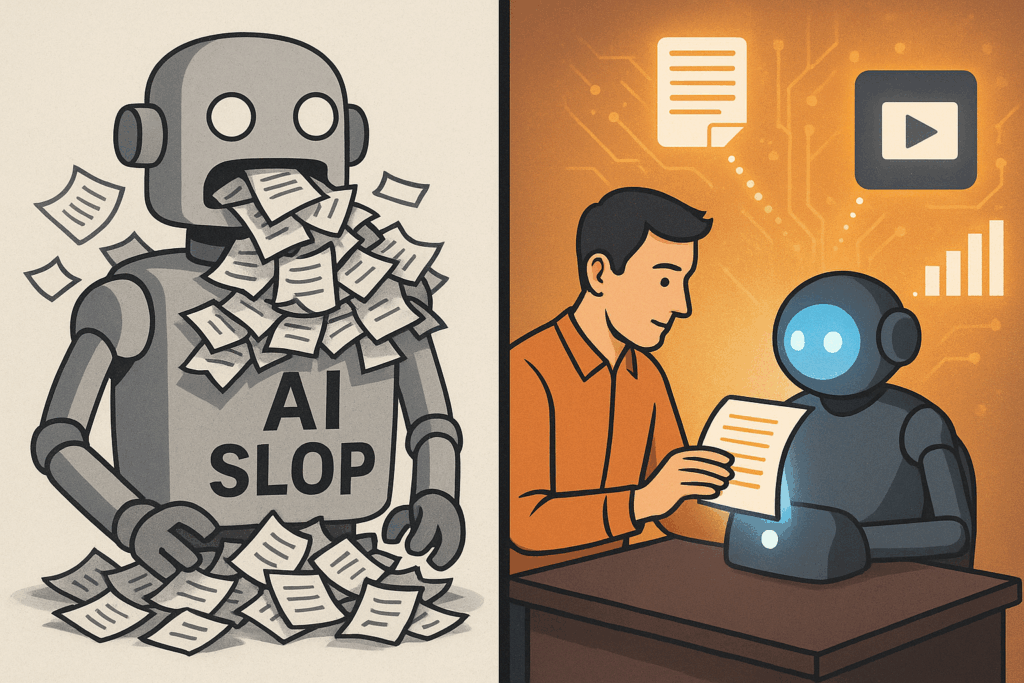
AI won’t replace content marketers or creators. But content creators who use AI effectively will replace those who don’t. The fear that your content will be lost in an ocean of AI-generated material misses what’s actually happening: algorithms are getting better at surfacing high-quality content, and AI tools are making it easier than ever to produce that high-quality content at scale.
Table of Contents
ToggleWhat is AI Slop?
“AI slop” refers to the flood of low-effort, low-quality content generated by AI. It’s the digital clutter that prioritizes quantity over quality and lacks any original insight.
Two characteristics define AI slop:
Generic content. Because AI pulls from existing data, it often produces the same bland phrases and common knowledge that everyone else has already published. The output reads like a remix of what’s already online, resulting in lifeless, copycat content.
Hallucinations. AI makes stuff up. Without human oversight, it can fabricate facts, references, or details that aren’t true. This creates misinformative content that erodes trust.
If you’ve ever asked ChatGPT to write a blog post and received something unusable, you’ve seen AI slop firsthand. The problem isn’t AI itself. The problem is using AI without novel input and human oversight.
Why This is the Best Time to Create Content
Most of the content online is now AI-generated. By 2026, estimates suggest up to 90% of online content could be AI-generated. If you’re a business owner, creating content might seem pointless.
The opposite is true. This is the best time to be creating content.
Here’s why: while the volume of content has exploded, most of it is terrible. A recent industry survey found that although 81% of B2B marketing teams use generative AI for content, only 17% rate the quality as “excellent or very good.” That’s a lot of mediocre blog posts flooding the internet.
Meanwhile, algorithms are getting better and better at surfacing high-quality content. There’s a reason we’re spending more time on TikTok. There’s a reason Google search traffic hasn’t declined even as more people use large language models. The algorithms are hungry for content that actually provides value, and they’re increasingly good at finding it.
Audiences are noticing the glut of generic AI content, too. They’re tuning it out. When you publish a well-thought-out article or genuinely insightful video, it stands out because everything around it is AI slop.
In other words, the bar for quantity has risen, but the bar for quality is as low as ever among AI-generated content. That’s your opportunity.
@tjrobertson52 Will AI Replace Content Creators? No way. Algorithms favor quality and AI can help you create it faster. Start with your expertise, not generic prompts 🎯 #aicontentcreation #contentmarketing #aitools
♬ original sound – TJ Robertson – TJ Robertson
How to Create High-Quality Content with AI
People are slow to realize this: you can create high-quality content quickly using AI. The key is understanding what makes content high-quality and setting up the right workflow.
Start with Novel Input
To avoid generic output, you need to start with something original. If you’re a business owner, you’re the expert in something. You likely have data, case studies, customer insights, or an internal knowledge base. This proprietary information is what separates valuable content from AI slop.
The input we use at TJ Digital is video transcripts. I record videos while walking my dog, sharing opinions, insights, and answers to common questions. These transcripts become the foundation for blog posts, social media content, newsletters, and more.
When working with clients, the first thing we do is identify and gather their unique input: case studies, anything they’ve written, their knowledge base, and insights from discovery calls. This original material gives AI something fresh to work with.
Without novel input, any AI will just remix what’s already online. With it, AI tools can amplify your expertise instead of producing another pile of slop.
Use a Human-in-the-Loop Workflow
The second factor that creates AI slop is errors and hallucinations. AI makes mistakes. The solution is keeping a human in the loop.
Here’s how we approach content creation:
1. Create source material. Record a short-form video or write a detailed outline. The goal is to capture your actual expertise in some form. A two-minute video takes less than five minutes to record.
2. Transcribe and clean. If your source is a video, transcribe it. Lightly clean up the transcript by removing filler words and off-topic tangents. You now have text that sounds like you and contains genuine information.
3. Have AI draft from the transcript. Feed the transcript to an LLM along with your brand guidelines. Ask it to extract key points, structure them, and draft content in multiple formats: blog posts, social posts, emails, whatever you need.
4. Review and iterate. A human reviews the AI’s output, ensures accuracy, checks for hallucinations, and refines the content. This step is non-negotiable.
5. Polish and publish. A final editing pass catches any awkward phrasing and adds missing context. Then you publish.
The entire process takes about 30 minutes and produces 10 pieces of high-quality content. Not only does this help you get found on multiple platforms, but it also increases your visibility in large language models.
Does Google Still Send Traffic to Websites?
There’s concern that AI-powered search results will eliminate website traffic. If the answer appears right on the search page, why would users visit your site?
The short answer: Google still sends substantial traffic to websites.
As of late 2024, Google’s AI Overview feature appeared on roughly 13% of search queries. The majority of searches still show traditional results where users click through. And even for queries with AI summaries, Google provides source links.
More importantly, Google’s algorithms continue to reward helpful, reliable content. Google has doubled down on E-E-A-T criteria (Experience, Expertise, Authoritativeness, Trustworthiness) specifically to weed out low-value AI-generated pages. High-quality expert content is more likely to be included in AI-driven results and rank well in traditional results.
Some marketers report that while overall traffic may be down, the traffic they do receive is more engaged. The AI filters out casual information-seekers, leaving readers who genuinely want deeper information and are more likely to convert.
How to Get Recommended by Large Language Models
When people use ChatGPT or other AI assistants to ask for recommendations, you want your business to be the answer. This requires a different approach than traditional SEO.
LLMs don’t rank pages by old SEO rules. They pull concise answers from content they trust. Your content needs to be structured in a way that directly answers questions.
Key tactics:
Answer questions immediately. State the direct answer first, then elaborate. LLMs favor content they can easily parse for relevant snippets.
Use clear structure. Organize content with descriptive headings and bullet points when appropriate. A how-to article with numbered steps or a product page with a Q&A section is more likely to be picked up.
Publish at scale. The more high-quality pages you have on relevant questions, the greater the odds an LLM will cite your content. Businesses are finding they can rank in LLMs faster than in Google.
Build authority. Get mentioned in authoritative places across the web. Having presence in respected listicles, industry publications, and trusted forums signals credibility to AI systems.
Use Proprietary Data to Stand Out
The companies with unique data sets have an edge in AI-powered content. Proprietary data includes your internal statistics, case study results, customer insights, original research, and documented processes.
When you include specific results and original examples in your content, you provide value that readers can’t find anywhere else. These concrete details make your content more credible and differentiate you from generic AI output.
Some marketers hesitate to share their “secret sauce.” Here’s the reality: giving away proprietary insights builds trust. Share the process, sell the implementation. The specificity proves you actually know what you’re talking about.
AI Video and Image Creation is Getting Better
AI capabilities for visual content are advancing rapidly. Google’s latest image generation models can now handle text and complex layouts correctly, making AI-generated infographics viable for the first time. Text-to-video generation is also emerging, with models like Veo 3.1 producing short video clips with native audio.
These tools are still early, but they’re accelerating content production. You can generate an infographic to accompany each blog post or create short video clips to promote articles on social media. The trajectory is clear: AI is getting better at visual content, and it’s worth experimenting with these tools.
The Bottom Line
The world is filling with AI content. Much more than today. When people go to large language models for recommendations, those models will sift through all that content looking for sources to cite.
My advice: start thinking about how you can make sure more of that content recommends you than your competitors.
AI won’t replace content marketing. But those who use AI effectively to amplify their expertise will outpace those who don’t. The flood of AI slop makes high-quality, expert-driven content more valuable, not less.
Ready to get your business recommended by AI? Contact TJ Digital for a free digital marketing audit. We help businesses create the kind of high-quality content that algorithms reward, using AI workflows that amplify your expertise instead of producing slop.