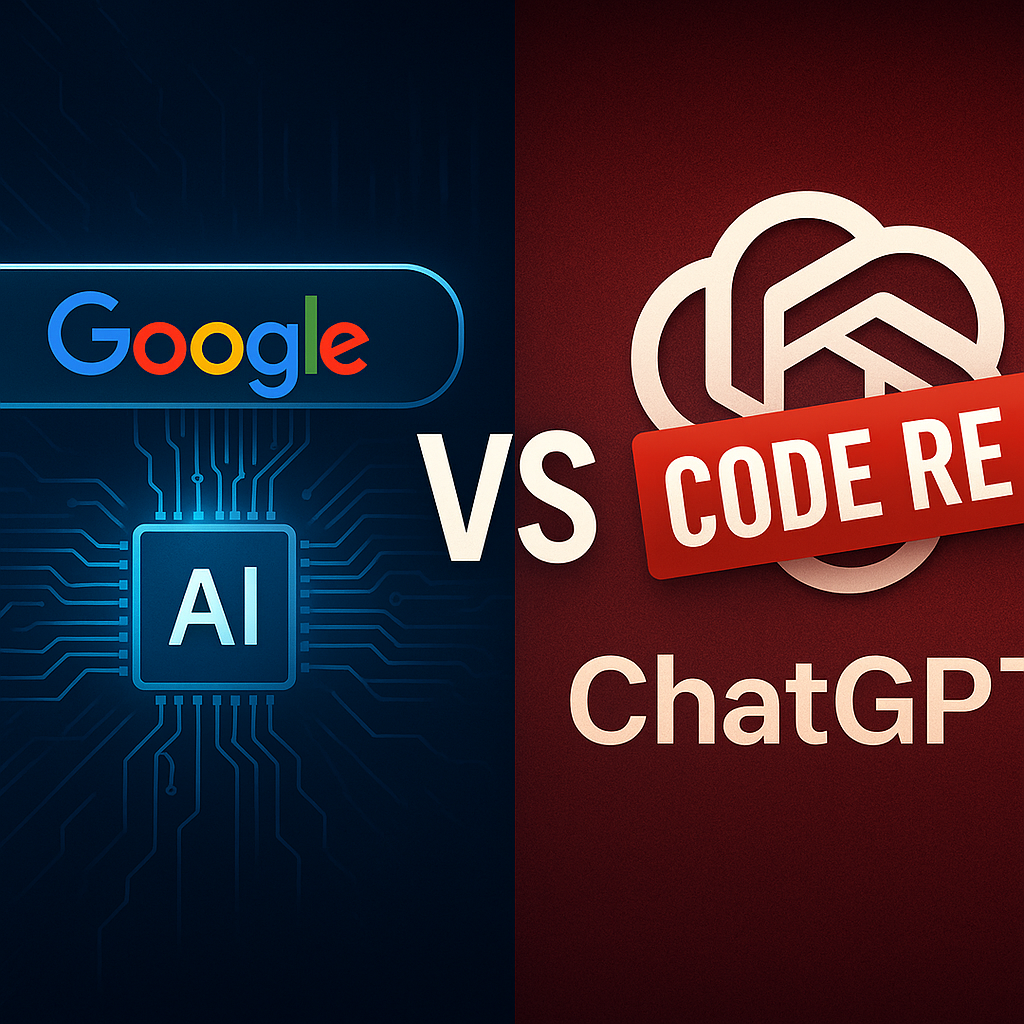
Reports have emerged that Sam Altman called for a “code red” inside OpenAI. The reason: Google’s Gemini has them worried about the future of ChatGPT. And honestly, they’re right to be worried.
Gemini 3 crushed most of the benchmarks when it released. While there are still areas where other models perform better, Gemini is now widely considered the best overall model. What makes this remarkable is how far behind Google was just a year ago. Google is moving faster than the other model makers. Now that they have a lead, it’s hard to see how they would ever lose it.
This matters for business owners because as AI continues to replace traditional search, being visible in these platforms becomes essential. Understanding which platforms are likely to dominate helps you make smarter decisions about where to invest your marketing efforts.
Table of Contents
ToggleGoogle Has a Massive Distribution Advantage
ChatGPT has become popular, but it’s not nearly as popular as Google. You might think no one uses Gemini, but Gemini is built into Google Search. The prediction is that by Q3 2026, Google’s AI mode will replace traditional search results entirely. At that point, using Google means using Gemini.
The numbers back this up. Google handles about 14 billion searches per day. That’s roughly 210 times the volume of queries ChatGPT sees. Even if ChatGPT continues growing, that gap is massive.
@tjrobertson52 Will Google beat ChatGPT? Sam Altman called code red after Gemini crushed the benchmarks 👀 #AI #ChatGPT #GoogleGemini #Tech
♬ original sound – TJ Robertson – TJ Robertson
Google’s Search Is Years Ahead
It’s easy to complain about Google’s search results. But the truth is that search is really hard. Google has decades of investment in ranking, indexing, and understanding user queries.
In one analysis of 62 varied queries, Google was found to be the better solution for most searches. ChatGPT can sometimes match Google on informational questions, but Google consistently edges it out on accuracy and usefulness.
It would take OpenAI several years to create a search engine as good as Google’s. And they don’t have several years to spare.
OpenAI Is Hemorrhaging Money
OpenAI is not profitable. They won’t be until around 2030 at the current rate. Reports indicate they’re planning to lose roughly $9 billion in 2025 on $13 billion of revenue. That’s a 70% cash burn rate.
Google, meanwhile, earned about $100.1 billion in net income in 2024. They’re the most profitable tech company in the industry. Google can fund AI development from existing profits while OpenAI relies on constant external funding.
How Do the Models Actually Compare?
Here’s how Gemini and ChatGPT stack up across key dimensions:
| Category | Google Gemini | ChatGPT |
| Benchmark Performance | Gemini 3 scored 37.5% on “Humanity’s Last Exam” | GPT-5.1 scored 26.5% on the same test |
| Context Window | Up to 1 million tokens | Tens of thousands of tokens |
| Search Volume | 14 billion queries/day (via Google Search) | ~66 million queries/day |
| Profitability | Parent company earned $100.1B in 2024 | Expected losses through 2028 |
| Enterprise Solution | Deep integration with Google Workspace/Cloud | Enterprise-grade security, Microsoft integration |
Sources: Business Insider comparison, Google Gemini blog
Google’s TPU Advantage
Google trains and serves Gemini models on their own custom chips called Tensor Processing Units (TPUs). This means they’re not dependent on third-party chip manufacturers like NVIDIA.
Industry analysis estimates Google can obtain compute at only about 20% of what competitors pay for NVIDIA GPUs. This is because NVIDIA charges 4-6x the chip’s manufacturing cost, while Google bypasses that markup entirely.
The result: Google can train and run models far more cheaply. They’ve also started renting out TPUs to other companies like Anthropic, creating an additional revenue stream.
Will Apple Integrate Gemini Into the iPhone?
It appears very likely. Bloomberg and Reuters have reported that Apple is finalizing a deal to use Google’s Gemini to power a revamped Siri. The deal is reportedly worth about $1 billion per year.
If this goes through, future iPhones would have Gemini AI under the hood. This would expand Google’s AI distribution massively, putting Gemini in the hands of billions of iPhone users.
Google Has the Best Enterprise Solution
For businesses worried about privacy, Google’s Gemini Enterprise explicitly states that business data isn’t used to train its models. You own your data, not Google.
OpenAI’s enterprise terms make similar promises. But Google has the advantage of deep integration with Google Workspace and Cloud, which many businesses already use.
Google Controls the Agent-to-Agent Protocol
Google controls the agent-to-agent protocol, which is becoming the standard when AI agents communicate with other agents. This is going to be a huge part of the economy as we start letting AI control more tasks.
Google’s Gemini 2.5 Computer Use model is designed specifically for controlling apps and web interfaces. It outperforms alternatives on web and mobile control benchmarks. And Google is integrating Gemini directly into Chrome, letting it read your tabs, history, and Google apps to perform tasks on your behalf.
OpenAI has responded with Atlas, their new AI-native browser. It’s promising, but currently Mac-only. Google’s Chrome dominates desktop usage, giving it a significant head start in deploying autonomous agents at scale.
What About Video Generation?
Google’s Veo and OpenAI’s Sora are both advancing rapidly. Head-to-head tests show they’re now quite comparable:
- Sora 2.0 produces highly realistic movements and physics
- Veo 3 creates beautifully cinematic scenes with dramatic lighting
Neither clearly dominates. Sora seems slightly ahead in getting a usable clip on the first try, but Veo is very close in quality. Both companies have deep technical talent and massive compute, so both will keep improving.
Is the Paid Version of Gemini Worth It?
The free version of Gemini uses the 2.5 Flash model with a 32,000 token context window. The paid version ($20/month) unlocks the 3.0 Pro model with a 1 million token context window.
For casual questions and general lookups, the free model often works fine. But analysts note the paid tier significantly improves performance on complex reasoning, coding, and research tasks.
If you’re already using the paid thinking version and still disappointed, you might just have different standards for where these models should be right now. But for most professionals who rely on heavy AI use, the paid version is worth it.
What Does This Mean for Businesses?
As AI models continue replacing traditional search, being visible in these platforms becomes critical. Google’s AI mode is predicted to replace traditional search results by Q3 2026. That means the way businesses get found online is about to change significantly.
The good news: most tactics that help you rank in traditional search engines also help you get cited by AI algorithms. The fundamentals haven’t changed that much yet. But there are additional optimizations specifically for large language models that forward-thinking businesses are already implementing.
The Bottom Line
It would take a miracle for Google not to win this thing. They have the better model, the distribution advantage, the more mature search algorithm, the custom hardware, the profitability, the enterprise solution, and the agent infrastructure.
OpenAI will certainly release new models that beat Gemini on some benchmarks. But when you look at the trajectory, Google is just moving faster. Something would have to fundamentally change for OpenAI to outpace them at this point.
For businesses, the takeaway is clear: AI is becoming the primary way people search for information. Whether it’s Google’s Gemini or ChatGPT, your business needs to be visible in these AI-powered platforms. The companies that start optimizing for AI algorithms now will have a significant advantage over those that wait.TJ Robertson is the founder of TJ Digital, an AI optimization agency that helps businesses show up in AI algorithms like ChatGPT and Google’s AI mode. Contact us for a free digital marketing audit of your website.