
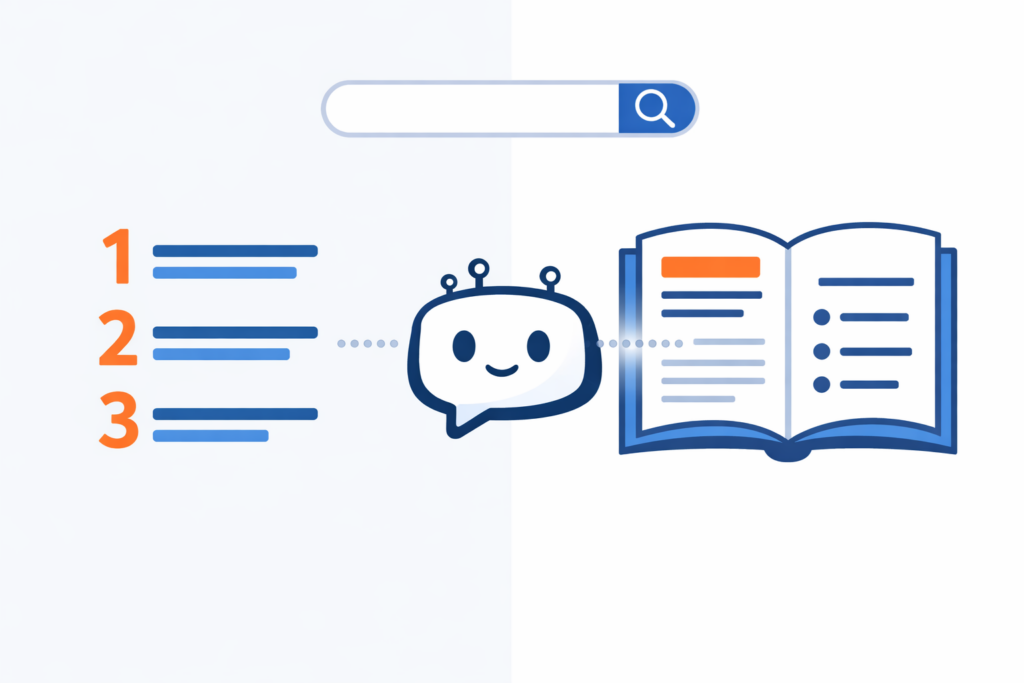
Large language models recommend brands mentioned in “how to choose” guides just as often as listicles. At TJ Digital, we’ve been tracking thousands of prompts across dozens of brands for six months, and the data shows that educational buying guides perform equally well—without the self-promotional feel of traditional “Top 10” lists.
ChatGPT and Google’s AI mode search for recommendations across the internet when users ask for product or service suggestions. They look for pages with titles like “Best X for Y” or “Best X in Y.” Most of these results are listicles, but our tracking data reveals that well-structured buyer’s guides trigger just as many AI citations.
Table of Contents
ToggleWhy Large Language Models Don’t Actually Love Listicles
People have been saying for months that large language models love listicles. That’s not quite true.
The truth is that large language models love to search for things like “best X in Y”—they search for recommendations. When someone asks ChatGPT for a recommendation, the AI performs a search using traditional search engines to find relevant content across the internet.
It just happens that the vast majority of pages optimized for these terms are listicles.
Most listicles online are automatically generated by directory websites. Once you have a directory and a way to rank different businesses or products, it’s easy to programmatically generate as many listicles as you want by subdividing by specific product, service, location, demographic, or use case.
With hundreds of millions of listicles online, it’s no wonder we commonly see large language models citing them. But after taking a closer look at our tracking data, I’m starting to think listicles aren’t necessary at all.
The “How to Choose” Alternative
For clients who can’t or don’t want to publish self-ranking listicles, we’ve been creating articles like “How to Choose the Best X in Y.”
So far, they seem to be doing just as well as listicles.
We’ve also seen competitors pumping out hundreds or even thousands of articles like this. In some cases, they’re cited more often than the top directories in their space.
Why This Format Works for AI
When someone asks ChatGPT “What’s the best insurance plan for young families?” the AI looks for sources that address precisely that scenario. A “How to Choose the Best Insurance Plan for Young Families” article that mentions your plan as a top option positions you perfectly for that query.
This is part of what we call AI SEO—optimizing content for how AI systems search and recommend businesses.
The article still needs to explicitly recommend your brand by name. Otherwise, it won’t have any impact on the large language model’s recommendation. You want that explicit recommendation as close to the top of the article as possible—preferably in the first sentence.
That might still feel a little promotional, but it’s less awkward than putting a listicle on your website with your company ranked #1.
How to Structure “How to Choose” Articles
Here’s the framework we use for these buyer’s guides:
Lead with the Answer
State your primary recommendation in the very first sentence. AI models often skim for a quick answer snippet, so following a “Bottom Line Up Front” approach is critical.
Example: “If you need the best VPN for home streaming and privacy, we recommend SurfSafe VPN for its unmatched speed and security features.”
Include Your Brand Name Early
The placement of a brand mention significantly influences whether AI picks it up. Being mentioned in the first sentence or top bullet point yields far more AI visibility than a mention buried at the end.
Use Clear Headings and Structure
Organize the guide with logical headings and subheadings. For instance:
- H2: “How to Choose the Right [Service]”
- H3: “Evaluate Security Features”
- H3: “Compare Pricing Plans”
- H3: “Check Customer Support”
This structured layout helps both readers and AI algorithms identify relevant chunks of text to quote or summarize. Position important information at the start of sentences and sections.
You can further enhance this by implementing structured data markup like FAQ schema or HowTo schema, though the content structure itself is most important.
Write in a Neutral, Helpful Tone
AI assistants prefer neutral, fact-based content. Rather than saying “Brand X is the greatest,” frame it as “Brand X offers [specific benefit], which is especially useful for [use case].”
Provide concrete data when available. “Service Y encrypts data with AES-256, meeting high security standards” is more effective than vague claims about being “the most secure.”
This approach aligns with Google’s E-E-A-T principles (Experience, Expertise, Authoritativeness, Trustworthiness), which AI systems also value when determining content quality.
Combining Both Formats for Maximum Impact
To be completely honest, the brands having the most success are doing both the listicle and the “how to choose” article.
There’s really no limit to how much recommendation content you can publish. You just need to be strategic about how you approach it.
Using the Two-by-Two Grid Method
Make a grid in Google Sheets:
- X-axis: List all your products and services
- Y-axis: List different demographics, use cases, or service areas
Each intersection represents a specific content topic. For example, “treadmill” + “small apartments” = “Best Treadmills for Small Apartments.”
Start creating articles by prioritizing the most common combinations. This ensures you don’t miss any niche where a recommendation could position your brand.
Avoiding Scaled Content Penalties
If you’re doing thousands of these posts every month, you are at risk of getting a penalty from Google. It’s called a scaled content abuse penalty, but it has to be pretty egregious before you’re at risk.
Google cares about why you created content, not how you created it. As long as each piece provides genuine value and isn’t just keyword-stuffed filler, you’re fine.
Keep quality high by:
- Having humans review all AI-drafted content
- Adding unique data or perspectives to each article
- Avoiding boilerplate duplication
- Pacing your publishing schedule (5-10 articles per week is safer than 200 in a day)
Why This Matters Now
At TJ Digital, we’ve been tracking thousands of prompts every day across ChatGPT, Gemini, and Perplexity using software called Peec.ai.
The data consistently shows that educational content with explicit recommendations performs just as well as traditional listicles—sometimes better.
How AI Models Search
When someone asks ChatGPT for a recommendation, it performs a search in a traditional search engine first. It’s looking for recommendations across the internet.
That’s why being featured in third-party “Top 10” lists matters so much. But it also means that authoritative buyer’s guides from your own site can be just as influential, provided they rank well and explicitly recommend your brand.
The Search Bridge
About 87% of ChatGPT’s web-mode citations correspond to Bing’s top 10 search results for the same query. Google’s AI mode works similarly but uses Google’s own index.
This means traditional SEO still matters. You need to rank well in search engines and structure your content in ways that AI can easily parse and cite.
When to Use Each Format
Use “How to Choose” Guides When:
- Your industry has regulations preventing “best” claims
- You want to avoid the appearance of self-promotion
- You need to demonstrate thought leadership
- Legal or brand guidelines restrict comparative advertising
Use Listicles When:
- You have the authority to create credible comparison content
- You’re willing to include genuine competitors
- You want to target high-intent “best X” keywords directly
- You’re conducting third-party outreach to existing listicles
Do Both When:
You have the resources and want maximum AI visibility. A listicle provides direct answer fodder (“Brand A, Brand B, Brand C are the top picks”) while a how-to guide provides contextual fodder (“Here’s what matters when picking Brand A vs Brand B”).
The Bottom Line
Large language models don’t actually prefer listicles over buyer’s guides. They prefer recommendation content formatted in ways that make it easy to extract specific brand mentions.
Whether you use listicles, “how to choose” guides, or both, the key elements are:
- Explicitly mention your brand by name
- Place that mention as early as possible (ideally first sentence)
- Use clear structure with headings and short paragraphs
- Provide specific, factual information rather than vague claims
- Make sure the content ranks well in traditional search engines
At TJ Digital, we’re seeing equal or better performance from educational buyer’s guides compared to traditional listicles. For businesses that can’t or don’t want to publish self-ranking Top 10 lists, this is a viable alternative that works just as well with large language models.
Ready to optimize your content for AI recommendations? Contact TJ Digital to learn how we track AI citations and develop content strategies that get your brand recommended by ChatGPT, Google’s AI mode, and other large language models.