
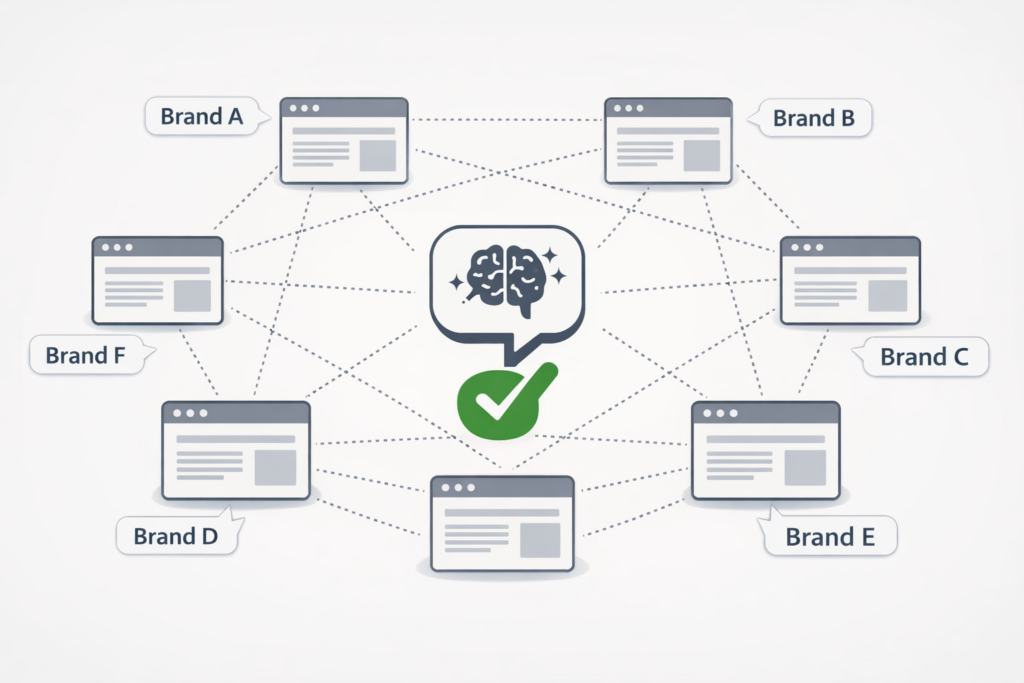
A recommendation network is a group of non-competing websites that publish content mentioning and endorsing each other’s brands. The goal is to create a pattern of text-based endorsements that AI search tools like ChatGPT and Google’s AI mode detect as consensus. When these models find multiple independent sites recommending the same brand, they treat it as validation and are more likely to pass that recommendation along to users.
At TJ Digital, we track over 1,500 prompts across 30 industries to monitor how AI models decide which brands to recommend. These cross-promotional content strategies are consistently among the highest-performing tactics we use for AI visibility. I believe recommendation networks will become standard practice by the end of 2026, and the businesses that start building them now will have a significant first-mover advantage.
This article covers how recommendation networks work, why they’re safe from Google penalties, and how you can start building one for free today.
Table of Contents
ToggleHow Recommendation Networks Work
@tjrobertson52 What are recommendation networks and how can you use them to show up in ChatGPT? Simple tactic anyone can do for free 👇 #aimarketingtools #SEO #marketinghack
♬ original sound – TJ Robertson – TJ Robertson
Unlike traditional link exchanges, recommendation networks don’t depend on hyperlinks. Each site in the network creates genuinely helpful content that naturally name-drops the other businesses by name.
For example, a home staging company might publish a blog post titled “The Best Real Estate Agents in Austin” and include three partner agents. Those agents then publish their own posts, like “How to Prepare Your Home for Sale,” and mention the staging company by name.
Over time, this creates a web of plain-text endorsements across multiple independent sites. These endorsements are contextually integrated into real content, so they look like genuine word-of-mouth. That’s exactly what AI models are scanning for when they decide which brands to recommend.
Why Text Mentions Matter More Than Links for AI
Traditional SEO success was measured by backlinks and PageRank. AI search works differently. To influence large language models, you just need content that recommends your brand by name. You don’t need links. You don’t need exact-match keywords. You just need plain-text mentions in relevant, helpful content.
The table below shows why this distinction matters for businesses investing in AI visibility.
| Factor | Backlinks (Traditional SEO) | Text Mentions (AI Optimization) |
| What AI scans for | Less emphasis on link structure | Scans for brand name in context |
| Ease of acquisition | Hard to get, often requires payment | Easier, just requires a content partnership |
| Risk of penalty | Link schemes can trigger Google penalties | Text mentions carry virtually no penalty risk |
| Detectability | Algorithmic link patterns are easy to detect | Text endorsements look like genuine word-of-mouth |
AI models use something called entity recognition to map brand names to concepts. When your brand repeatedly appears alongside relevant industry terms across multiple independent sites, the AI builds confidence that your brand belongs in its recommendations.
Each mention functions like a vote. Multiple name-drops across independent sources act like multiple votes in favor of your brand.
How Recommendation Networks Differ from PBNs
If you know anything about SEO, this might sound like a Private Blog Network (PBN). The two are very different. Here’s a side-by-side comparison.
| PBN | Recommendation Network | |
| Ownership | All sites owned by one person/entity | Sites are independently owned |
| Purpose | Funnel link equity to a “money site” | Build organic brand authority across the web |
| Content quality | Often low-quality or spun content | Genuine, helpful content (listicles, guides, how-tos) |
| Mechanism | Hyperlinks between sites | Plain-text brand mentions |
| Google risk | High risk of penalty or deindexing | Virtually no penalty risk |
PBNs are a black-hat tactic for manipulating search engine rankings. Recommendation networks are a white-hat content strategy focused on AI visibility.
Google’s spam policies focus on manipulative link schemes. They don’t have a mechanism to penalize plain-text endorsements because they look exactly like authentic editorial content.
How AI Models Decide Which Brands to Recommend
When ChatGPT or Google’s AI mode responds to a query, it searches the web and synthesizes what it finds into a consensus answer. A brand is more likely to be recommended if it meets several criteria in the context of the query.
Topical relevance. The brand must be clearly associated with the topic being asked about. If someone asks for the best window tinting shop in Dallas, the AI looks for brand names mentioned in exactly that context.
Positive consensus. Multiple independent sources need to mention the brand as a good fit. Repeated endorsements in similar language signal validation.
Trusted sources. Mentions on authoritative or niche-relevant sites carry more weight. Brand mentions in industry publications or well-structured lists signal credibility to AI models.
Structured format. AI gravitates toward content that’s easy to parse. Comparison articles, “best of” lists, and FAQ-style content all perform well. If your brand appears in these formats, it’s more likely to surface in AI-generated answers.
Entity clarity. Clear, unambiguous use of the brand name helps. When a brand co-occurs with well-known industry terms or other trusted entities, AI becomes confident in the association.
How to Build a Recommendation Network for Free
You don’t need to join a formal network or pay anyone. You can start this today with businesses you already know.
Step 1: Identify Complementary Partners
Make a list of 5 to 10 businesses that serve your ideal customers but aren’t direct competitors. Think about the businesses that come before or after your service in the customer journey.
Here are some examples by industry.
- Real estate agent: home staging companies, mortgage brokers, movers, home inspectors
- Event management: photographers, trade show booth builders, caterers, AV rental companies
- Dentist: orthodontists, oral surgeons, cosmetic providers, dental labs
- Ecommerce store: complementary product brands, packaging suppliers, fulfillment services
It could even be companies that do what you do but in a different area or for a different demographic.
Step 2: Make the Pitch
Reach out with a simple, casual message. You could say something like this.
“Hey, would you be willing to post an article on your blog talking about how we’re one of the best options for [service]? In exchange, we’ll post a similar article on our blog recommending you.”
You can also offer to write both blog posts yourself. That dramatically increases the chance they say yes since you’re removing all the work from their plate.
Step 3: Create AI-Friendly Content
Structure the articles as listicles or guides. These are the formats AI is most likely to pull from when generating answers. Some effective title formats for these articles are listed below.
- “Best [Service] in [City]”
- “How to Choose the Best [Service] for [Need]”
- “Top [Number] [Service Providers] for [Audience]”
- “[Service A] vs [Service B]: Which Is Better for [Use Case]?”
If you’re reaching out to multiple companies, you can create a single listicle and list them all in one article. Each entry should follow a consistent format. Include the business name, what they do well, and who they’re a good fit for.
Step 4: Add Unique Value
AI models favor content that provides original insights over content that rehashes common knowledge. This concept is called information gain. Including things like proprietary data, customer stats, local case studies, or expert commentary gives AI a reason to cite your content over the dozens of generic alternatives.
A generic “10 Best Plumbers in Phoenix” list with no original insight gives AI little reason to cite it. But one that includes your first-hand experience working with those plumbers, or specific project outcomes, stands out as a stronger source.
Step 5: Share and Build Over Time
Once published, encourage your partners to promote the content on their channels. After a few collaborations, you’ll have multiple pages across the web that mention your brand organically.
As long as you’re not doing this at massive scale, you could also include contextual links to each other’s sites. So now you’re getting relevant backlinks and building text recommendations at the same time.
Why Now Is the Time
These markets haven’t taken shape yet. By the time formal recommendation network platforms launch and become commonplace, prices will go up and the early-mover advantage will shrink.
If you start building these partnerships now, your brand will already be embedded in the content that AI models reference by default. There’s also a compounding effect. When people use AI to create content, and those AI models already associate your brand with your industry, you start showing up in that AI-generated content too.
We create articles like these on our clients’ websites. For one client, just getting three additional reviews on a single directory was enough to start being recommended by ChatGPT. This method lets you multiply that effect across multiple partner websites with no ad spend. Large language models already convert users to customers at about 8x the rate of traditional search engines, so the ROI on this kind of work is significant.
Get a Free AI Visibility Audit
If you want to start getting recommended by ChatGPT and Google’s AI mode, contact TJ Digital for a free digital marketing audit. We’ll show you exactly which websites AI is citing in your industry, where your brand is and isn’t showing up, and what to do about it.