
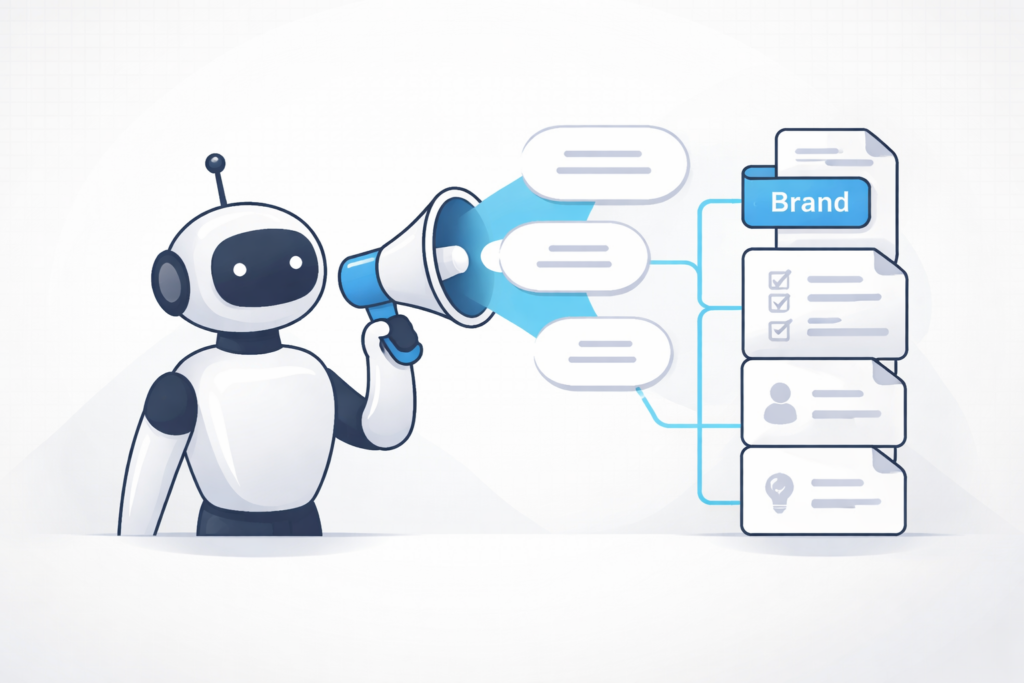
The most effective way for a business to use AI right now is to build what’s called a “brand ambassador.” A brand ambassador is a project set up in ChatGPT, Claude, or Gemini that understands everything about your brand. It can draft content, write ad copy, answer questions about your company, and help brainstorm strategy. At TJ Digital, we’ve been building these for our clients for over two and a half years. Our team is now 3-4x more efficient than we were before we started using them, and they’re the foundation of nearly everything we produce.
Every business owner I talk to feels like they’re falling behind on AI. The truth is, we’re all falling behind. The technology is moving too fast for anyone to keep up with. The question isn’t whether you’re being left behind. It’s where you’re being left behind.
There are a million things you can do to improve your business with AI. That’s the problem. I’m watching a lot of businesses sink time into building AI systems that’ll be replaced by software within months. But building a brand ambassador is different. It’s not going away anytime soon, and it pays for itself almost immediately.
Table of Contents
ToggleWhat Is an AI Brand Ambassador?
@tjrobertson52 Everyone’s getting left behind with AI. The real question is WHERE to focus. Here’s the one project actually worth building 👇 #AIforBusiness #SmallBusiness #AITips #Marketing
♬ original sound – TJ Robertson – TJ Robertson
A brand ambassador is an AI project loaded with everything there is to know about your business. Your website copy, brand voice guidelines, service descriptions, customer profiles, company history, and anything else the AI might need to accurately represent you.
Think of it like onboarding an employee who has perfect memory. You give it your brand information once, and it remembers every detail forever. No human will read through 6,000 words of brand guidelines to find the one detail that makes a great headline. AI does that in seconds.
Once it’s set up, everyone on your team can use it. Need to draft a social media post? Ask the brand ambassador. Writing an email to a lead? The brand ambassador already knows your tone, your services, and your differentiators.
We build these for every client. In the simplest form, whenever we have a question about a client’s business, we ask the AI first. That’s an email exchange saved. But more deeply, every blog post, ad, web page, and video script we create runs through the brand ambassador. The result is content that sounds like the business owner wrote it, not like a marketing agency guessed at their voice.
Why Most AI Output Is Terrible (and How to Fix It)
If you go to ChatGPT and say “write me a blog post,” the output is going to be generic and unusable. If you create a 20-page document with everything about your brand and ask the same question, the output will be better, but probably still not great.
The difference comes down to context. Out of the box, AI defaults to generic internet writing. It doesn’t know your quirks, your opinions, or how you talk to customers. Without that information, it guesses. And it guesses wrong.
A brand ambassador closes that gap by giving the AI structured, organized context about your specific business. The more relevant context you provide, the less editing you’ll do later. It’s the same reason you wouldn’t hand a new employee a one-sentence job description and expect great work on day one.
How to Build a Brand Ambassador Step by Step
Here’s the process I’ve developed over two and a half years of building these for small and medium businesses.
Step 1: Gather your existing brand information. Start by feeding the AI all of your website copy. Then run deep research in ChatGPT or Claude to collect all the publicly available information about your brand. This gives the AI a solid baseline to work from.
Step 2: Organize and identify gaps. Have the AI organize all that information and flag what’s missing. There will always be gaps. Things like your ideal customer profile, how you handle objections, your pricing philosophy, and the specific language your team uses internally.
Step 3: Generate a questionnaire. Ask the AI to create a list of questions that would fill in those gaps. This step is underrated. The AI is good at recognizing what it doesn’t know yet.
Step 4: Record someone answering those questions. Have the founder or a key team member answer those questions on camera or in a voice recording. You don’t need high production value. You just need their actual words and thought process. Transcribed audio is literally your brand’s own words in text form, and it becomes high-quality reference material for the AI to pull from.
Step 5: Feed the transcript back in and organize it. Transcribe the recording and give it back to the AI. Have it organize all the information into about a dozen separate documents, each focused on a specific topic (brand voice, services, customer profiles, company history, competitive positioning, and so on).
Step 6: Set up your project with clear instructions. In the project’s instructions, define each document and tell the AI when to refer to each one. This helps the model pull only the information relevant to whatever you’re working on, instead of trying to use everything at once.
Why Does the Brand Ambassador Get Things Wrong at First?
You’ll find that when you start using your brand ambassador, it’s pretty good but not great. It’s going to get things wrong. It’s going to misrepresent your brand in subtle ways.
This is normal. There are a few common reasons.
The first is insufficient training data. If you only gave it your homepage and an About page, it doesn’t have enough to work with. You need the full picture: services, case studies, past emails, sales call transcripts, anything that reflects how your business actually communicates.
The second is vague instructions. Telling the AI to “keep it casual” isn’t enough. You need to be specific. Something like “use short paragraphs of 3-4 lines, start most sentences with action verbs, and never use words like ‘innovative’ or ‘cutting-edge'” is far more useful.
The third is context window limitations. Not all platforms handle large amounts of information equally well. Claude currently handles long documents better than most alternatives, which is one reason I recommend it for brand ambassador projects.
How to Iterate Until the Output Is Actually Good
The businesses that get real value from AI are the ones that keep iterating. Most people try it once, get mediocre output, and give up.
Here’s what the iteration process looks like in practice:
- Generate content with the AI using your current setup. Start with something specific, like a social media post or a short email draft. Review it against what you’d actually say or write yourself.
- Take note of everything it gets wrong. Every time it uses the wrong tone, misrepresents a service, or defaults to generic language, write it down. Be specific about what’s wrong and what the correct version would look like.
- Pass that feedback back into the project. Ask yourself whether you need to update an existing document or add a new one. Sometimes the fix is adding a single sentence to your brand voice document. Sometimes it means creating an entirely new reference file.
- Add more examples of whatever content type you’re creating. If you’re going to write a lot of newsletters, give it 2-3 of your best past newsletters. The AI learns patterns from examples faster than from rules alone.
- Repeat until first drafts need only light editing. Each round of feedback makes the next output better. After 10-20 rounds of iteration, the brand ambassador should be producing content that’s close to what you’d write yourself.
This is the part that takes effort. But it’s also where the real value gets built.
What Can a Brand Ambassador Do Once It’s Dialed In?
Once your brand ambassador is refined, it becomes the engine behind almost all of your marketing output.
| Use Case | What the Brand Ambassador Does |
| Blog posts | Writes in your voice with your specific expertise, links to the right pages, and includes proper calls to action |
| Ad copy (Google and Meta) | Generates headlines and descriptions that reflect your brand, not generic marketing language |
| Social media posts | Creates platform-specific content in the right tone for each channel |
| Email drafts | Handles client communication, follow-ups, and newsletters using your natural language patterns |
| Internal Q&A | Answers team questions about the business without anyone having to dig through old emails or meeting notes |
| Content repurposing | Takes a single video transcript and turns it into 8-10 pieces of content across platforms |
None of this output is good because the AI is smart. It’s good because the AI has the right context. That’s the whole game with AI right now.
Should You Build This Yourself or Hire Someone?
If you want to try this yourself, here’s the simplest starting point:
- Open a new project in Claude (my current recommendation for brand ambassadors)
- Upload your website’s About page, Services page, and any marketing materials you have
- Write a short set of instructions describing your brand voice, your target audience, and what the AI should never say
- Ask it to write something specific, like a social media post or a short email
- Review the output, note what’s wrong, and update your instructions or documents
- Repeat
You won’t get it perfect on the first try. Probably not on the tenth either. But by the twentieth iteration, you’ll have something that saves you real time every day.
That said, this process does take a lot of effort to do well. It’s taken us over two years and we’re currently on version 3.0 of our brand ambassador system. If you’d rather skip the learning curve, that’s what we do at TJ Digital. We build brand ambassadors and full AI content systems for small and medium businesses. Every campaign starts with a 90-minute discovery call, and within a week your brand ambassador is producing content in your voice.
We also offer a free digital marketing audit for any business with at least a $750 monthly budget. No credit card, no obligation. Just a video walkthrough of what we’d recommend for your specific situation.