
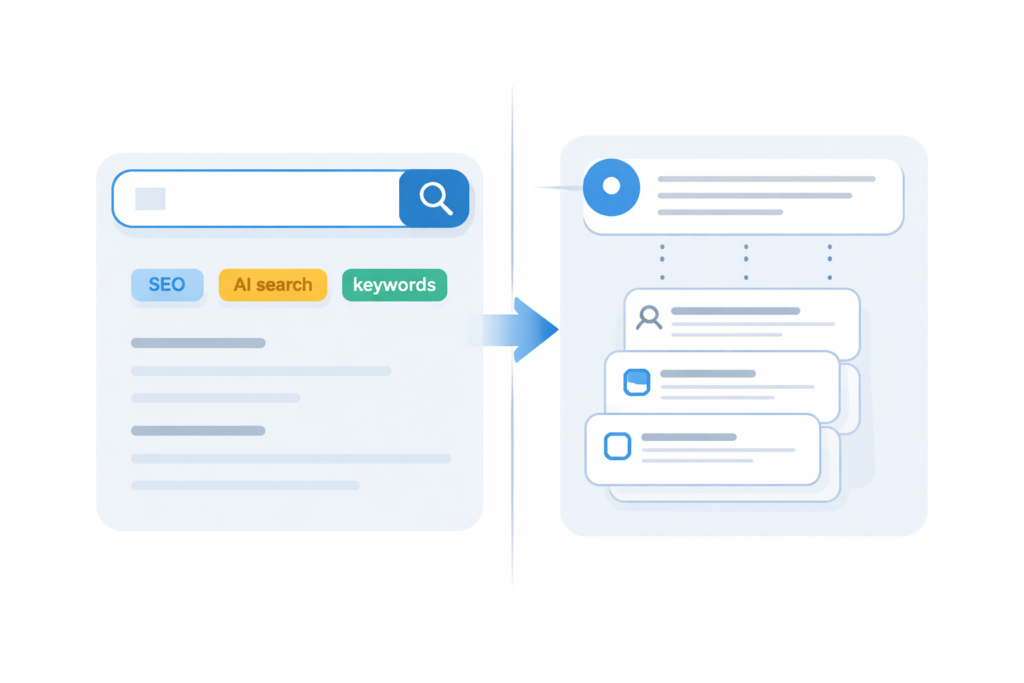
Yes, keywords still matter for AI search. Despite widespread claims that AI systems have evolved beyond keyword matching, commercial intent queries in tools like ChatGPT and Gemini are still driven almost entirely by keyword-based searches in traditional search engines.
At TJ Digital, we track AI search visibility for clients across multiple platforms, and the data is consistent: the game hasn’t fundamentally changed. It’s just been misrepresented. Large language models already convert users to customers at roughly 8 times the rate of traditional search engines, which makes understanding how they actually surface results critical for any business investing in AI search visibility.
The reason so much GEO advice contradicts this is simple: there’s enormous demand for AI search expertise right now, and very few practitioners are actually running controlled experiments. Most of what’s circulating is reasoned speculation. And some of it sounds convincing because the logic, on the surface, makes sense.
Table of Contents
ToggleWhy There’s So Much Misinformation About GEO
@tjrobertson52 Most GEO advice is speculation dressed as strategy. Keywords aren’t dead — the data says otherwise. #GEO #AIsearch #SEO #AISearchOptimization
♬ original sound – TJ Robertson – TJ Robertson
When a topic goes hot fast, speculation fills the gap before data can catch up.
GEO (Generative Engine Optimization) is a perfect example. Everyone wants to know how to rank in AI search. That demand creates pressure on marketers and consultants to speak with authority on the topic, even when the evidence isn’t there yet.
The speculation usually follows a pattern: take something you know about AI systems, apply it to search, and assume it works. A few examples that sound reasonable but don’t hold up under testing:
- Structured data must boost AI rankings: AI loves structured data, so adding schema markup should make your content rank higher in AI results. Logical, but the data doesn’t support it as a direct ranking signal.
- You need a Markdown version of every page: AI systems process Markdown, so surely having a Markdown-formatted version of your pages helps. Also sounds right. Also not proven.
I’ve seen both of these circulate confidently online. And both, when you actually run the experiments and look at the results, fall apart.
The more significant version of this is the idea that keywords are becoming obsolete for AI search entirely.
Why Some Experts Say Keywords Don’t Matter for AI Search
The reasoning goes like this: large language models are trained on essentially all the content on the internet. Unlike traditional search engines, they’re not dependent on simple keyword matching. They understand meaning and context. So there’s no point optimizing for specific search terms anymore. AI will surface relevant content based on understanding alone.
I’ll be honest: I speculated on this myself, about 10 months ago. At the time it made sense. Large language models were just gaining the ability to do real-time searches, and the vast majority of responses were still coming from training data alone. If responses come from training data, keyword optimization becomes a lot less important.
That’s not where we are anymore.
What Actually Happens When You Submit a Commercial Query
The landscape has shifted. Today, the majority of prompts will trigger a live search. For commercial intent queries specifically, anything where someone is looking to buy, hire, or compare, the response is almost entirely determined by the results of that search.
And those are keyword-based searches in a traditional search engine.
A study of ChatGPT’s product results found that 83% of its shopping carousel items came directly from Google’s top shopping results. ChatGPT wasn’t generating product recommendations from its training data. It was running keyword searches in Google Shopping and returning those results.
The large language model is, in a meaningful sense, a layer on top of a traditional search engine, not a replacement for one. It adds conversational framing and interpretation. The underlying retrieval is still keyword-driven.
For informational queries (“how does machine learning work?”), LLMs do lean more on their training data. But for commercial and transactional queries, keyword-based retrieval is the backbone.
The BrowseComp Argument (and Why It Doesn’t Change Much)
In November, OpenAI released a benchmark called BrowseComp. It measures how well an AI agent can find information that’s genuinely hard to locate: multi-hop queries, obscure facts, the kind of thing you’d struggle to pull up with a few traditional searches. It’s a genuine test of an AI’s ability to browse and reason across the web.
Within three months, Google’s Gemini 3.1 model had already doubled the high score on that benchmark.
The reaction in some corners of the SEO world was predictable: if AI can find anything regardless of how it’s structured or labeled, keywords must be even less important than we thought.
But here’s what that argument misses.
The fact that a large language model is capable of deep semantic retrieval doesn’t mean it uses that capability for every query. Capability and default behavior are different things.
This distinction keeps getting lost in GEO commentary. What AI chooses to do by default is what matters for your strategy, and the default is keyword-based retrieval. Keyword searches are fast, reliable, and cheap. Deep semantic browsing is computationally expensive. There’s rarely a reason for an LLM to do something costly when a keyword search does the job in a fraction of the time.
GEO vs. Traditional SEO: What’s Actually Different
GEO and traditional SEO share the same foundation. Google has said explicitly that optimizing for AI search is the same as traditional SEO. The basics still apply: keyword research, quality content, technical health, and authoritative links.
Where GEO adds something new is in the layer above that foundation:
| Factor | Traditional SEO | GEO |
| Keyword optimization | Target specific search terms in titles, headings, content | Same, plus conversational phrasing and question-based terms |
| Content structure | Clear headings, meta tags, readable formatting | Q&A format, self-contained sentences, direct answer-first structure |
| Schema markup | Helpful for rich snippets, click-through rate | Helps AI parse and extract structured information |
| Authority signals | Backlinks from trusted sources | Backlinks plus brand mentions, citations in AI-generated answers |
| Primary goal | Rank in search results | Rank in search results and get cited in AI responses |
GEO doesn’t replace keyword strategy. It adds a set of formatting and authority practices on top of it. If your keyword fundamentals are weak, no amount of GEO optimization will make up for it.
What This Means for Your Search Strategy
The practical takeaway here is to ignore advice that asks you to overhaul your strategy based on speculation about how AI should work. That includes advice about abandoning keyword optimization because AI systems are getting smarter.
Run experiments. Identify a topic cluster, create an “LLM-ready” version with structured Q&A and schema, leave another cluster unchanged, and compare how often each version gets cited in AI responses over the following months. Track appearances in AI Overviews, citation frequency in ChatGPT and Gemini responses, and shifts in organic traffic. That’s how you build a strategy grounded in evidence rather than theory.
For a breakdown of the specific content formats that tend to get cited most in AI responses, see our post on the best blog post types for ranking in LLMs.
The fundamentals of our AI SEO services are built on this same principle: test what works, document it, and build processes around results rather than assumptions.
FAQ: Keywords and AI Search
Are keywords obsolete for AI search?
No. While AI systems are capable of semantic understanding, keyword-based searches remain the default retrieval method, especially for commercial and transactional queries. Keyword optimization is still the foundation of both SEO and GEO.
Does adding schema markup improve AI search rankings?
Schema markup helps AI systems parse and extract information from your pages, but it doesn’t directly improve rankings. It’s most valuable for generating rich snippets and helping AI identify the structure of your content, which can increase citation frequency over time.
Is GEO different from SEO?
GEO builds on traditional SEO rather than replacing it. The same keyword, content, and authority fundamentals apply. GEO adds practices around content structure (Q&A format, direct answers, self-contained sentences) and brand authority signals that increase the likelihood of being cited in AI-generated responses.
Should I have a Markdown version of every page for AI search?
There’s no evidence that Markdown formatting provides a meaningful advantage over well-structured HTML. What matters is that your content is well-organized, uses clear headings, and answers questions directly. Format is less important than structure.
How do I know which GEO tactics actually work?
The only reliable way is to run controlled experiments. Create structured, AI-optimized content on one topic cluster, leave a comparable cluster unchanged, and track AI citations and organic performance over 2-3 months. Industry tools like Semrush’s AI Visibility Index can help track whether your content is appearing in AI-generated summaries.
At TJ Digital, we work with small and medium-sized businesses building AI search visibility on tested strategy, not assumptions. If you want a clear-eyed look at where your site stands, request a free audit and we’ll show you exactly what’s moving the needle.