
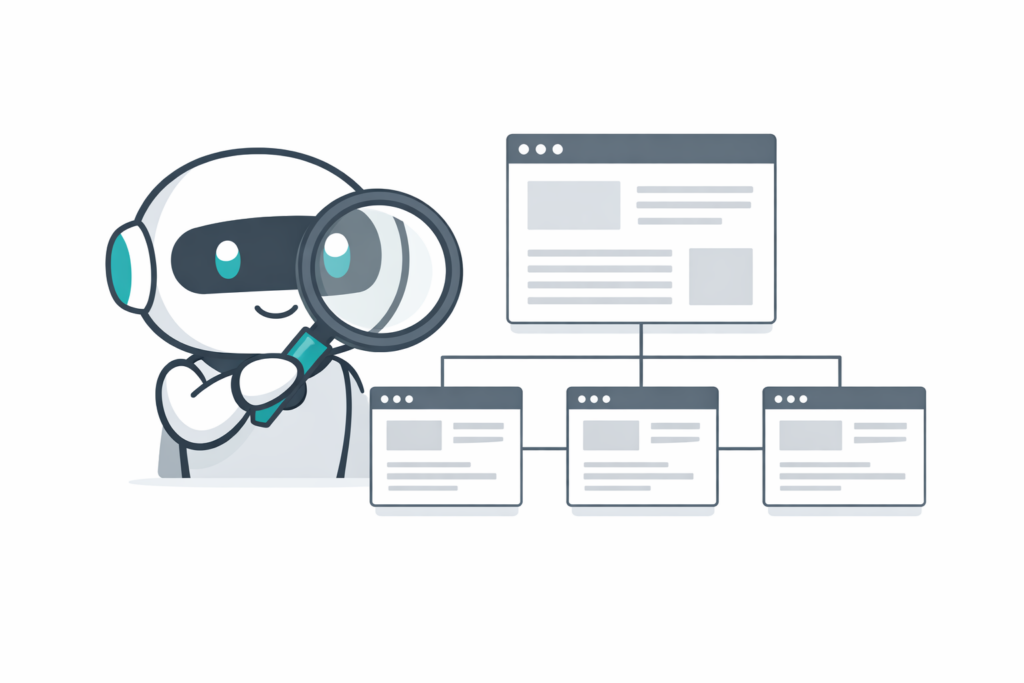
The way customers find and vet businesses is changing fast. Within the next few years, a significant portion of buying decisions won’t start with a human typing into Google. They’ll start with an AI agent that already knows what the customer needs, what your competitors offer, and what your website says about you. At TJ Digital, we’ve helped dozens of small and medium businesses adapt their online presence for this shift. LLMs already convert users to customers at roughly 8 times the rate of traditional search engines, and that gap is widening.
To show up when AI agents evaluate your business, your website needs to do one thing above all else: contain every piece of information that might be relevant to any prospective customer. That’s a lot of content, but the structure below is the most direct path to get there.
Table of Contents
ToggleHow AI Agents Actually Research Your Business
@tjrobertson52 AI agents are about to replace humans on your website. Here’s exactly how to structure your site so the AI recommends YOU over your competitors 👀 Full breakdown on YouTube #AISearch #WebsiteStrategy #SEO #ContentMarketing #MarketingTips
♬ original sound – TJ Robertson – TJ Robertson
When an AI agent researches your business, it doesn’t browse the way a human does. It crawls your pages, reads visible text, and synthesizes everything it finds alongside information about your competitors and your customer’s specific needs. It then makes a recommendation.
That means your website is no longer just a marketing tool. For AI-assisted buyers, it’s the entire sales conversation. Every question a prospect might ask on a call, every objection, every “how much does it cost”: if the answer isn’t on your site, the AI either guesses or points the buyer somewhere else.
Websites structured for AI agents also tend to convert human visitors better. These aren’t competing goals.
The Pages Your Website Needs
For at least the next year or two, you still want your site easy for humans to use. That means a clean homepage and sensible navigation. But underneath that, you want depth. Top-level pages should cover the most important information, then link out to more specific subpages. Here’s what that looks like in practice.
A Strong About Page
Your About page is where you get to brag. AI systems use it to verify who you are, establish credibility, and decide how much weight to give your other content. Don’t be modest here.
Include your company history, your differentiators, key team members with real credentials, and why a customer should choose you over anyone else. From there, link out to dedicated subpages on specific benefits, individual team member bios, and any awards or press mentions. This hub-and-spoke structure gives AI a clear picture of your brand as an entity, not just a domain.
Adding Organization schema markup with fields like your founding date, address, and social profiles helps AI systems formally recognize your brand. Mark up key team members with Person schema too, linking them to content they’ve authored on your site.
An FAQ Page (And Make It Long)
The goal of your FAQ page isn’t to rank for common industry questions. The goal is to answer every question that might come up on a sales call.
Think of it as training the AI to act as your best salesperson. Cover pricing concerns, timeline expectations, process questions, common objections, comparisons to competitors, and anything else a prospect has ever asked you. This page can be very long. AI has no problem with long.
What AI does have a problem with is accordions. It’s tempting to hide answers behind expandable toggles to keep the page clean, but most LLM crawlers can’t click to reveal hidden content. If the answer isn’t visible in the page’s static HTML, the AI can’t read it. Keep the text visible on the page, and add FAQPage schema markup so crawlers explicitly recognize the Q&A structure.
A Pricing Page
Show something, even if you don’t list exact quotes. AI agents frequently look for “how much does X cost” answers, and if you don’t provide any information, a competitor who does will get the recommendation instead.
You don’t have to publish a rate card. Explain your pricing model, provide ballpark ranges, and list the factors that affect cost. Write it in plain HTML, not behind sliders or login walls. A paragraph that says “Our SEO services start around $X for small businesses and scale based on site size and competition” is far more useful to an AI than a page that just says “contact us for pricing.”
A “How to Work with Us” Page
Walk prospects through your process step by step. What happens after they contact you? How long does onboarding take? What do they need to provide? What does a typical engagement look like?
This page removes friction for both human buyers and AI agents trying to assess whether your business is a practical match for a prospective customer’s needs.
Service Pages and Sub-Service Pages
Each core service needs its own page with detailed information. If you offer sub-services, those need their own pages too, linked from the main service page. This is the foundation of our AI SEO service for every client we work with.
Here’s why the granularity matters: when someone searches for “ceramic window tinting” and you have a dedicated page for it but your competitor doesn’t, you win that search by default. The same logic applies to AI. If an agent is looking for a specific service variant and you have a page that addresses it directly, you’re the obvious citation.
Use a pillar-and-cluster structure:
- A top-level service overview page linking to each sub-service
- Each sub-service page linking back to the parent and to related content
- Clean, descriptive URLs that reflect the hierarchy (e.g., /services/seo/technical-audit/)
The internal linking between these pages matters. Use link text that makes the relationship explicit. “Our SEO services include technical SEO audits” is more useful to a crawler than a generic “learn more.”
“X for Y” Use Case Pages
Build a dedicated page for every service-and-audience combination that describes your ideal customer. A dental practice targeting attorneys is different from one targeting contractors, even if the service is identical.
These pages follow a simple title structure: “SEO Services for Dentists,” “Google Ads for Law Firms,” “Content Marketing for SaaS Companies.” They can be set up as standalone pages or blog posts, then linked from your service pages and a use case hub.
AI systems are increasingly responding to long, specific prompts. A prospective customer asking an AI “what’s the best SEO agency for a small dental practice” is much more likely to get sent your way if you have a page that speaks directly to that query.
Case Studies
When a buyer describes a problem to an AI, the AI looks for specific, documented examples of that problem being solved. Case studies with real outcomes are among the most citable content types for AI platforms.
Structure them with clear subheadings: Challenge, Solution, Results. Lead with the numbers. “Client saw a 150% increase in organic traffic in 90 days” is a ready-made citation. Vague claims like “we helped them grow significantly” are not.
Tailor case studies to the problems your best customers face. If you work with a lot of dentists, publish a case study about an SEO result for a dental client. That specificity is exactly what AI agents look for when matching a user’s situation to a solution.
A Reviews Page
Pull together your best reviews in one place. Summarize what customers consistently say about you. This gives AI a concentrated source of third-party validation instead of requiring it to dig through individual review platforms.
Competitor Comparison Pages
This one makes people uncomfortable, but it’s worth doing. A page for each major competitor that explains, honestly and specifically, why you’re the better fit for your ideal customer is a direct response to one of the most common AI search queries: “X vs Y, which is better for [use case].”
Write these from your customer’s perspective. If a particular competitor is a better fit for large enterprises and you serve small businesses, say that. Honesty here builds more trust than a generic “we’re better at everything.” For a deeper look at how we approach this type of content, see our post on bottom-of-funnel content strategy.
Page Structure at a Glance
| Page Type | Primary Purpose | Key Content to Include |
| About | Entity credibility | Company history, team bios, awards, press, schema markup |
| FAQ | Train AI as salesperson | Every sales question answered in visible HTML, FAQPage schema |
| Pricing | Address cost objections | Pricing model, ballpark ranges, value framing |
| How to Work with Us | Remove friction | Step-by-step process, timeline, what to expect |
| Service Pages | Capture service queries | Detailed service info, sub-service links, internal linking |
| Sub-Service Pages | Capture specific queries | Deep content on one variant of a service |
| X for Y Pages | Niche audience capture | Use case-specific content, comparisons, relevant outcomes |
| Case Studies | Proof for specific problems | Challenge / Solution / Results structure with real metrics |
| Reviews | Social proof aggregation | Best testimonials, summary of common feedback |
| Competitor Pages | Direct comparison queries | Honest, specific differentiation by customer type |
The Accordion Problem
It bears repeating: do not hide important content behind JavaScript accordions or tabs.
This is a common design decision that quietly tanks AI visibility. When a human clicks a “+” to expand an answer, it feels clean. But most LLM crawlers don’t execute interactive scripts. If the content requires a click to reveal, the AI almost certainly won’t see it.
This applies to your FAQ answers, service details, pricing explanations, and anything else a prospect might need to make a decision. Keep it in the static HTML. If the page feels long, that’s fine. AI doesn’t mind scrolling.
Don’t Forget Bottom-of-Funnel Blog Posts
Everything above is branded content, the kind of information AI looks for once it’s already aware of your company. But most of the content we create for clients right now targets people who don’t know your brand yet.
These are decision-stage blog posts that answer questions like:
- “How to choose the best SEO agency”
- “What does window tinting cost in [city]”
- “Magento vs Shopify for small businesses”
- “Signs your website isn’t showing up in AI search”
People searching these terms are close to a purchasing decision. A well-structured blog post that answers the question directly and naturally positions your services can move them from research to contact without a sales call.
If you’re building toward AI search visibility, this content layer is where a lot of the new traffic comes from.
Frequently Asked Questions
How many pages does a website need to rank in AI search?
There’s no fixed number. The goal is to have a page for every relevant question, use case, audience type, and service variant. For most small businesses, this means building out over time, starting with the highest-priority pages and adding depth from there. A site with 20 well-structured pages will outperform one with 200 thin pages.
Does my FAQ page need to use schema markup to show up in AI results?
Schema markup isn’t required for AI visibility, but FAQPage schema makes it easier for crawlers to formally recognize your Q&A pairs and increases the likelihood your answers get cited directly. It’s a straightforward addition with meaningful upside.
How long does it take to build out a website for AI search?
There’s no fixed timeline. Building this out properly is a serious content project, and most businesses spread it across several months, starting with the highest-priority pages first. Most of your competitors haven’t started yet. The earlier you build it out, the more ground you cover.
Can I still show up in AI search without all of these pages?
You’ll show up for whatever your site covers. If you have strong service pages and a detailed About page, you’ll get picked up for queries related to those. Each additional layer, case studies, use case pages, competitor comparisons, adds more coverage and more chances to be the cited source for a specific query.
Build It Now, Not in 2027
The businesses showing up consistently in ChatGPT, Google’s AI Mode, and other AI platforms right now are the ones whose websites are structured as content hubs, not minimalist brochures. This strategy is already working.
If you want help building this out, content production is the core of what we do at TJ Digital. We’re currently working with a waitlist, but you’re welcome to reach out and get in the queue. The sooner the content is built, the more ground you cover before your competitors catch on.