
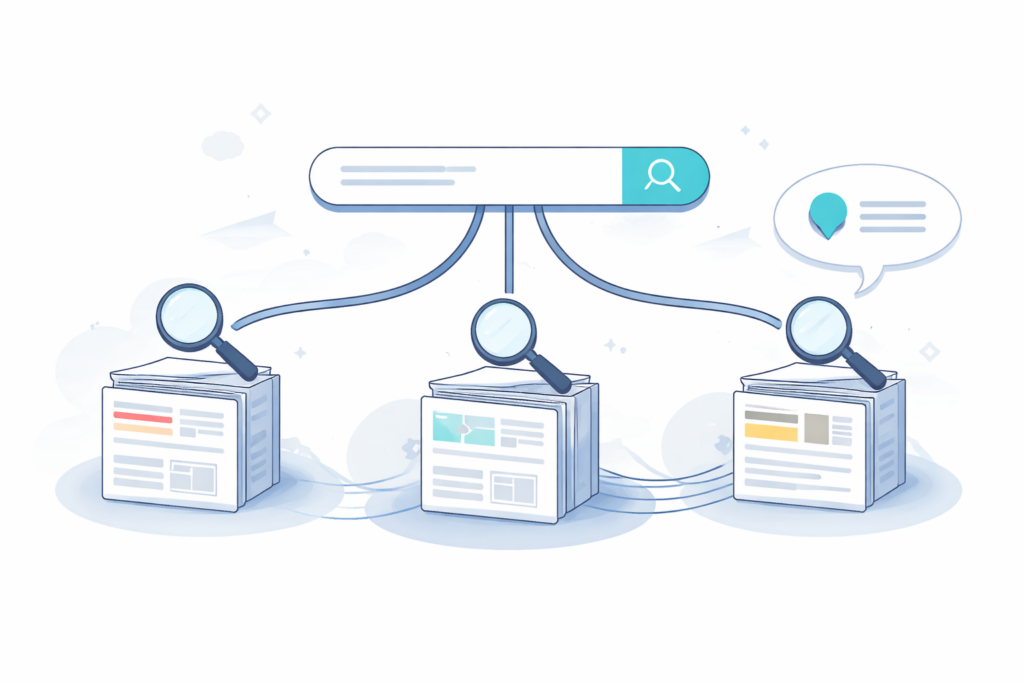
AI search works by taking a user’s query, breaking it into multiple related sub-searches, pulling content from across the top results, and synthesizing a single answer. For businesses, that changes almost everything about how you should think about visibility. At TJ Digital, this is the core of what we do. The shift from traditional SEO to AI optimization is the most significant change I’ve seen in 15 years of digital marketing.
This article breaks down how AI search actually works, where it differs from classic SEO, and what your business should be doing about it.
Table of Contents
ToggleWhat AI Search Actually Means for Your Business
@tjrobertson52 When you ask an AI for a recommendation it runs 3+ searches behind the scenes and looks at 10-20 results — not just the top 3 like humans do. That means ranking 1 doesn’t matter anymore. Here’s what does 👆 #AISearch #SEO #aimarketingtips #DigitalMarketing
♬ original sound – TJ Robertson – TJ Robertson
When I say “AI search,” I mean any time someone uses a large language model like ChatGPT or Google’s AI Mode to find an answer. There are some differences between platforms, but they all fundamentally work the same way.
If you sell a product or service, the only AI results that matter to you are recommendations. You want the AI to recommend your brand as the solution.
How AI Search Works: Query Fan-Out
When a user asks an AI for a recommendation, it doesn’t just look up the phrase they typed. It evaluates everything it knows about the user, determines what information it actually needs to answer the question fully, and then runs three or more searches.
This is called query fan-out. A single question like “best CRM for small businesses” gets broken into a series of more specific searches covering different angles. The AI gathers content from each of those results and synthesizes a single answer.
Google’s AI uses Google’s own search index. ChatGPT has used a mix of Google, Bing, and its own index. But Google is still the dominant search engine, and I don’t see that changing anytime soon.
How AI Search Differs from Traditional SEO
A lot of SEOs looked at this and said nothing has changed, because it’s still Google results that matter. That completely misses the point. There are three real differences that open up significant opportunities if you’re paying attention.
1. Queries Are More Specific and Personalized
AI search doesn’t generate one generic query. It generates personalized, specific sub-queries based on everything it knows about the user and their context. You’re no longer competing over a handful of high-volume, highly competitive keywords.
The strategy shifts to creating content that targets specific use cases, scenarios, and audience segments. Hyper-specific content that would have felt too narrow for traditional SEO is exactly what AI search is looking for.
2. Position Doesn’t Work the Same Way
In traditional search, humans typically look at the top three results and are far more likely to click position one. AI behaves differently. It commonly evaluates 10 to 20 results, and Yotpo’s research found that 93.7% of links in Google’s AI Overview answers came from beyond the top 10 organic positions, meaning AI is routinely pulling from results that human searchers would never see.
More importantly, AI doesn’t appear to have the same position bias humans do. If you’re anywhere in the top 20 results, you’re roughly in an equal playing field with everyone else in that set. That lowers the competitive bar significantly and makes a lot of keywords worth targeting that traditional SEO logic would have ruled out.
3. Your Website Isn’t the Only Path
For most brands, creating content on your own website is still the most effective way to influence AI results. But it’s not the only way. Posting on Reddit, getting ranked higher in directories, and earning mentions on third-party websites can all have a real impact on how AI search platforms recommend you.
The critical qualifier here: these mentions only matter if they’re on pages that AI models are actually citing. A lot of people are mass-spamming brand mentions across the internet, and that tends to be almost completely ineffective.
| Factor | Traditional SEO | AI Search |
| Query type | Single keyword or phrase | Multiple specific, personalized sub-queries |
| Results evaluated | Top 3 typically clicked | Top 10–20 evaluated |
| Position importance | Strong bias toward #1 | Relatively equal within top 20 |
| Content that matters | Your website | Website + third-party mentions, Reddit, directories |
| Primary goal | High ranking | Getting cited or recommended |
The Right Strategy: Surgical Placement Over Mass Mentions
AI models typically pull from a small set of trusted sources when answering any given question. Research shows LLMs often draw from as few as 12 pages to answer queries in a given category. That same small group of pages tends to show up repeatedly across related queries.
The right approach is to identify exactly which pages AI models are citing for your category, and then make sure your brand is prominently represented on those pages.
This is what we call mention building at TJ Digital, and it’s one of the highest-leverage tactics in our AI SEO services right now. Getting your brand onto a single high-authority page that AI consistently cites is worth far more than dozens of low-authority mentions scattered across the web.
How to Find Which Pages AI Is Citing
You can do this manually or with tools:
- Manual probing: Run your target queries through Perplexity, Google’s AI Mode, or ChatGPT. Check which sources are cited and log those URLs across a range of related prompts.
- SEO tracking tools: Platforms like Semrush’s AI Visibility Toolkit run bulk queries against LLMs and return a report of which domains and pages are being cited most often. This shows you where your competitors are appearing and where you’re absent.
Once you have that list, focus your energy on getting your brand prominently represented on the pages that keep showing up. That might mean getting listed on a specific review platform, contributing to a directory that AI consistently cites, or earning coverage in an industry roundup that LLMs trust.
How to Optimize Your Content for AI Search
Query fan-out rewards content that covers a topic thoroughly, not just a single keyword. Because AI is running multiple related searches per query, content that addresses a topic from multiple angles is more likely to match several of those sub-queries.
A few things worth doing:
- Write content that answers the specific questions your customers are actually asking, not just the broadest version of the keyword
- Build out content clusters where multiple pages address different facets of the same topic
- Make sure your most important pages are technically accessible to crawlers and load properly without JavaScript rendering (many AI bots only see raw HTML)
- Keep key pages updated, AI crawlers favor content updated within the past year
FAQ
Does ranking #1 on Google still matter for AI search?
Being #1 still provides some advantage, but it’s no longer the defining factor it once was. Yotpo’s research found that 93.7% of links in Google’s AI Overview answers came from outside the top 10 organic positions. Getting cited by AI is a separate goal from ranking first, and they require partially overlapping but distinct strategies.
Do Google AI and ChatGPT use the same sources?
No. Google’s AI runs on Google’s own search index, so strong Google rankings help there. ChatGPT search primarily uses Bing’s index, with some publisher partnerships for news content. A page that ranks well on Google but isn’t indexed by Bing could be missing from ChatGPT results entirely. For full AI search coverage, it’s worth verifying your site is indexed in both.
What does “mention building” mean and how does it differ from link building?
Traditional link building focuses on getting other websites to link to yours, primarily to improve your Google ranking. Mention building is about getting your brand referenced positively on the specific pages AI models are already citing for your category. A backlink is a secondary outcome. The real goal is being part of the conversation AI is already having when someone in your market asks for a recommendation.
If you want to know where your brand currently stands in AI search results and which pages you’re missing from, we offer a free digital marketing audit that covers AI visibility alongside traditional SEO. Contact TJ Digital to get started.