
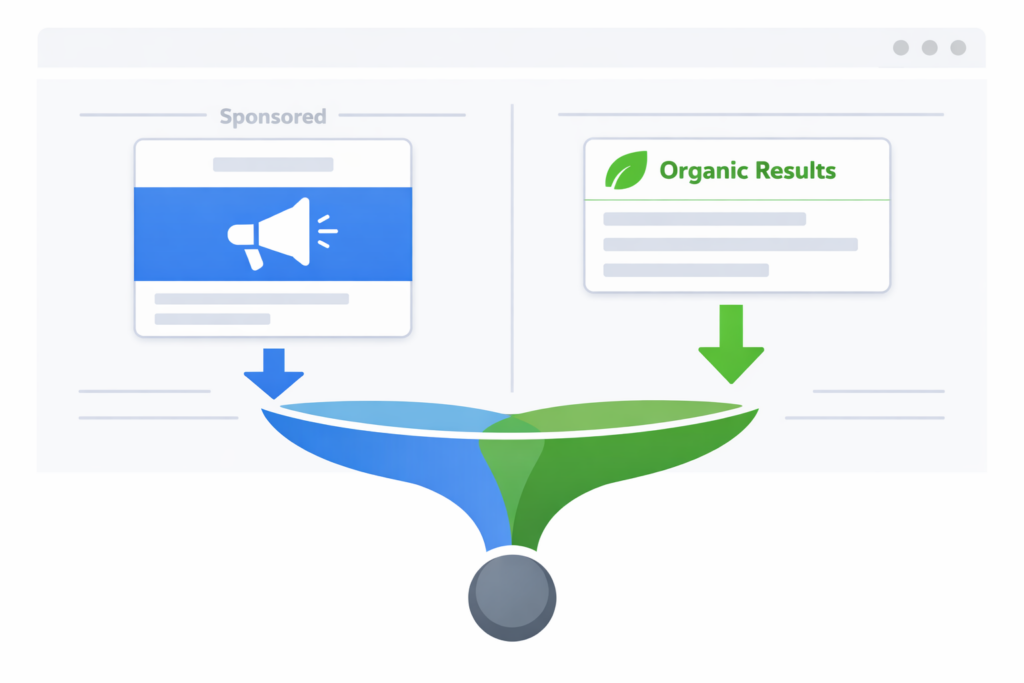
You don’t have to choose between Google Ads and SEO. They target different users, and running both doesn’t mean you’re competing with yourself. At TJ Digital, we manage both channels for small and medium businesses, and across 15 years and hundreds of campaigns, I’ve seen brands that combine paid and organic search consistently outperform those relying on just one. Industry research supports this: companies using both channels together see roughly 35-40% higher ROI than those using only one.
This is one of the most common questions I get from clients. If I’m already ranking organically, why would I also pay for ads? It sounds like you’d just be paying for clicks you would have gotten for free. But once you understand how users actually behave on a search results page, the logic falls apart pretty quickly.
Table of Contents
ToggleAre Google Ads and SEO Competing with Each Other?
@tjrobertson52 “Google Ads and SEO compete with each other” — here’s why that’s wrong. 20% click ads, the rest don’t. Two different audiences. Full breakdown 👆 #GoogleAds #SEO #DigitalMarketing #PPC
♬ original sound – TJ Robertson – TJ Robertson
Think about it from the searcher’s perspective. Someone searches for your product or service, and Google shows them sponsored results at the top. About 20% of users click on one of those sponsored results. The rest either scroll down to the organic results or perform a different search.
That’s the key: a given user is either going to click a sponsored result or they’re not. If they’re in the 20% that clicks an ad, your organic ranking doesn’t matter for that click. The only way to reach that person is through Google Ads. And if they scroll past every ad and go straight to the organic results, your ad spend doesn’t matter. The only way to reach that person is by ranking organically.
These are two separate pools of potential customers. Running both channels means you’re covering both pools instead of leaving one on the table.
How Does AI Search Change Google Ads vs SEO?
The way search results look is changing with AI overviews and AI mode, but the core principle holds. Sponsored ads are still clearly labeled in AI results. Some users will still ignore them, others won’t.
The main difference is that with AI responses, many users now see both the organic recommendation and the ads in closer proximity. So ranking organically can actually increase the likelihood that someone clicks your ad or converts after clicking it. If the AI response is already recommending your business and the user also sees your ad, that’s a strong double signal.
We’ll have to see how ads and AI responses continue to evolve. There might be a future scenario where the AI model is clearly recommending you as the top choice, and a significant number of users still click your ad instead of just Googling your business name. But as it stands right now, you’re rarely competing against yourself.
Should You Run Ads on Your Own Brand Name?
There is one exception to the “you’re not competing with yourself” rule: branded searches.
If someone searches for your business by name, they’re almost certainly going to scroll past the ads because they’re looking specifically for your website. So in that case, yes, a sponsored click might be taking a click away from your organic listing.
That seems like a clear argument against bidding on your own brand name. But there’s a catch. If your competitors are running ads on your brand name, you might be losing clicks to them. This typically happens when a user doesn’t realize they’ve clicked through to a competitor’s site. They Googled your name, clicked the first result, and assumed it was you.
The good news: because your website is far more relevant to your own brand name, you’ll pay significantly less per click than your competitors do for those terms.
My recommendation is to check whether Google is showing ads when someone searches your brand name. If competitors are bidding on it, spending a couple dollars a day to protect your brand is usually worth it.
Google Ads vs SEO: Cost and ROI Comparison
Both channels can drive leads, but they work on very different timelines and cost structures. Here’s how they compare:
| Factor | Google Ads | SEO |
| Time to results | Immediate (same day) | 3-6 months for initial results, 6-12+ months for full impact |
| Cost per lead | Higher (~$181/lead per HubSpot data) | Lower over time (~$31/lead) |
| Average ROI | ~$2 revenue per $1 spent (Google estimate) | Median ROI of about 748% (SEOProfy) |
| Traffic when you stop paying | Stops immediately | Continues for months or years |
| Conversion rate | Avg. ~1.3% | Avg. ~2.4% |
| Best for | High-intent searches, competitive keywords, fast testing | Long-term growth, building authority, reducing cost per lead |
| Budget requirement | Ongoing ad spend + management fees | Content creation + optimization investment |
The cost-per-lead gap widens over time. Paid search “rents” traffic. You pay per click, and when the budget runs out, the leads stop. SEO “builds equity.” Content keeps attracting leads long after it’s published, and the effective cost per lead drops the longer it performs. One analysis showed that after two years, SEO content can reach an effective cost per lead under $7.
Google Ads’ biggest advantage is speed. If you need leads this week, not six months from now, ads are the only option. For many of the businesses we work with at TJ Digital, the best approach is running ads for immediate leads while building out SEO and AI optimization as a longer-term investment.
When Should You Use Google Ads?
Google Ads makes sense when:
- People are already searching for your product or service (high existing demand)
- You need leads now and can’t wait months for organic rankings
- Your profit margins are high enough to cover the cost per click ($5-$50 per click is typical)
- You want to test which keywords convert before investing SEO resources into them
- Organic rankings for your target keywords are dominated by large competitors
One thing I tell every client: if you offer something novel that people don’t know to search for, Google Ads will struggle. Ads work when there’s existing demand to capture.
It’s also worth noting that Google Ads extends beyond search. Performance Max campaigns can show your ads across YouTube, Gmail, display networks, and apps. This is why we recommend every client have at least one promotional video ready, even if it’s just you talking to a camera for two minutes.
When Should You Focus on SEO?
SEO is the better investment when:
- You can afford to wait 3-6+ months for meaningful results
- Ad costs for your target keywords are prohibitively high
- You want to build topical authority and trust in your industry
- You have a broad set of topics to cover that your audience searches for
- You’re looking for the lowest possible cost per lead over time
The data on long-term SEO performance is hard to ignore. One benchmark study found a median SEO ROI of about 748%, and organic leads tend to convert at nearly double the rate of paid leads, roughly 2.4% vs. 1.3%. That tracks with what I’ve seen. Once a well-written blog post or service page starts ranking, it can bring in leads for years at essentially no additional cost.
SEO also feeds your other marketing efforts. The content you create for search can be repurposed for social media, email newsletters, and even ad creative. At TJ Digital, we build content repurposing systems that turn a single piece of input, like a short video transcript, into multiple high-quality assets across channels.
Should Your Business Use Google Ads, SEO, or Both?
The honest answer for most businesses is both, phased in based on your budget and urgency.
If you need leads now, start with Google Ads. Run a test campaign for a few months, measure your actual cost per acquisition, and compare it to your profit margin per customer. If each lead costs less than what a sale earns, keep scaling. At the same time, start building organic content so that six to twelve months from now, SEO is picking up where ads become expensive.
If budget is tight, prioritize whichever channel fits your situation. Can’t afford $1,500+/month in ad spend? Focus on SEO. Have the budget but can’t wait? Run ads while SEO catches up.
Use both channels as a feedback loop. PPC data shows you which keywords actually convert, and that’s valuable intel for your SEO strategy. Strong organic rankings can improve your ad Quality Scores and lower your cost per click.
FAQ
How much does Google Ads cost per month for a small business?
Costs vary widely by industry, but typical small business budgets range from $1,500 to $10,000 per month in ad spend. On top of that, you’ll pay management fees to whoever runs the campaigns. At TJ Digital, our Google Ads management is a flat $750/month (or $600 if bundled with an SEO plan), and we don’t take a percentage of your ad budget.
How long does SEO take to show results?
Most businesses start seeing traffic and ranking improvements within 3-6 months of consistent work. Full results, especially in competitive industries, typically take 6-12 months. The tradeoff is that once content ranks well, it keeps generating leads at very low ongoing cost.
Can Google Ads hurt my organic rankings?
No. Running Google Ads does not directly affect your organic search rankings, positively or negatively. Google has confirmed that paid and organic results are determined by separate systems. They’re independent channels that happen to appear on the same page.
Get a Free Audit of Your Ads and SEO
Not sure where your marketing budget will have the most impact? Contact TJ Digital for a free digital marketing audit. I’ll review your current ads, organic rankings, and website, then put together a clear plan showing where your next dollar should go. No credit card, no obligation.