
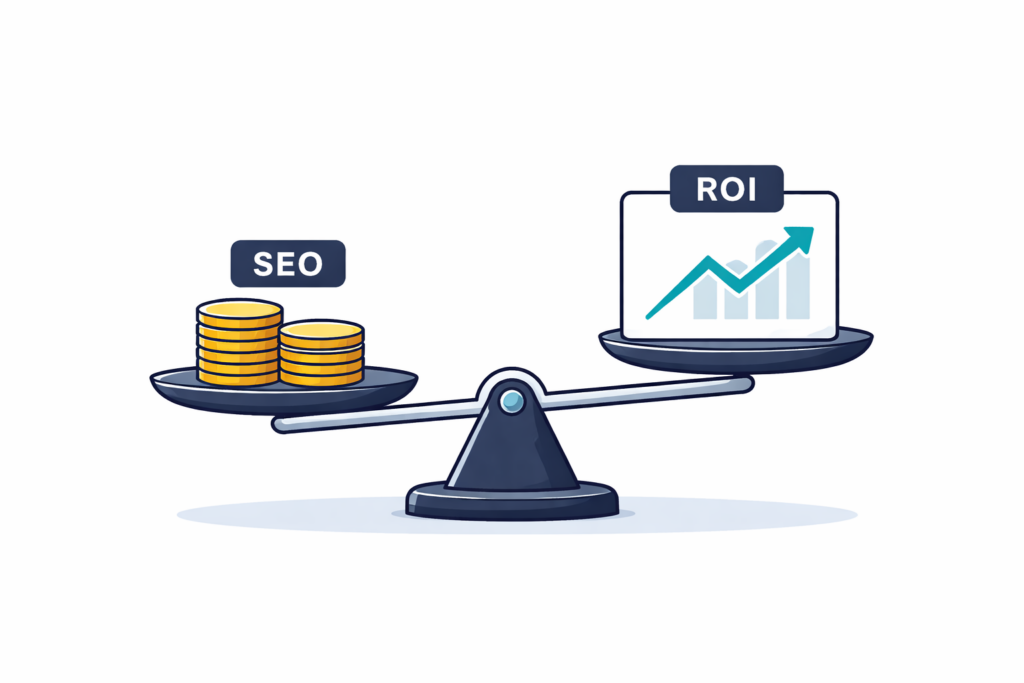
Almost every business should be doing SEO. The real question is how much you should be spending on it. Most small-to-medium businesses investing in professional SEO pay between $1,500 and $5,000 per month, but that number only makes sense when the ROI justifies it. At TJ Digital, we work with businesses at every stage, and after managing roughly 40 AI SEO campaigns, the answer comes down to three factors: how established your brand is, whether people actually search for what you sell, and how competitive your space is. If you’re an established brand with real search demand, you should be investing heavily. If you launched last month and nobody knows what you do, you’d be throwing money away.
The basics are practically free. The more advanced work is where budgets start to matter.
Table of Contents
ToggleWhat SEO basics can you handle without a big budget?
@tjrobertson52 Not every business should be paying for SEO. It depends on 3 things — and most people don’t think about the second one. #SEO #MarketingTips #SmallBusiness #DigitalMarketing
♬ original sound – TJ Robertson – TJ Robertson
Every business with a website should cover the fundamentals, and none of them require a significant investment.
Make sure every page on your site has a unique, keyword-optimized title tag and meta description that clearly describes what the page is about. Use the terms people actually search for when looking for your product or service. If you’re a local business, claim and fully complete your Google Business Profile with your accurate name, address, phone number, hours, and photos. Then actively collect genuine customer reviews. Google Business Profile is the top local ranking factor, with reviews coming in second.
Keep your NAP (name, address, phone) information consistent across local directories like Yelp and any industry-specific sites. Make sure your site loads fast and works well on mobile.
I consider all of this SEO. But none of it requires thousands of dollars a month.
What actually determines your SEO budget?
Three factors dictate how much you should invest, and they’re not equally weighted.
| Factor | Weight | What it means |
| Brand establishment | Highest | Revenue, online authority, industry recognition |
| Search demand | High | Do potential customers go to Google for your product or service? |
| Competitive landscape | Lower | How large and invested are your direct competitors? |
Brand establishment is the biggest factor. The more established you are, meaning higher revenue, stronger reputation, and more online authority, the higher the ROI on your SEO investment. A well-known brand with a long publishing history and frequent mentions from other trusted sources is more likely to appear as a reference in both traditional search and AI-generated answers. That means established brands see faster, better returns from every dollar spent on SEO.
Search demand is the second factor. If your potential customers regularly go to Google to look for the product or service you offer, SEO will be more effective for you. If you offer something novel that people wouldn’t know to search for, or something where people might not trust Google’s results, SEO is going to be less effective.
Competition is the smallest factor. Yes, if your direct competitors are larger brands investing more in SEO, it’s going to be harder. But that’s true for all forms of marketing. And as we move into AI search, it’s getting easier to compete in crowded spaces as long as you can carve out a niche where you’re still seen as the best option.
Is SEO worth it if no one is searching for what I sell?
Traditional SEO relies on existing search queries. If nobody knows to search for your product, you can’t rank for it. In those cases, marketing needs to create awareness first through PR, ads, social media, or content that targets the problem you solve rather than the product itself.
That said, this is becoming less true with AI search. When someone asks ChatGPT or Google’s AI for a recommendation, the model can suggest products the person wasn’t directly looking for. AI assistants infer needs and recommend solutions, even for categories the user didn’t know existed. However, AI agents require structured, high-quality product information. If your product data is missing or unstructured, AI models won’t even consider it.
So even for novel products, the play is to write helpful content around the problems you solve, make sure your brand information is complete and machine-readable, and build a presence that AI models can draw on.
Should you invest in SEO or Google Ads first?
If you’re a brand new startup that just launched a website and nobody knows what you do, you’d be throwing your money away investing in SEO right now. You’re much better off running Google Ads or social media ads. Or, if you have the knack for it, organic social media through short-form video.
Google Ads provide nearly instant leads. Once your campaign is set up and approved, ads can be running within days. That’s invaluable for new brands that need customers quickly. SEO, on the other hand, is a long-term play. Even with best practices, it typically takes months to see real traction.
But you don’t have to choose. If you have the budget, running both is the smartest move. Ads bring in customers now. SEO is an investment in your future. Companies using both channels together consistently outperform those relying on just one.
| Strategy | Best for | Timeline | Cost structure |
| Google Ads only | New startups needing leads now | Days to launch | Ongoing per-click spend |
| SEO only | Established brands with authority | 3-6+ months for traction | Monthly retainer, compounding returns |
| Both combined | Mid-stage businesses with budget | Immediate + long-term | Higher upfront, best long-term ROI |
How long does it take to see results from SEO?
SEO has always been unpredictable, but the timeline is getting shorter.
In traditional search, most websites see noticeable gains in 3-6 months, with strong results often taking 6-12 months in competitive niches. Early technical fixes can show up in a few weeks, rankings often start moving in 1-3 months, and real traffic and lead impact typically follows in 3-6 months or more.
In AI search, results are coming faster. AI citation visibility can show early signals within 60-90 days, compared to the 6-12 months that traditional ranking gains typically require. We’re seeing meaningful results in AI search in about three months, versus the six to twelve month window that used to be standard.
But it’s still unpredictable. More predictable than organic social media, but unpredictable nonetheless. If you can’t afford to wait three months or take on that risk, and you need customers right now, advertising is probably a better use of your budget.
When does it make sense to hire an SEO agency?
Hiring an agency makes sense when three conditions are met:
- Your traffic and revenue have grown enough that organic leads are meaningful to your business. Agencies typically charge thousands per month. Market averages run roughly $1,500-$5,000 per month for small-to-medium businesses, with higher-end programs reaching $10,000 or more. That spend needs to be justified by the return in leads and sales.
- Your internal team can’t keep up. When SEO keeps getting pushed back by busy staff or gets done haphazardly, that’s a signal to bring in professionals. Complex technical audits, large-scale content production, and link-building campaigns require specialized skills.
- You have the budget. Typically several thousand dollars per month to invest in a full-service strategy.
If you’re a large established brand and people routinely go to Google looking for your product or service, you should absolutely be investing a lot in SEO. It’s the highest-ROI marketing channel available for that profile of business.
How do you compete in SEO against bigger brands?
Small businesses can still win by focusing on niches and specificity rather than going head-to-head with large competitors on broad terms.
- Target long-tail keywords. Ranking for a specific phrase like “how to install mini-split AC unit” is far easier than trying to rank for “air conditioning installation” against national brands. Most large competitors overlook these specific queries.
- Focus on local and specialized markets. If you serve a particular city or niche, optimize for those areas specifically. Create content for neighborhoods, specific demographics, or specialized use cases. National chains tend to ignore these terms entirely.
- Build content authority in your niche. Regularly publish helpful content that addresses your audience’s specific questions. Becoming the go-to resource in a narrow field builds the kind of authority that both search engines and AI models reward.
- Collect reviews and earn relevant links. For local and niche queries, positive customer reviews and a few quality backlinks from relevant local partners or industry publications help your pages outrank bigger sites that lack that specific relevance.
The advantage of AI search is that it breaks queries into dozens of sub-searches. A large brand might dominate the broad category, but if you own the more specific variations, you can still be the one getting recommended.
Does SEO ROI improve as your brand grows?
Yes. Brand authority strongly amplifies SEO effectiveness. Search algorithms and AI assistants now treat brands as entities with trust and history. A recognized brand attracts more clicks, more engagement, and higher conversion rates when it does appear in results. This means every dollar spent on SEO goes further for an established brand than for an unknown one. SEO compounds over time, so the earlier you start building authority, the better your returns become.
Should I start with SEO or organic social media if I have a limited budget?
If your budget is tight and your brand is new, organic social media is a lower-risk starting point. Short-form video in particular requires almost no financial investment and can build brand awareness fast. Once you’ve built some recognition and have steady revenue coming in, that’s when SEO investment starts to make sense. Many of our clients start with video content and then layer on SEO as their business matures.
Is SEO still worth it with AI search taking over?
Yes, possibly more than ever. AI search models pull from the same content ecosystem that traditional search does. The brands that rank well in Google tend to be the ones AI models cite. And AI recommendations convert at a significantly higher rate than traditional search clicks, so even fewer recommendations can drive meaningful business results.
Start building your SEO strategy
Reach out to TJ Digital to figure out where your business falls on the spectrum and what level of SEO investment makes sense for your growth stage.