
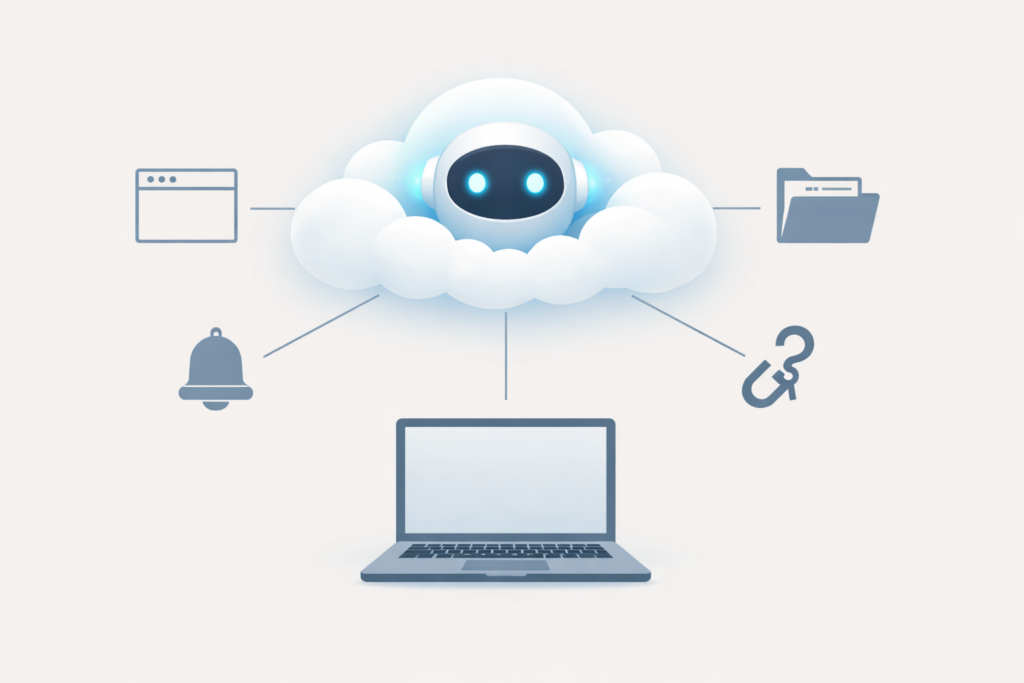
Claude Conway is an always-on AI agent from Anthropic that operates as a persistent, standalone environment inside the Claude app. Unlike traditional chatbots that wait for you to type a prompt, Conway can run in the background, connect to your files and browser, respond to external triggers through webhooks, and accept custom extensions from third-party developers.
At TJ Digital, where we’ve built AI-powered marketing systems for roughly 40 client campaigns, Conway looks like the moment we’ve been waiting for. AI agents are finally reaching the point where they stop being tools you visit and start being team members you work alongside.
Conway is still in testing. Anthropic hasn’t officially launched it yet, and details surfaced through a code leak and subsequent reporting from TestingCatalog in early April 2026. But what we’ve seen so far suggests this could be Anthropic’s most significant product move to date, and a direct answer to OpenClaw, the open-source agent platform that has dominated the agent space in 2026.
Table of Contents
ToggleHow Does Claude Conway Work?
@tjrobertson52 Anthropic just dropped Claude Conway, an always-on AI agent that could actually work like a real team member. Here’s why this matters 👇 #ClaudeConway #Anthropic #AIAgent #AITools #KnowledgeWork
♬ original sound – TJ Robertson – TJ Robertson
Conway opens as a separate sidebar within the Claude interface. Each instance gets its own dedicated window with three core areas called Search, Chat, and System.
The System section reveals the most about what Conway can actually do. Conway can run Claude Code, interact with Chrome through the browser, connect to external services, and send notifications.
It also supports webhooks, which means external apps and services can wake Conway up using public URLs. You don’t have to be sitting at your computer giving it instructions. An event happens, Conway responds.
For anyone running a business, the difference between reactive and proactive AI matters. Most AI tools today are reactive. You open them, you ask a question, you get an answer. Conway is designed to be proactive. It can stay connected to external systems and respond to events without you being involved.
Can You Add Extensions to Claude Conway?
Anthropic is also building an extensions system for Conway. The settings include an area where users can install custom tools, UI tabs, and context handlers by dropping in .cnw.zip files.
Think of it like an app store for your AI agent. Developers can build extensions that expand what Conway can do, and users can install them to customize their instance. This is a big deal because it means Conway’s functionality isn’t limited to what Anthropic builds. The community can extend it.
This approach is similar to how OpenClaw uses “skills” to let users and developers add integrations, but with one critical difference. Conway runs inside Anthropic’s controlled environment rather than on your local machine with full system access.
Why Does Conway Matter for Knowledge Workers?
I own a digital marketing agency, and the moment that companies like ours have been waiting for is when we can fully integrate AI agents just like we would a normal team member.
For this to work, the AI agent needs its own email account, its own Slack account, its own account in our task management system. It needs access to everything our team members have access to, and we need to communicate with it the same way we communicate with our team members.
This has been possible since OpenClaw went viral in early 2026. The problem is that OpenClaw has major security issues and a steep learning curve.
At least 9 CVEs were discovered in OpenClaw’s first two months, and over 42,000 instances were found exposed on the internet. Cisco’s AI security team found that a third-party OpenClaw skill performed data exfiltration without user awareness. One of OpenClaw’s own maintainers warned that if you can’t understand how to run a command line, the tool is too dangerous for you to use safely.
Conway could be the convenient, secure version of that vision.
How Does Conway Compare to OpenClaw?
Both Conway and OpenClaw are designed to turn AI into autonomous agents that can take action on your behalf. But they approach the problem from opposite directions.
| Feature | Claude Conway | OpenClaw |
| Hosting | Cloud-based, runs inside Claude’s interface | Self-hosted on your own machine |
| Setup difficulty | Sidebar toggle (based on leaked UI) | Requires command-line setup and configuration |
| Extension system | .cnw.zip files, curated by Anthropic | 700+ community skills on ClawHub, minimal vetting |
| Security model | Controlled environment within Anthropic’s infrastructure | Full system access, 9+ CVEs in first 60 days |
| Browser control | Built-in Chrome integration | Browser skill with full automation |
| Webhook support | Yes, external services can trigger Conway | Yes, event-driven architecture |
| Messaging channels | Currently limited to Claude interface | WhatsApp, Telegram, Slack, Discord, Signal, iMessage, and more |
| LLM support | Claude models only | 200+ LLM options including local models |
| Cost | Likely tied to Claude subscription tiers | Free software, API costs vary ($6-200+/month) |
| Maturity | Pre-release testing | 247,000+ GitHub stars, active global community |
OpenClaw gives you more flexibility and more integrations. Conway gives you less to worry about. For businesses that need an AI agent but don’t have a developer on staff, Conway is likely the better fit. For technical teams that want complete control and don’t mind the security overhead, OpenClaw remains powerful.
How Is Claude Conway Different from Cowork?
Anthropic already has Claude Cowork, a desktop agent that can take action on your computer. Conway appears to be the next step beyond Cowork.
Cowork requires you to be at your computer to initiate tasks. It can browse, access files, and execute multi-step workflows, but it still operates within a single session. Conway removes that limitation. It’s always on, it can be woken up by external events, and it persists between sessions.
Think of Cowork as an AI coworker who helps when you ask. Conway is more like an AI team member who works while you sleep.
When Will Conway Be Available?
Conway is still in internal testing at Anthropic. It surfaced through a code leak reported by TestingCatalog in early April 2026. Anthropic confirmed the leak was caused by a release packaging error and clarified it was not a security breach.
There’s no official release date yet. Based on Anthropic’s history of moving quickly from preview to launch (Cowork went from announcement to availability in weeks), it’s reasonable to expect Conway in some form within the next few months.
What Should Businesses Do Right Now?
You don’t need to wait for Conway to start preparing. The businesses that will benefit most from always-on AI agents are the ones that already have their systems organized for AI collaboration. That means having a comprehensive brand knowledge base, documented workflows, and clear processes that an agent can follow.
At TJ Digital, our entire operation is built around this principle. Every client gets an AI brand ambassador that contains everything about their business, their voice, their services, and their competitive landscape. When Conway or a similar always-on agent becomes available, plugging it into that system will be straightforward because the foundation is already in place.
The companies that wait to build these foundations until after the tools arrive will be months behind.
How Safe Is Claude Conway?
Based on what we know, Conway runs inside Anthropic’s infrastructure, which is a fundamentally different security posture than self-hosted tools like OpenClaw. Extensions must be explicitly installed, webhooks can be toggled on and off per service, and the browser integration appears to be controlled through Claude’s existing permission model.
That said, any always-on agent that can take actions on your behalf introduces risk. The key questions for businesses will be what data Conway can access, how extension permissions work in practice, and whether Anthropic provides granular controls over what the agent can and cannot do.
Common Questions About Claude Conway
Is Claude Conway the same as Claude Cowork?
No. Cowork is a desktop agent that assists during active sessions. Conway is designed to run continuously in the background and respond to external events through webhooks, even when you’re not using Claude directly.
Can Conway send emails or messages on my behalf?
Based on the leaked code, Conway supports external webhooks and Chrome integration. Specific messaging capabilities will depend on which extensions and connectors Anthropic enables at launch.
Do I need technical skills to use Conway?
Early indications suggest Conway will be accessible through the Claude interface as a sidebar, similar to how Cowork works today. It appears designed for non-technical users, unlike OpenClaw which requires command-line setup.
Will Conway work with tools like Notion or Slack?
Conway’s extension system and connector settings suggest third-party integrations are part of the plan. The .cnw.zip extension format indicates developers will be able to build custom integrations for specific tools.
Start Building Your AI Foundation Now
Conway hasn’t launched yet, but the direction is clear. AI agents are moving from reactive tools to persistent team members. The businesses that are ready for this shift are the ones that have already invested in organizing their brand knowledge, documenting their processes, and building systems that AI can plug into.
If you want to get ahead of this, reach out to TJ Digital. We’ll show you exactly where your business stands and what you should be building now so you’re ready when always-on agents arrive.