
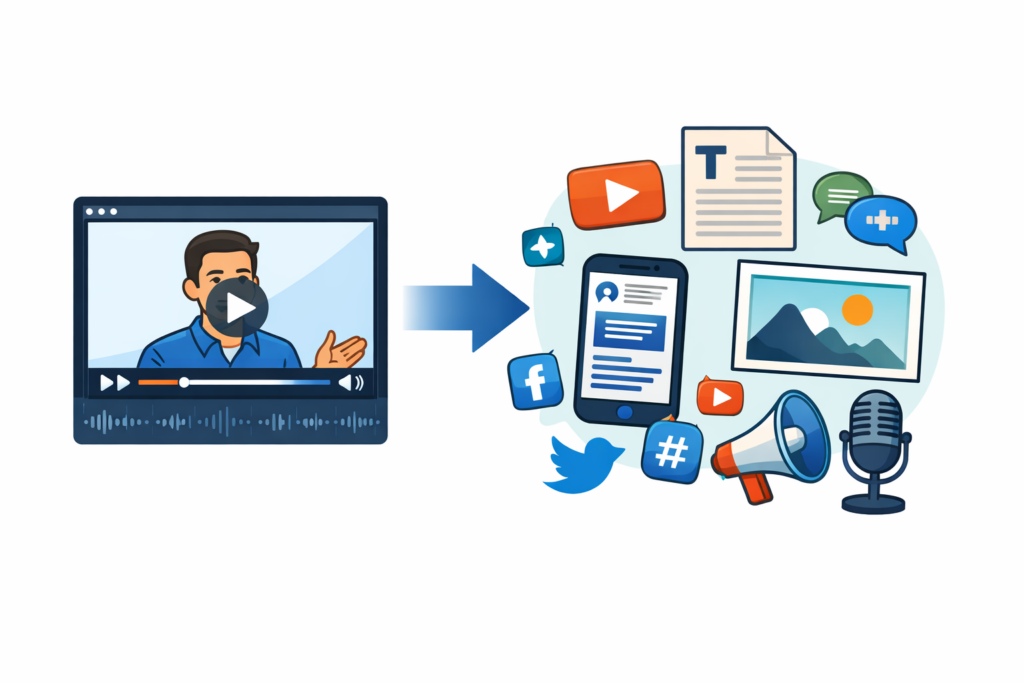
The best free digital marketing strategy for 2026 is a video-first content workflow where you record one short video, then repurpose it into 10 or more pieces of content across every platform that matters. At TJ Digital, we produce roughly 10 pieces of high-quality content from a single 30-minute process. This workflow is the only form of marketing we do for ourselves. It’s also the number one strategy we recommend to every client.
I’ve been developing this workflow for two or three years now, and it works for essentially any business. The catch is that most people won’t do it, because step two requires you to get on camera. But for the ones who stick with it, it works.
Table of Contents
ToggleHow does this content workflow generate leads?
@tjrobertson52 This free 4-step workflow is how we blew up our marketing agency and almost no one does it because step 2 is too scary 😅 Full breakdown here #DigitalMarketing #ContentStrategy #SmallBusines #MarketingTips
♬ original sound – TJ Robertson – TJ Robertson
This workflow generates leads by multiplying your presence across every platform that AI systems search before making a recommendation. By the end of 2026, most product and service searches will be mediated by AI. Google’s AI Mode is replacing traditional results, and platforms like ChatGPT and Perplexity already influence buying decisions. LLMs don’t just pull from one source. They run hundreds of specific sub-queries and recommend whichever business shows up most frequently across those results.
That’s the key insight behind this workflow. Every time you post a video, a blog post, a LinkedIn post, or a Reddit thread targeting the same topic, you create another opportunity to be found. One recording can generate 10 or more indexed assets, all targeting the same hyper-specific question. That kind of coverage is what gets you cited and recommended.
How to find the right content topics for AI search
The first step is topic selection, and getting this wrong makes everything else a waste of time.
The topics you want are the things people search for when they’re interested in your product or service. But here’s the shift. You’re no longer optimizing just for what humans type into Google. You need to know what the AI searches for when a user asks about your category.
Broad keywords are too competitive and too vague for AI citation. What works are hyper-specific questions that mirror how real buyers ask LLMs for help. These follow patterns like the examples below.
- “How to choose the best X for Y”
- “What does X cost in [city/region]”
- “X vs Y for [use case]: what to pick and why”
- “Common mistakes when implementing X in [industry]”
If you’re a local business, make sure each topic references the specific area you serve. A dentist in Henderson, NV shouldn’t target “best teeth whitening options.” They should target “best teeth whitening options in Henderson NV for sensitive teeth.”
We use a product called Peec.ai to see which prompts trigger AI citations and who’s currently getting recommended. If you’re just starting out, you can brainstorm with Gemini for free. Ask it to generate the questions a potential customer might type into ChatGPT before buying your product or service. Then validate those topics against what you’re actually hearing in sales calls, support tickets, and proposals.
How to record a business video in under 20 minutes
This is where most people quit.
You need to record a video, and yes, you personally need to be in it (or a subject matter expert from your team). But don’t overthink it. I recommend spending no more than 20 minutes per video. I have a full guide on making marketing videos for business that walks through the setup.
The key is eliminating setup time. Use a fixed camera, fixed lighting, fixed mic, and the same background every time. The only variable should be the topic.
What structure should your video follow?
Structure each video like an answer.
- One-sentence answer. State the direct answer to the topic question right at the top. This is the sentence AI systems are most likely to extract and cite.
- Criteria or steps. Walk through the supporting details. What to consider, what order to do things in, what most people get wrong.
- Example from your experience. Share a real client story, a project outcome, or something you’ve tested firsthand. This is your experience signal, and it’s the thing AI can’t replicate.
- Call to action. Tell viewers what to do next. Download a checklist, book a consultation, watch the next video.
Prioritize audio quality over video quality. Viewers will tolerate an average-looking video, but bad audio makes people leave. If you’re going to invest in one upgrade, make it a better microphone.
One more thing. Speak in clean, complete sentences. Avoid excessive tangents. State product names, locations, and use cases out loud. This protects the transcript quality, which directly affects how well the rest of the workflow performs.
How to turn a video transcript into blog posts and social content
Once the video is recorded, transcribe it and use the transcript as the foundation for all your written content.
I recommend using Claude to write the blog post, but any of the major models will work. The important part is that the transcript is your source of truth. You’re not asking AI to generate opinions. You’re asking it to take your spoken words and restructure them into a well-organized article.
Here’s the process we use at TJ Digital.
- Run the transcript through Gemini to identify the questions answered in the video.
- Feed those questions to ChatGPT’s deep research mode to collect supporting data, stats, and citations.
- Give the transcript, the research, and your article writing guidelines to Claude to draft the blog post.
We do this inside a Claude Project that already contains our brand guide, our SEO writing guidelines, and a list of every internal page on our website. The whole process takes about 30 minutes from transcript to published draft. If you want to learn more about this, I wrote a full guide on building a content machine.
Beyond the blog post, take that same transcript and create additional content for other platforms.
- A LinkedIn post (insight + implication format, keep it under 3,000 characters, front-load the hook)
- A Reddit post (community-first, no self-promotion, format it as “here’s a checklist I use” or “here’s what I’d do in your situation”)
- A Substack or newsletter edition (editorial tone, not marketing copy)
- A post on X, Medium, or any other platform where your audience spends time
For each platform, you just need to show Claude how to do it once. Save that as a reusable skill, and it happens automatically after that.
How to edit and distribute video across every platform
The last step is the video itself. If you recorded following the structure above, editing should take minutes, not hours.
For expert-style talking head videos, the fastest editing approach is text-based editing. Tools like Descript let you edit the video by editing the transcript. You read through the text, delete the parts you don’t want, and the video cuts automatically. It’s the fastest way to go from raw recording to finished video.
If your bottleneck is packaging short clips with captions for TikTok, Reels, or Shorts, CapCut is faster for that specific task.
Once edited, post the video to TikTok, YouTube, Instagram, Facebook, and LinkedIn. Start the title, caption, or post on every platform with the topic question. Now every time a person (or more likely, an AI) searches for that topic, you have 10 or more opportunities to show up in the results.
Why does a video-first strategy work for small businesses?
A video-first strategy works because it creates a high-trust, high-leverage source of truth that feeds every other content channel with authentic expertise. One 20-minute recording gives you more usable marketing material than most businesses produce in a month.
| Advantage | Why It Matters |
| High-trust format | Video shows a real person with real expertise, which is exactly what AI and human audiences use to evaluate credibility |
| One input, many outputs | A single 20-minute recording produces blog posts, social content, short-form clips, and newsletter material |
| AI citation surface area | Each piece of published content is another asset that AI systems can retrieve and cite when recommending businesses |
| Low cost | The only requirement is a phone, a microphone, and a free AI tool. No ad spend required |
| Compounds over time | Every video adds to a growing library of indexed content, making your business harder to ignore |
This approach is especially effective for small businesses because the expertise is visibly embodied by a real person. Transcript-driven repurposing preserves the expert’s voice, which means the content doesn’t read like generic AI output. That matters more in 2026 than ever, because Google actively penalizes scaled, low-value content while rewarding pages that demonstrate genuine experience.
How should you measure success with this workflow?
Don’t stop at views and traffic. Track two parallel scoreboards.
AI visibility. Are you being cited and recommended for prompts that map to purchase intent? Traditional analytics can’t see this well, which is why tools like Peec.ai exist. They track how AI systems like ChatGPT, Perplexity, and Google’s AI Mode mention, cite, and recommend your brand.
Pipeline impact. Video form fills, lead magnet conversions, and downstream CRM outcomes. Wistia’s research on embedded email collectors found that roughly 1 in 4 viewers fill out a lead form when they encounter one inside a video. That’s a conversion rate most landing pages would love to have.
The combination of these two metrics tells you whether your content is actually generating business, not just getting impressions.
What are the most common mistakes with this strategy?
Going too broad on topics. “Digital marketing tips” will never get you cited. “How to choose a digital marketing agency for a dental practice in [city]” might. The more specific, the better.
Refusing to be on camera. The entire workflow depends on authentic human expertise captured on video. AI-generated scripts read by a faceless voiceover won’t build trust or earn citations.
Overproducing the videos. If you’re spending more than 20 minutes per video, you’re overcomplicating it. The goal is consistency, not cinematic quality.
Skipping the repurposing step. The video alone is valuable, but the real leverage comes from distributing the same content across every platform. One video should become 10 assets, minimum.
Publishing AI-generated content without your voice in it. Google’s guidance on this is clear. Using AI to mass-produce pages without adding unique value may violate their spam policies. The transcript grounds the content in your actual expertise, which is what keeps it safe and effective. I cover the types of blog posts that actually work in a separate guide.
Frequently asked questions about this content workflow
How often should I publish content using this workflow?
Once per week is the pace I recommend for most businesses. That gives you roughly 40 to 50 videos per year, each producing 10 or more content assets. Weekly consistency matters more than volume. Publishing four solid pieces per month will outperform publishing 20 low-effort posts.
Do I need expensive equipment to start?
No. A smartphone and a decent microphone are enough. You can get a clip-on lavalier mic for under $30 that will dramatically improve your audio quality. Most of the tools involved in the repurposing step, including Claude, Gemini, and Descript, offer free tiers that are sufficient to get started.
How long does it take to see results from this strategy?
Most businesses start seeing traction within three months of consistent weekly publishing. AI citation results can take longer because LLMs update their training data and retrieval indexes on different schedules. The key is that every piece of content you publish is a permanent asset that continues working for you.
Can I hire someone to be on camera instead of doing it myself?
Yes, as long as that person has real expertise in your business. The whole point of the video is to capture authentic knowledge and experience that AI tools can’t fabricate on their own. A marketing intern reading a script won’t produce the same results as a subject matter expert speaking from experience.
Start with one video this week
You don’t need a studio, a team, or a budget to start this. You need a phone, a topic from your list, and 20 minutes. Record the video, transcribe it, and turn it into a blog post and a couple of social posts. Do that once a week for three months and watch what happens.
If you want help building this workflow for your business, or if you want us to handle the repurposing for you, reach out to TJ Digital. We’ll show you exactly how we’d set it up for your brand.