
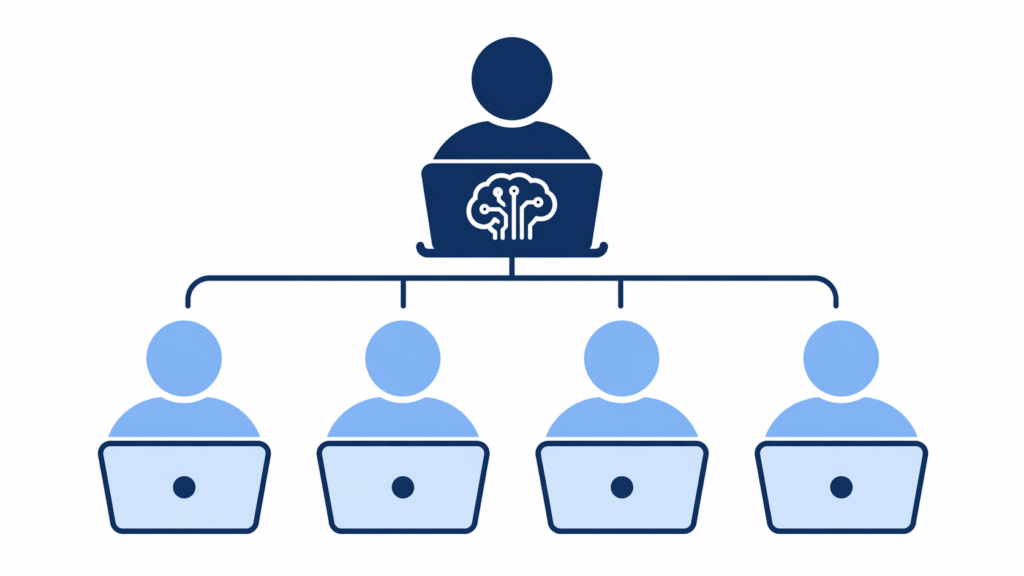
Everyone in your organization needs to be using AI. Only a small group needs to keep up with it.
Those are two different things, and conflating them causes real problems.
At TJ Digital, AI runs through every part of our workflow. It lets us deliver roughly four times the workload at the same rates. That ratio only works because we made a deliberate decision about who spends time building AI systems and who focuses on running them.
Table of Contents
ToggleDo All Employees Need to Use AI?
@tjrobertson52 Stop telling your whole team to “keep up with AI.” Everyone should be USING it — but keeping up with it is a full-time job. You want 10-20% of your team building AI workflows. The rest? Focus on what humans do best. And if you don’t have someone who’s already obsessed with AI on your team, hire an agency. #AIStrategy #AIForBusiness #businesstipsandtricks #AIWorkflows
♬ original sound – TJ Robertson – TJ Robertson
Yes. If your team is doing reporting, content creation, strategy analysis, or presentations without AI, that is a problem. The efficiency gap between people who use these tools and people who don’t is growing.
Using AI will become at least as important as knowing how to use a computer. That’s not an exaggeration. It’s just where things are heading, and businesses that treat it as optional will feel that soon enough.
This applies to every role. Your account managers, writers, analysts, and salespeople should all be running AI tools as a basic part of their day. If they aren’t, they’re working harder than they need to and producing less than they could.
Why Keeping Up With AI Is a Completely Separate Job
Here’s where most businesses overcorrect.
They watch the AI space move fast, they panic, and they try to get everyone on the team tracking every new model release and capability update. That approach is exhausting and produces almost nothing useful for most people.
Paying attention to what models can do this month that they couldn’t do last month, and figuring out how to update your systems accordingly, is a full-time job. It doesn’t make sense to have your entire team spending time on that.
Most of your people should be focused on their actual work. A small group should be focused on making sure AI is being used as effectively as possible to support that work.
What the AI Workflow Builder Role Actually Looks Like
For each major function in your business, you want at least one person whose job is figuring out the best way to use AI for that function.
This person stays current on tools like Claude Code and Claude Managed Agents. They know how to build skills and set up workflows. They train the rest of the team on how to use those workflows.
The key word is “use,” not “build.” When I set up an AI workflow at TJ Digital, the end result is a five to ten minute SOP I can hand to a teammate. It shows them how to open Claude, select the right skill, and Claude guides them through the rest of the process from there. They don’t need to understand how the workflow was built. They just need to follow the steps.
The complexity lives inside the workflow, not in the person running it. That’s the goal.
Everyone else on the team needs to be comfortable using these tools. They need to understand what AI can and can’t do. Beyond that, you want their time focused on the things humans still do best.
How Many People Should Be Building AI Systems?
BCG’s research on AI adoption found that organizations capturing the most value allocate roughly 10% of effort to algorithms, 20% to technology infrastructure, and 70% to people and processes. The technical work is a small slice of the total, but it has to be done right.
In practice, this might mean 10 to 20 percent of your team builds AI workflows and the other 80 to 90 percent runs them.
That ratio changes depending on your business size and how deeply AI can be applied to your core work. The underlying principle stays the same. You don’t need everyone to be an AI engineer. You need a small group who actually are.
How Do You Find the Right Person for This Role?
This is where most businesses get stuck.
They look around their team and try to decide who should own AI development. In my experience, if you have to ask the question, you probably don’t have that person yet.
The people who are good at this work are already obsessed with it. They’re already experimenting with new tools on their own time. They’re already thinking about how to automate things. You don’t need to convince them to get interested. You just need to give them more room to do what they’re already doing.
Forcing someone to become interested in AI doesn’t work. You can train someone to use a tool. You can’t train someone to be the kind of person who stays up at night reading about it.
Look for curiosity and a habit of tinkering. That’s the real tell.
Should You Hire an AI Specialist or Work With an Agency?
If you don’t have that person internally, you have two options. You can hire someone, or you can work with an agency.
| Hire in-house | Work with an agency | |
| Time to see results | 6 to 12 months | Weeks |
| Cost structure | Salary, benefits, onboarding time | Monthly retainer |
| Long-term knowledge ownership | Yes, once fully ramped | Requires deliberate transfer |
| Customization depth | Deep over time | Depends on agency quality |
| Main risk | Long ramp, potential wrong hire | Vendor dependency |
For most businesses right now, working with an agency is the faster path. Hiring the right AI specialist is a slow process. The search takes time. The ramp-up takes more. With how quickly this space is moving, most businesses can’t absorb a six to twelve month delay before they start seeing results.
Long term, if your business is large enough to justify it, having someone in-house is the right move. They can take what an agency helped you build and keep extending it. They accumulate institutional knowledge that stays inside the company.
Short term, an agency that has already built these workflows and processes can get you moving immediately.
What Should You Look for in an AI Agency?
If you’re evaluating agencies, the most important question is whether they actually use AI in their own operations and whether they’re transparent about it.
A lot of agencies have adopted AI tools internally to cut their costs without passing those savings to clients. Others haven’t meaningfully changed how they work at all. Neither of those is what you want.
At TJ Digital, AI runs through everything we do, and we’re open about that. We start every new engagement with a Two-Week Strategic Assessment, which gives us a full picture of your current position before we recommend anything. It’s a good way to understand what’s actually worth doing before committing to a longer campaign.
If you want to start with something lower commitment, we also offer a free digital marketing audit. Request yours here.