
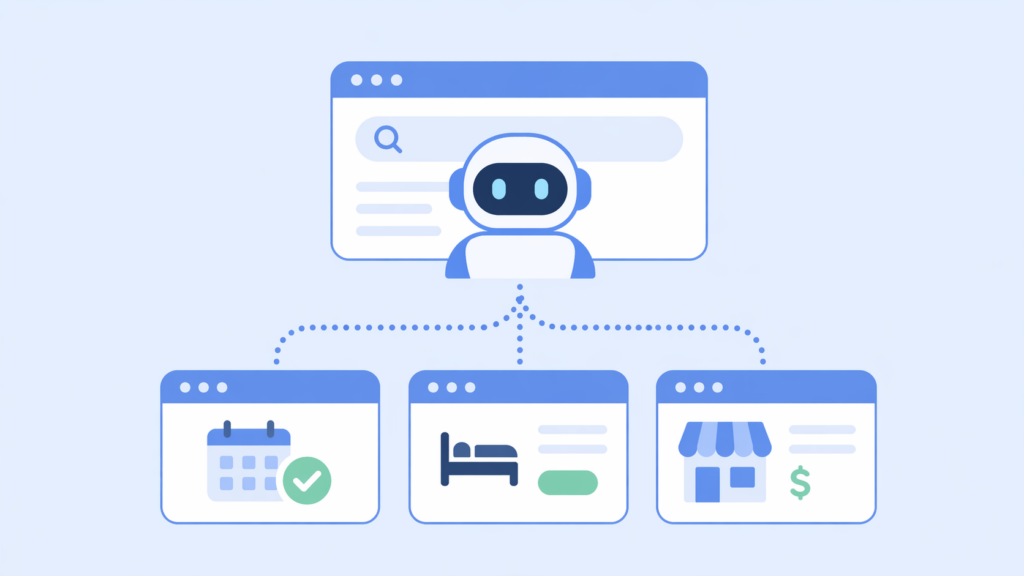
Google is evolving from a search engine into an AI agent manager. When someone searches, Google will spin up agents to complete tasks on their behalf. Those agents will book flights, collect quotes, and check inventory. The businesses they select will be the ones with structured data, accurate pricing, and machine-readable page content.
At TJ Digital, we track AI search visibility for clients across dozens of industries. AI-referred visitors convert at roughly 8x the rate of traditional search visitors. That gap is only going to grow as agents take over more of the search experience.
Table of Contents
ToggleWhat does “AI agent manager” mean for Google search?
@tjrobertson52 Google’s CEO just said search is becoming an agent manager. Agents will book flights, compare prices, and gather info FOR you. Your website’s future audience? AI agents, not humans. SEO isn’t dead, it’s evolving. #SEO #GoogleSearch #AIAgents #DigitalMarketing
♬ original sound – TJ Robertson – TJ Robertson
An AI agent manager means Google doesn’t just return links. It spins up multiple agents to interact with websites directly and complete tasks for the user. Those agents book, quote, compare, and purchase on behalf of the person who searched.
Google CEO Sundar Pichai appeared on the Cheeky Pint podcast and described the future of search in terms that go well beyond AI Overviews. When you enter a query, Google won’t just return results or generate an AI summary. It will spin up multiple agents to interact with websites and complete tasks on your behalf.
Those agents might book a dinner reservation. They might check inventory at several different stores to find your size. They might contact local service providers, collect quotes, and return a comparison.
Google AI Mode is already testing agentic booking in labs, pulling availability from restaurant, event, and wellness booking sites and surfacing real options directly in search. The Have AI Get Prices feature is live for home service businesses, with Google’s AI calling providers to ask about pricing and availability before presenting the user with a comparison list.
This isn’t a distant prediction. It’s already happening for certain queries, and it’s expanding.
How do AI agents interact with websites compared to search crawlers?
Traditional crawlers like Googlebot passively read HTML, follow links, and build an index. AI agents operate differently. They look for things they can do on your site, not just things they can read.
A crawler builds a database of words. An agent executes actions.
The protocol being developed to support this is called WebMCP, an extension of the Model Context Protocol (MCP). MCP is an open standard introduced by Anthropic in 2024 that lets AI systems discover and call external tools and data sources. WebMCP applies that concept to the web. Instead of an agent guessing which form to fill or which button to click, your site declares callable functions and the agent calls them directly.
Without that structure, agents have to reverse-engineer your site. They make mistakes, get confused, and move on to a competitor whose site is easier to work with.
| Factor | Traditional SEO | AI Agent Optimization |
| Primary audience | Human visitors | Agents acting for humans |
| Optimization focus | Keywords, backlinks, content quality | Structured data, machine-readable actions |
| How your site gets read | Passive HTML indexing | Active task execution |
| Key technical format | Meta tags, text content | Schema markup, WebMCP tool contracts |
| Who makes the decision | Human reads results and clicks | Agent evaluates options and recommends |
Why does the AI agent shift matter for your SEO strategy?
SEO matters more now than it did five years ago. The targeting is shifting from human visitors to AI agents, but the core principle hasn’t changed. Make it easy for the right system to find and recommend your business.
For most of search’s history, ranking meant getting a human to click your link. Going forward, ranking means getting an AI agent to select your site as the best match for a user’s request.
The agents making those choices need structured, accurate, machine-readable information. Vague marketing copy won’t get you recommended. Neither will outdated pricing, inconsistent business listings, or content buried behind JavaScript interactions that agents can’t reliably parse.
I’ve been saying for a while that by the end of 2026, Google’s results page will look more like AI Mode than the classic ten-link format. That’s not speculation at this point. It’s the direction Google is building toward openly.
The businesses that start optimizing for this now will be ahead when it becomes the standard. The ones running a 2020 SEO playbook will be trying to catch up while their competitors are already showing up in every agent recommendation.
What should you add to your website to be AI agent-ready?
The most impactful additions are complete schema markup, plain-text pricing, FAQ content, and accurate data everywhere your business is listed online. Here is what each of those looks like in practice.
Complete schema markup. Agents evaluate pages based on how complete and machine-readable their data is. Service details, pricing ranges, hours, service area, and customer reviews all need to be in structured markup, not just written into a paragraph. The more attributes you expose, the more confident an agent can be in recommending you.
Pricing information in plain text. Google’s “Have AI Get Prices” feature calls local businesses and asks about pricing and availability. If your site has no clear price range, you go into that interaction with nothing backing you up. A straightforward line like “Most projects run between $X and $X” makes a real difference. Include that in both your website copy and your Google Business Profile.
FAQ content built around agent queries. Agents frequently scan FAQ sections for direct answers. A well-structured FAQ page that mirrors the specific questions users are asking AI tools about your industry is one of the highest-impact things you can add right now.
Visible, accessible content. Critical information needs to be in the HTML. Pricing, availability, service area, and deliverables should all be visible in plain text, not hidden behind tabs, scripts, or modal pop-ups that agents can’t reliably read.
Consistent data across the web. AI systems build confidence from seeing the same information repeated across multiple sources. If your name, address, phone number, and service area differ between your website, Google Business Profile, and third-party directories, agents treat that inconsistency as a reliability problem. It can remove you from consideration entirely.
A staffed phone line. Google’s AI calling feature marks businesses as unreachable if no one picks up. That’s a lost lead you’ll never know about. Train your team to recognize and respond to AI-driven calls clearly and with accurate pricing information ready.
Will Google replace the 10 blue links by 2026?
The traditional results list isn’t disappearing entirely, but its role is shrinking fast.
AI Overviews already appear above traditional results for a wide range of queries. For factual and informational searches, the AI answer has largely replaced the click. For shopping, local services, and multi-step tasks, Google is building hybrid interfaces where the AI handles the primary answer and organic links serve as supporting sources.
That doesn’t mean organic traffic disappears. AI Overviews still link out to sources. Being cited in an AI answer often drives more qualified traffic than a mid-page organic ranking does. People arriving from an AI recommendation have already been vetted and matched to a solution. That conversion rate difference is significant.
Most businesses will be affected by AI search. The only variable is whether they show up when agents are searching.
Common questions about AI agents and SEO
How is AI agent SEO different from traditional SEO?
They overlap but they’re not the same. Traditional SEO focuses on helping human visitors find and understand your content. AI agent optimization focuses on helping automated systems gather, verify, and act on information from your site. The content still matters, but how it’s structured and how consistently it’s presented across the web carries more weight than it used to.
Does structured data actually affect AI search visibility?
Yes. Agents evaluate pages based on what they can confidently read and act on. Schema markup for services, products, reviews, FAQs, and local business information is one of the most direct ways to improve how AI systems understand and surface your site.
How soon will AI agents be completing transactions directly on websites?
They already do in limited ways. Google AI Mode surfaces booking availability and links users through to checkout. OpenAI’s Operator has demonstrated fully autonomous checkout flows. The capability is expanding, which is why building agent-friendly site architecture now is worth the effort.
What is WebMCP and does my website need it?
WebMCP is Google’s proposed protocol for letting AI agents interact with web-based tools and functions. It’s in early preview. If your site has booking, quoting, or any interactive functionality, it’s worth understanding how it works.
If your current agency is still focused on keyword density and backlink counts while ignoring AI search visibility, we should talk. At TJ Digital, every campaign is built around how search actually works today, not how it worked five years ago. Get a free digital marketing audit and see exactly where your business stands.