
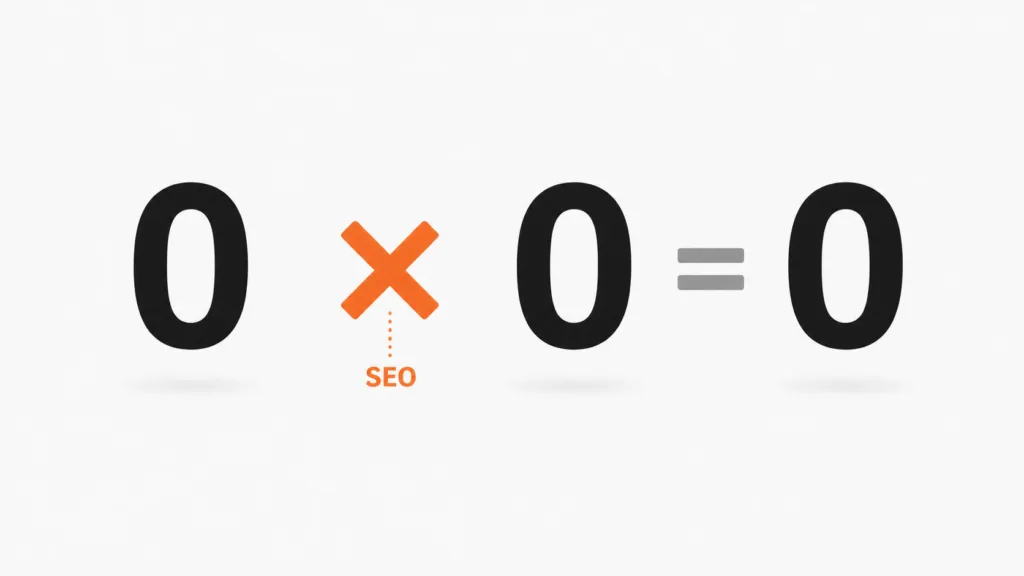
SEO works as a multiplier. If your brand already has traction, demand, and an audience, SEO compounds what you have. If you’re starting from zero, there’s nothing for SEO to multiply.
At TJ Digital, we manage AI SEO campaigns for roughly 40 to 50 clients. The ones who get the strongest results almost always came in with revenue, brand recognition, and clarity on what they sell. The newer ones usually need something else first.
Here’s the short version. If you’re doing under $1 million a year in revenue and you need customers now, SEO probably isn’t your best move. Run ads, make videos, and do founder-led sales first. Build the foundation, then come back to SEO once you have something for it to amplify.
Table of Contents
ToggleWhy SEO Works Like a Multiplier
Anything multiplied by zero is still zero. That’s the framing I keep coming back to with prospects.
Search engines reward signals brands already have. Google’s own ranking systems weigh expertise, source quality, and whether other prominent sites link to or reference your content.
The Ahrefs AI Overview study of 75,000 brands found that the strongest correlations with AI Overview visibility were brand web mentions, brand anchors, and branded search volume. Brands in the top quartile for web mentions averaged 169 AI Overview mentions. The next quartile down averaged 14.
That’s the multiplier effect in numbers. Visibility accrues to brands that already have visibility. If you don’t have any of those signals yet, an SEO campaign is going to spend months building them slowly while your business waits for traffic.
@tjrobertson52 SEO is a multiplier—anything times zero is still zero. New brand? Run ads first. Here’s why most agencies won’t tell you this. #SEO #MarketingTips #StartupAdvice
♬ original sound – TJ Robertson – TJ Robertson
What Should a New Business Do Instead of SEO?
Run ads. Create videos. Talk to customers directly.
About once a week, someone reaches out to me and says they just launched, they’re finishing their website, and they want to dominate search. I tell them the same thing every time. SEO is fine to think about. Don’t prioritize it.
Paid ads do what new businesses actually need. Google Ads typically reviews ads within one business day, and once they’re approved they start running. WordStream’s 2025 benchmarks across more than 16,000 campaigns showed an average search ad conversion rate of 7.52% and a cost per lead of $70.11. Paid ads cost money, and they also run within a day, give you real performance data, and put the budget fully under your control.
Video is the second lever. Wyzowl’s 2026 survey found that 82% of marketers say video gives them a good ROI and 85% say it helps generate leads. Short-form video came out as the highest-ROI media format in HubSpot’s 2026 marketing data.
The format does two things at once. It builds the brand signals SEO will eventually multiply, and it creates direct demand right now.
Founder-led sales is the third lever. Y Combinator’s early-stage advice has been the same for years.
Recruit your first users manually. Charge them. Learn what to build.
None of that is glamorous. It’s how almost every successful business gets started.
When Does SEO Actually Pay Off?
When you have something for it to multiply.
That usually looks like one of three situations.
- An established brand with people already searching for your name and your category
- A business with real revenue, message clarity, and the budget to wait three to twelve months for compounding returns
- A founder who understands the timeline, has cash flow from other channels, and is willing to treat SEO as a long-term bet
If none of those describe you yet, the math doesn’t work. Search Engine Land’s 2026 data shows SEO typically takes three to six months for measurable movement and six to twelve months for significant ranking and revenue impact in competitive industries. A serious SEO retainer at $1,500 to $5,000 a month is a real investment to make against a payoff window that long.
Once you’re past that threshold, my experience across roughly 40 client campaigns is that SEO produces a strong ROI about 90% of the time, often within the first few months. Those campaigns produce results because the brand finally has the signals SEO can compound.
For a deeper breakdown of how the math works at different revenue levels, I wrote a separate piece on how much to spend on SEO each month.
Should You Wait Until $1 Million in Revenue Before Hiring an SEO Agency?
This is the heuristic I give most business owners. Don’t make a serious SEO investment until you’re doing about $1 million a year in revenue.
Other SEOs hear this and think I’m crazy. SEO can absolutely work below that threshold. It’s just unpredictable, the timeline is long, and a $2,000 to $3,000 monthly retainer takes up a meaningful slice of a small business’s marketing budget.
Gartner’s 2025 CMO Spend Survey put marketing budgets at 7.7% of company revenue, which would be about $77,000 per year on $1 million in sales. A $30,000 to $40,000 SEO retainer eats most of that before you’ve spent a dollar on ads, creative, or sales support.
Treat the heuristic as a sanity check. Below $1 million, an SEO retainer can absorb too much of your total budget and starve the channels that actually move customers in the door. Above $1 million, SEO becomes one growth lever among several instead of a make-or-break gamble.
There’s an exception for businesses with strong local intent. Keeping a Google Business Profile current, claiming local citations, and getting basic on-page work done is cheap and worth doing immediately. That work is separate from committing to a twelve-month SEO retainer.
| Revenue Stage | Recommended Approach |
| Pre-revenue or under $250K | Founder-led sales, paid ads, organic video. Skip paid SEO retainers. |
| $250K to $1M | Foundational SEO only. Spend the marketing budget on ads and content. |
| $1M to $5M | SEO becomes a strong bet alongside paid acquisition. Most businesses see ROI within months. |
| $5M and above | SEO is usually one of the best long-term investments in the marketing mix. |
Does AI Search Change When to Invest in SEO?
AI search raises the baseline of what every web presence needs to do. The timeline for when SEO pays off hasn’t really changed.
Google’s own guidance says SEO best practices remain relevant for AI features and that pages need to be indexed and eligible to appear in AI Overviews. OpenAI’s publisher guidance says any public site can show up in ChatGPT search if it isn’t blocking the crawler. Every business now needs a crawlable, citable web presence at a minimum.
That doesn’t mean every business needs a full SEO retainer. McKinsey reports half of consumers are using AI-powered search, but BrightEdge’s 2025 data showed AI search was still under 1% of referral traffic while organic search drove the majority of conversions. AI search visibility matters and it’s growing fast. It hasn’t replaced traditional search yet.
The takeaway holds. Get the foundation right early. Make a serious SEO investment when you have a brand worth amplifying.
What Foundational SEO Can a Small Team Do Without an Agency?
A small team can handle the basics without hiring anyone. Focus on these.
- Set up Google Search Console and watch the Performance report. It tells you what queries your site appears for, how many clicks you’re getting, and where you rank.
- Make sure every page is reachable by clicking through from the homepage. For sites under 500 pages, that often replaces the need for a sitemap entirely.
- Write clear, useful titles and meta descriptions for each page. The title should reflect what someone would type into Google to find that page.
- Use internal links to connect related content. Don’t send every link to the homepage.
- Keep your Google Business Profile complete and current if you serve a local market.
- Add structured data where it fits the page (articles, FAQs, products, local business). Google’s documentation has examples for each type.
That stack costs nothing and covers maybe 70% of what most small businesses need to be discoverable. If you want a more detailed comparison of paid and organic search, I broke that down in Google Ads vs SEO.
Other Common Questions About SEO Timing
How long does SEO take to show results?
SEO typically takes three to six months for measurable movement and six to twelve months for significant traffic and revenue impact in competitive categories. Site age, domain authority, and competitive density all affect the timeline. Established sites with content equity often see results faster.
Is local SEO different for new businesses?
Local SEO is one of the few areas where investment makes sense early. Claiming your Google Business Profile, building consistent citations, and ranking for “near me” searches is cheap, fast, and high-intent. That work is separate from a full SEO retainer.
Should I do SEO if I’m already running paid ads?
Yes, once you have data. Paid ads and SEO complement each other well, especially after you’ve identified which keywords actually convert. Use ad performance data to prioritize SEO targets, then let organic search compound visibility over time.
Will my competitors get ahead if I delay SEO?
Probably not. The competitive moat in SEO comes from brand signals, content depth, and backlinks earned over years. Most new competitors don’t establish those during their first year either.
Use that time to build product, revenue, and reputation. Those signals give you a head start when you start investing in SEO.
Get a Free Marketing Audit
Want a straight answer on whether SEO is the right move for your business right now? Request a free marketing audit and I’ll personally review your site and tell you what to prioritize first.