
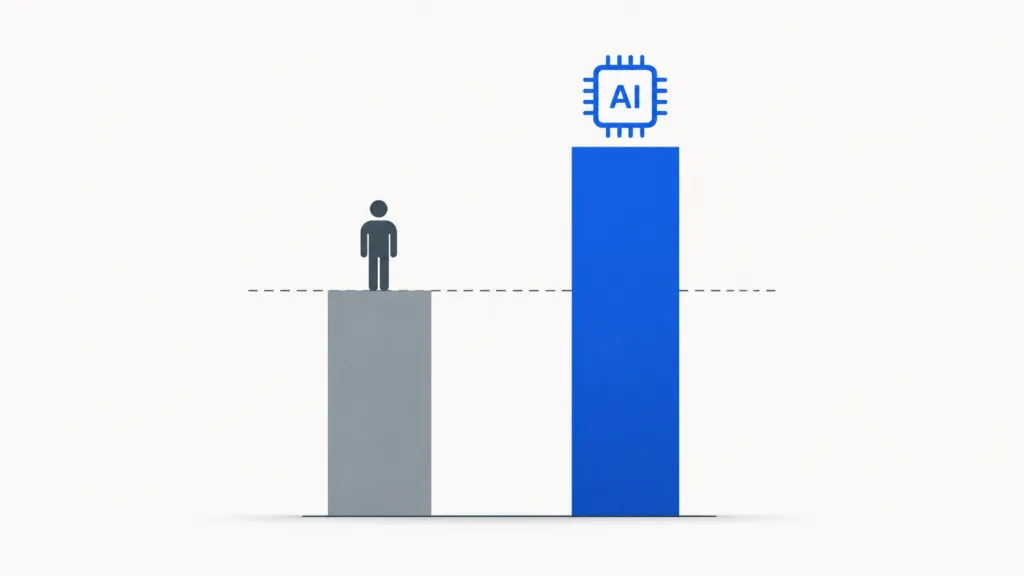
Most reputable companies still aren’t automating much with AI, and the reason is simple: AI that performs at human level isn’t valuable anymore. At TJ Digital, where we run SEO and AI search visibility for around 40 clients, we’ve spent the last year building automation tools for our agency and our clients. The lesson keeps repeating. If your AI tool only matches what a person can do, it has no real value. The bar has moved.
Two years ago, an AI that could draft a competent email or summarize a meeting felt like magic. Today it feels like a cheap version of the human equivalent. Expectations have caught up with capability, and they’re still climbing. So if you’re wondering why every “AI-powered” SaaS pitched to you over the last 18 months hasn’t actually changed your operations, this is why.
Table of Contents
Toggle“About as good as a human” isn’t good enough
When AI does a task at roughly the same quality as a person, customers and employees can feel the seams. The output is technically fine. It’s also vaguely impersonal, slightly off, and obviously machine-generated. Something about it reads as cheap.
That perception is real, and the data backs it up. A recent CIO survey found that more than 70% of managers prefer humans for tasks involving innovation, judgment, or client service. Only 9% would replace their workforce with AI. 62% of business leaders doubt AI can create genuinely new products. 53% say their customers prefer working with humans.
The floor for AI value sits well above human parity. AI now needs to clearly beat a person, or it gets compared to that person and found wanting.
@tjrobertson52 AI that’s “almost as good” is worthless now. The only tools that matter are ones that actually beat humans. 👀 Where do you think the bar lands? #AI #AIAutomation #Tech2026 #AITools
♬ original sound – TJ Robertson – TJ Robertson
The vibe-coded SaaS problem
This is why so many AI startups are quietly dying. The dominant business model in 2024 was: take a workflow, wrap it around GPT-4, slap on a UI, charge $50 to $100 per month. SEO audits, email summarization, contract review, content generation. Hundreds of these tools shipped.
The math stopped working almost immediately. Most of these products are a single API call dressed up in a login screen. A junior developer with ChatGPT and Stripe can rebuild any of them in an afternoon. The big foundation model providers keep eating these features for free. There’s no proprietary data, no real lock-in, and no defensible technology.
Venture investors caught on. According to Baytech Consulting, anything pitched as “ChatGPT with a prettier interface” now gets immediate passes from leading firms. The competitive moat collapsed because the underlying model is a commodity that anyone can rent.
This is what I mean when I say “vibe coded.” You can build something cool over a weekend that does an okay job at a real task. Two years ago that was enough to start a company. Today it’s worthless because someone with real domain expertise is building the version that’s actually better than a human.
What “better than human” actually takes
The interesting tools right now are the ones that beat human performance on specific, well-defined tasks. Those exist. They’re just much harder to build.
Take tax prep. When you ask the best general-purpose LLMs to fill out a U.S. tax return, they hit somewhere between 23% and 42% accuracy. That’s not useful. The specialized system Filed reaches 72.5% accuracy on the same benchmark. Filed gets there through architecture: multiple LLM agents working together, rule-based validation layers, document checks, and engineered handoffs to human reviewers for edge cases. Bigger models alone don’t produce that kind of jump in accuracy.
Coding is another good example. Anthropic’s Claude Opus 4.6 hit 80.9% on SWE-Bench Verified, the first time any model has crossed the 80% threshold on real-world software engineering problems. It outperformed every human candidate on Anthropic’s own internal coding test. Multi-file refactoring, debugging across a codebase, reasoning about architectural decisions. Senior-engineer-level work, done reliably.
The pattern is consistent across the domains where AI is genuinely useful right now:
| What works | What doesn’t |
| Custom architecture (multi-agent, rule-based checks, validation layers) | Single API call dressed as a product |
| Proprietary data and workflows | Generic prompts on top of a public model |
| Domain expertise from the team building it | Generalist developers building “AI for X” |
| Months of iteration on edge cases | Weekend MVPs |
| Better than a human on a specific task | About as good as a human on a broad task |
Real AI value comes from architecture and expertise. The model is the cheap part now. BCG’s research on AI providers makes the same point: as foundational models commoditize, the firms that win are the ones with proprietary data and workflow integration that competitors can’t replicate.
AI has become table stakes
The other shift happening is on the buyer side. Companies are no longer impressed by “AI-powered” anything. They expect it. By 2026, embedded AI agents are projected to be the default in business software. Oracle is calling 2026 the year of operationalizing AI, the point where pilots end and production deployments are non-negotiable.
This changes how SaaS gets evaluated. New tools have to clear a much higher bar than “we added a chatbot.” A summary generator or a basic Q&A bot inside a CRM is now the minimum buyers expect, and pricing it as a premium feature falls flat.
It’s also why so many companies are building AI tools internally instead of buying them. One CIO report on SaaS found that 60% of business leaders are already building custom AI tools, often as shadow IT projects, because the SaaS options don’t fit their actual workflows. SaaS sprawl is real, AI surcharges are real, and at some point the math tips toward building.
2026 is the inflection point
For the last two years, AI has been a story about what’s possible. Demos, pilots, proof-of-concepts. The companies building real automation kept it quiet because the technology was unstable and the use cases were narrow.
That’s changing fast. The models are good enough now that domain experts can build production-grade systems. The cost has come down enough to make the math work. And the expectations have risen enough that companies who don’t build will get out-executed by the ones who do.
If you have real domain expertise and you’re willing to put in the time, the tools you build now will be worth a lot in 12 months. If you’re still trying to wrap a generic LLM around a basic workflow and call it a product, you’re already late.
Build vs. buy: what actually makes sense
For most companies, the question now is whether to build AI tools or buy them. Both have a place.
Buy when:
- The task is generic and your data isn’t a competitive advantage
- A vendor has deeper domain expertise in the specific problem than you do
- You need something running this quarter and don’t have engineering capacity
- The tool is a small piece of your stack, not core to your offering
Build when:
- You have proprietary data that no vendor can replicate
- Your workflows are unique enough that off-the-shelf tools won’t fit
- AI is core to your product or competitive advantage
- You have the engineering practices to maintain it (testing, monitoring, security)
The middle ground, which is where most companies actually live, uses off-the-shelf tools for commodity tasks while building custom solutions for the workflows that matter most. That’s roughly the model we run at TJ Digital, and it’s the one I’d recommend for most service businesses figuring out their AI strategy in 2026.
What this means for you
If you’re a business owner or a SaaS buyer, the practical takeaway is: stop being impressed by AI features in software demos. Ask whether the AI is actually better than a human at the task it’s automating. If the answer is “about as good,” it’s not worth paying for. If the answer is “better, here’s the data,” that’s a tool worth your money.
If you’re a builder, the bar has moved permanently. The next decade of AI value will come from specialized systems built on real domain expertise and proprietary architecture. Generic wrappers are already obsolete. The opportunity is enormous, and the work to capture it is real.
We’re past the easy phase of AI automation. What’s coming next is harder, more valuable, and more interesting.
If you want to talk about how AI fits into your SEO and content strategy, get in touch with us at TJ Digital. We work with clients to figure out where AI actually adds value and where it’s still cheaper and better to use a human.