
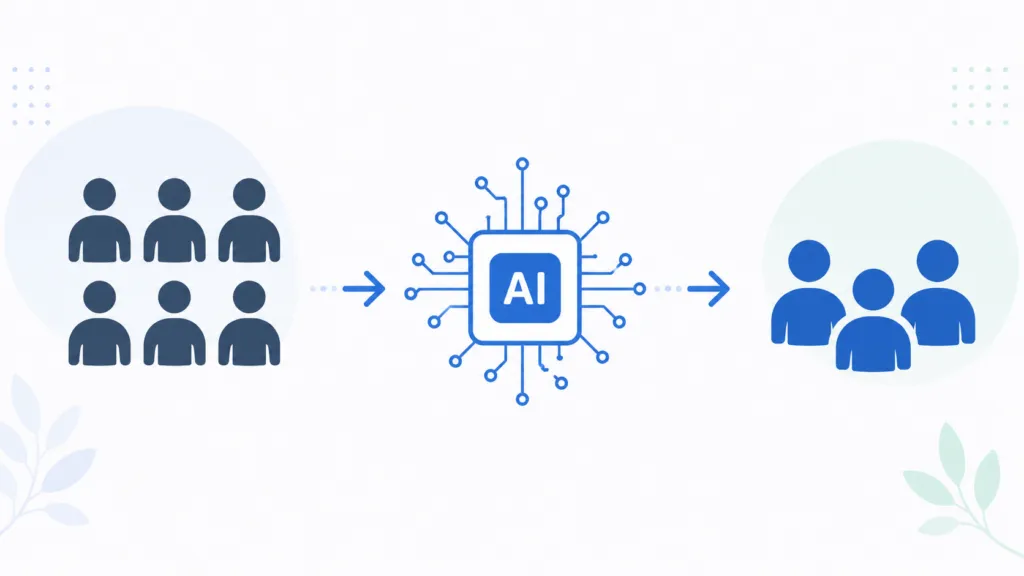
AI is reducing team sizes by letting one person carry workflows that used to need five or six. With strong documentation and AI skills built around the work, two or three people can now do what teams of specialists used to do, and they spend most of their time on what humans do best, like communicating. At TJ Digital, this is how we deliver roughly four times the workload of a traditional agency at the same rates, with a much leaner team.
The shift is not subtle. The companies that rebuild their processes with AI in mind are quietly outperforming the ones that just added AI to their existing workflows. And if you run a small or medium-sized business, the gap between those two groups is going to keep widening for a while.
Table of Contents
ToggleWhy Generalists With AI Are Outperforming Specialists
If you have good communication skills and you know how to use AI, you can do about 80% of white-collar jobs better than an expert at that job could do without those skills. That is not a prediction. That is what the data already shows.
In a 2024 BCG study, 480 consultants used AI to tackle technical data-science tasks. On a coding-based data-cleaning task, the consultants with AI hit 86% of the data-scientist benchmark, a 49 percentage point improvement over consultants without AI. The same study found that participants with no prior coding experience reached 84% of the data-scientist benchmark once they had AI assistance.
Hiring is starting to reflect that. The 2024 Microsoft Work Trend Index found that 71% of leaders would rather hire a less experienced candidate with AI skills than a more experienced one without them. Another 66% said they would not hire someone without AI skills at all.
This does not mean specialists are disappearing. There is still custom work and there are still edge cases that AI does not handle well. But the line for what counts as a specialist is moving, and a lot of work that used to require one no longer does.
@tjrobertson52 If you can communicate well and know how to use AI, you can do 80% of white-collar jobs better than an expert without those skills. Companies are realizing this and teams of 5 or 6 are becoming teams of 2 or 3. One person. One project. Start to finish. No handoffs. 👀 #AItools #FutureOfWork #BusinessTips #ProductivityHack
♬ original sound – TJ Robertson – TJ Robertson
Why Companies Don’t Need Teams of Five or Six Anymore
The companies figuring out how to rebuild their processes with AI in mind are realizing they don’t need teams of five or six people anymore. They need teams of two or three. Just by giving AI the right documentation and a few sophisticated skills, those two or three people can handle the roles of several specialists.
A 2025 Procter & Gamble field experiment makes the case in numbers. With 776 professionals working on real product-innovation problems, individuals using AI matched the average performance of teams without AI, and AI-equipped individuals spent 16.4% less time than the no-AI baseline. One person plus AI can now substitute for what a small team used to deliver.
There is a nuance worth being honest about. The same study found AI-equipped teams were more likely to produce top-decile work than AI-equipped individuals, so if you are chasing exceptional output, well-composed teams still matter. For most everyday work, though, a smaller team with AI ships faster and cheaper than a larger team without it.
Why Bigger Teams Are Less Efficient
It has often been said that a team of three people doesn’t produce three times the output of one person. They produce about twice the output. The other unit of output is paid in coordination tax.
When you reduce team size, you remove the inefficiencies of having to share information, coordinate projects, hop on calls to make sure everyone is on the same page, or wait for someone else to finish their task before you can proceed. The data on white-collar work is brutal on this point. Microsoft’s infinite workday telemetry shows the average worker now receives 117 emails a day and 153 Teams messages per weekday, with interruptions every two minutes during core hours.
Atlassian’s 2024 State of Teams report adds the rest of the picture. Executives estimated only 24% of their teams were doing mission-critical work, and 50% of knowledge workers said they had worked on a project only to discover another team was doing the same thing. That is duplicated effort, status meetings, and constant context switching, all of which scale with team size.
There is also a quieter shift happening inside individual roles. A Harvard Business School study of GitHub Copilot found that once developers had AI assistance, their work moved away from project-management coordination and toward independent core production. The researchers concluded that AI has the potential to flatten organizational hierarchies, which is exactly what smaller, AI-first teams already feel like in practice.
What “AI-First” Process Design Actually Looks Like
When you structure your business for AI first, where AI is handling most of the work, one person can often take a project from beginning to end uninterrupted. That is the whole shift in one sentence. Everything else is implementation.
The trap most teams fall into is treating AI like another app to bolt onto an existing workflow. Microsoft’s 2024 Work Trend Index found that 41% of AI-familiar leaders expected to redesign their business processes from the ground up within five years, which means most of them have not started yet. The companies that win the next two years are the ones that start now.
Here is how AI-first process design actually changes the day-to-day work.
| Workflow Stage | Traditional Team (5-6 People) | AI-First Team (2-3 People) |
| Project ownership | Distributed across specialists | One person owns end to end |
| Daily coordination | Standups, syncs, status meetings | Documented in shared tools |
| Production work | Each specialist contributes a piece | One person produces with AI |
| Quality control | Sequential reviews and handoffs | Human review built into the workflow |
| Internal communication | High volume, frequent context switching | Low, asynchronous, documented |
What makes this work, and the part most teams underinvest in, is documentation. AI is only as good as the context you give it. The teams getting the biggest gains are the ones writing down their brand voice, their processes, their internal rules, and their edge cases in a form AI can use.
That is the moat. The model is commodity. The documentation around the model is not.
Where Specialists Still Matter
I want to be clear about the limits here. There is still room for specialists, and AI can make people perform worse on tasks that fall outside the model’s competence because they end up trusting bad output. Microsoft Research found that higher confidence in AI correlated with less critical thinking, while higher self-confidence in your own work correlated with more.
The specialist’s job is shifting toward quality assurance, exception handling, domain judgment, and deciding when not to trust the model. On routine work inside the model’s strengths, AI lets a generalist hit specialist-level output. On the harder stuff at the edge, the specialist’s value goes up.
Operationally, this means a leaner team with one or two strong generalists and on-call specialists for the hard cases tends to beat a fully staffed traditional team on cost and speed, while matching it on quality.
What This Means for Small and Medium-Sized Businesses
If you run a small or medium-sized business, the practical takeaway is simple. You do not need a five-person marketing department, and you should not be paying an agency that staffs your account like one. The work that justified those headcounts five years ago is now done by AI at a quality level that would have been out of reach for SMB budgets.
The right question to ask any agency or in-house team right now is whether they have rebuilt their process around AI or just added it on top. The first group is producing about four times the work at the same cost. The second group is charging the same and pocketing the difference.
The same logic applies inside your own company. If a workflow takes five people and a stack of meetings to ship, there is a strong chance two people with the right documentation and AI skills could do it faster.
Will AI Replace Specialists Entirely?
No. AI handles routine and mid-complexity work very well, but it underperforms on tasks at the edge of its competence and overconfidence in AI output is a real risk. The specialist role is shifting toward judgment, exception handling, and quality control, not disappearing.
How Small Can an AI-First Team Get?
For most white-collar workflows, two or three people with strong documentation and AI tooling can replace what used to take a team of five or six. Some workflows can be carried end to end by a single person, especially in marketing, content production, and analyst-style work.
Do Generalists With AI Always Beat Teams?
For average and above-average output, the gap is real. For top-decile, exceptional work, well-composed AI-equipped teams still have an edge over AI-equipped individuals. The honest answer is that one strong person plus AI replaces a lot of mediocre teams and beats most average ones, but not the best teams.
What Does an AI-First Marketing Team Look Like?
It looks like a small group of generalists with deep documentation, a clear process, and AI doing most of the production work. At TJ Digital, that is roughly how the agency runs. We deliver about four times the workload of a comparable traditional agency at the same rates, with a much leaner team and full transparency into every task.
Contact us for a free digital marketing audit. We will show you exactly what AI-first marketing changes for a business at your size.