Ranking in AI search is easier than ranking in traditional Google has been for years, and the main reason is simple: almost no one is tracking it. At TJ Digital, we treat AI search visibility as the north star metric for every campaign, and we run daily prompt tracking and citation analysis across ChatGPT, Google AI Mode, and Google AI Overview for every client.
This article walks through why most SEO agencies are still flying blind, why tools like Ahrefs and SEMrush aren’t enough on their own, and how a tracking system built around real customer prompts gives you the data you actually need to win citations.
Table of Contents
ToggleWhy almost no one is tracking AI search yet
When I talk to businesses doing SEO, and even other SEO agencies, they tell me they check AI search visibility manually. They open ChatGPT or Google AI Mode, type in a few queries about their industry, and look for their brand. That blows my mind, because the software to track this at scale already exists and has for a while.
Manual checks miss the point in two ways.
First, they don’t get repeated enough to be useful. AI models are probabilistic, which means the same prompt can return different brands on different runs. A recent study on supposedly deterministic LLM settings found accuracy variations of up to 15% across naturally occurring runs and a best-to-worst gap of up to 70%. A single manual check tells you almost nothing.
Second, manual checks don’t capture the citations behind the answer. The brand that gets recommended in an AI response is the brand whose pages (or pages mentioning them) the model trusted enough to cite. If you’re not tracking citations, you’re not tracking the thing that actually drives the recommendation.
@tjrobertson52 Businesses are manually checking ChatGPT for their brand. There’s software for this and the real insight is in the citations, not the mentions. #AISeo #AISearch #SEOStrategy #GEO
♬ original sound – TJ Robertson – TJ Robertson
Why Ahrefs and SEMrush aren’t enough on their own
To be fair, both Ahrefs and SEMrush have added AI search features. Ahrefs has Brand Radar, which pulls visibility data from a database of 350+ million search-backed prompts. SEMrush has its AI Visibility Toolkit and now supports Position Tracking campaigns for ChatGPT and Google AI Mode. These are real upgrades and we use both at TJ Digital.
The problem is that these tools are built around common, search-backed prompts. The vast majority of queries people send to AI tools are not common. People give AI a lot more context when they search, and even when they don’t, the models pull in everything they know about the user to shape the response. Two people typing similar questions can get completely different answers based on what the model knows about each of them.
That means tracking common keyword-style prompts only captures a sliver of the actual queries your brand is competing in. The bigger opportunity is in long-tail, context-rich prompts that match how real customers describe their actual situation.
How to build a prompt set that reflects real customer behavior
You can’t track every possible AI prompt. There are billions, and most are unique. What you can do is build a representative sample of the prompts that matter for your business.
The framework we use:
- Pick 5 core topics aligned to your products or services
- Add 5 audience or use-case contexts (SMB, enterprise, beginner, location-specific, migration, etc.)
- Layer in 2 intents (recommendation and comparison)
That gives you a 50-prompt starter set. Each prompt should follow this rough pattern:
“I’m in [audience or location] looking for [product or service] to solve [problem]. Can you recommend a company?”
The goal is to simulate the information an AI would have when a real customer asks for a recommendation.
Here’s the difference between a generic prompt and a context-rich one:
| Prompt type | Example | What it tells you |
| Generic (keyword-style) | “best CRM software” | How you rank in a head term most buyers don’t actually search |
| Context-rich (real buyer) | “I run a 10-person agency and need a CRM that works with Slack and HubSpot, what do you recommend?” | Where you stand with the buyers you want to reach |
| Generic (local) | “best plumber Tampa” | A surface-level snapshot |
| Context-rich (local) | “I’m a homeowner in South Tampa with a slab leak and I need someone who can come out today, who do you recommend?” | The exact prompt that drives a real referral |
One more useful data point: a roughly 75% unbranded / 25% branded split is generally the right balance for a starter prompt set. Brands tend to dominate searches for their own name, so over-weighting branded prompts gives you vanity metrics that don’t reflect your real market visibility.
Tracking those prompts daily
Once you have your prompt set, run it across the major AI surfaces (ChatGPT, Google AI Mode, Google AI Overview, and Perplexity if it’s relevant for your industry) on a daily cadence.
We use Peec.ai for this and we’re big fans of their team. Other options include SEMrush’s AI Visibility Toolkit, Ahrefs Brand Radar, and Scrunch. They each have different strengths, but the core capability you need is the same: run a custom prompt library against the major AI engines, repeatedly, and capture both the brand mentions and the citations.
For brand-new tracking, we run prompts 4 times per day for the first couple of weeks to establish a baseline. Then we drop to 1 time per day once the variance is well understood. That matches what Peec recommends and lines up with practitioner research showing that early baselines need repeat runs to be reliable.
This part of the system tells you how visible you are. The next part is where the strategy gets built.
Citations are where the real opportunity lives
The thing that separates a useful AI tracking setup from a vanity dashboard is citation analysis.
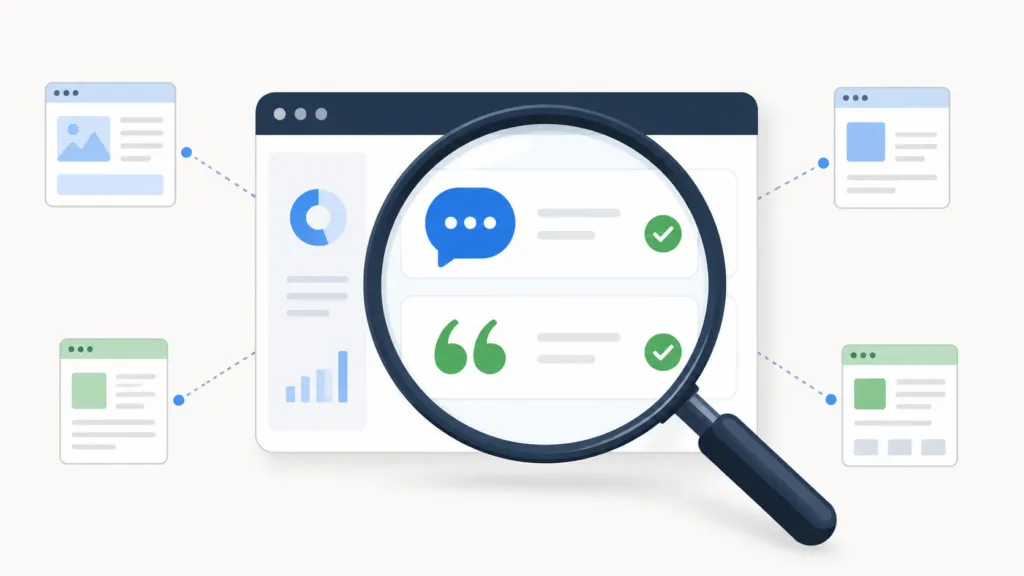
When ChatGPT or Google AI Mode answers a question that includes a brand recommendation, that answer was assembled from sources. Modern tracking tools show you the exact URLs the model cited for each prompt. That’s your actual roadmap. If your brand isn’t being recommended, the citation list tells you which pages are shaping the answer instead.
There are usually three buckets of cited pages, and each one gets a different play.
Pages on competitor sites
You can’t directly change competitor pages. What you can do is build a better version on your own domain, or earn citations on third-party pages the model trusts so your brand starts entering the answer set.
Pages on third-party sites
These are the listicles, review sites, comparison guides, news articles, forum threads, and directories that AI models cite as authoritative third-party sources. You have two options here. The first is editorial outreach: contact the writer or editor and make a case for inclusion. The second, which is almost always easier, is to build a better, more current version of that page on your own site. AI models update citation behavior as new content gets indexed and trusted, and a stronger asset usually wins over time.
Pages on your own site
If your pages are being cited but the answer still doesn’t recommend you, you have an entity or branding gap. The model trusts the content but isn’t connecting it strongly enough to your brand. Tightening the brand references, internal linking, and explicit context on those pages usually closes the loop.
What actually drives AI search visibility
Google has been clear that the same SEO fundamentals still apply to AI features. There’s no special schema, no AI text file, no secret signal to add. The pages that get cited are the pages that are indexed, snippet-eligible, well-structured, easy to crawl, and clearly answer the question being asked.
In practice, that means publishing clearer, more directly answerable content on the topics your prompt research surfaces, and earning presence on the third-party pages your buyers’ models already trust.
That’s why I keep saying ranking in AI search is easy right now. Great SEOs have always done this kind of work. The new ingredient is having prompt-level visibility data that tells you exactly where to focus.
Frequently asked questions
How often should I run AI prompts to track my visibility?
Run them 4 times per day for the first 2 to 4 weeks to establish a baseline, then drop to once per day for ongoing tracking. AI models are probabilistic, so single observations can be misleading.
What’s the difference between a source and a citation in AI search?
A source is any URL the model accesses while generating a response. A citation is a source the model explicitly references in the final answer. Both matter, but citations carry more weight because they’re effectively the model’s vote of confidence.
Can Google Search Console track AI search visibility?
Not cleanly. Google reports AI feature traffic inside the overall Web search type and treats an AI Overview as a single result element, so all links inside that overview share the same position. You can see aggregate impact, but you can’t isolate which prompts triggered AI features or which pages drove a citation.
Do I still need traditional SEO if I’m focused on AI search?
Yes. The fundamentals are the same. Pages that win AI citations are pages that are crawlable, indexable, well-structured, and trusted. Traditional SEO is the foundation. AI search optimization is what you build on top.
What’s a good first step if I want to start tracking AI search?
Build a 50-prompt starter set using the 5 topics × 5 contexts × 2 intents framework, plug it into a tool like Peec.ai or SEMrush’s AI Visibility Toolkit, and run it 4 times daily for two weeks. After two weeks of data you’ll know exactly which pages are shaping the answers in your category, and that’s the input for everything you do next.
Get an AI search tracking system built for your brand
If you’re running an SEO program right now and you’re not tracking AI search visibility at the prompt and citation level, you’re competing in a market you can’t see. At TJ Digital, we set up the tracking, identify the citation gaps, and build the content that wins recommendations across ChatGPT, Google AI Mode, and the rest of the AI search surfaces. Get in touch and we’ll send you a proposal showing what an AI search program would look like for your brand.