Structure your business for 2028 by designing every workflow for AI from the ground up. Then identify where humans uniquely add value and concentrate your best people there. That single mental shift separates businesses that will compound over the next few years from those that get outpaced by AI-native competitors.
At TJ Digital, we built the agency on this principle a little over a year ago. We now deliver about four times the workload at the same rates as a traditional agency. We are at capacity around 42 clients with a 2 to 3 month waitlist.
The temptation is to keep your existing systems and bolt AI onto them. The data already says that approach is failing.
Stanford’s 2026 AI Index reports that 88% of organizations now use AI in at least one business function. Only about a fifth have meaningfully redesigned a workflow around it. The companies that win over the next few years will be the ones rebuilding the work itself.
Table of Contents
ToggleWhy Most Businesses Are Getting AI Integration Wrong
There are two ways most existing businesses are trying to incorporate AI into their work. They are both wrong.
The first is the lazy version. The CEO turns to the team and tells them to use AI more. There is no guidance, no structure, no real system.
People end up using ChatGPT for tasks where it adds five minutes of value. They ignore it for the tasks where it could replace half the work.
The second is the more involved version. The founder looks at every existing process and asks which steps could be automated. That approach sounds rigorous, and it is essentially guaranteed to fail.
Here’s the thing. You are taking a system you already know will be obsolete in two to five years and asking AI to make it slightly faster.
McKinsey’s research is blunt. Layering automation onto legacy workflows produces incremental gains. Real value comes from reimagining the workflow itself around what people and AI each do best.
How to Redesign Your Business Around AI From the Ground Up
Here is an exercise I recommend every business owner go through. It works whether you are starting from scratch or running a 20-year-old company.
Imagine that every part of your business that can be done on a computer is handled entirely by AI. No human in your organization is allowed to touch a keyboard. Then ask three questions about what the AI would actually need to do that work.
@tjrobertson52 Stop trying to figure out where AI fits into your business. Build the whole system for AI, THEN figure out where humans add value. That’s the play. #AIBusiness #BusinessStrategy #AgencyLife #Entrepreneur #AIAutomation
♬ original sound – TJ Robertson – TJ Robertson
What Context Would the AI Need to Do Every Job?
This question maps to your knowledge base. Think about the documents, customer data, brand standards, and historical context an AI would need to do each role in your company.
Most companies fail this test immediately. The information lives in someone’s head, in old Slack threads, and in folder structures only the operations manager understands. None of that is accessible to an AI model.
This is the work we do for every client through our Brand Ambassador. We pull brand information out of the people who hold it and turn it into structured documents an AI can use. The goal is to make company context legible to a machine the same way it would be legible to a smart new hire.
What Tools and Software Would It Need?
Once the AI has the context, it needs the ability to act. That means software with machine interfaces an AI can operate, on top of the user-facing UI a person clicks through.
The emerging standard for this is the Model Context Protocol. It is an open spec for connecting AI systems to the tools and data sources where work actually happens.
If your CRM, project management tool, or content platform can be operated through MCP or a similar machine interface, AI can do real work in them. If they cannot, you have a bottleneck.
Older SaaS tools start to look like liabilities here. They were designed for a person sitting at a screen, and they assume that person is always there.
What Expert Intuition Needs to Be Captured?
This is the question most businesses are ignoring. It is also the most important one.
Every business runs on judgment that lives in a few key people. Think of the senior account manager who knows when to push back on a client. Or the founder who knows which sales lead is worth a phone call.
That judgment is not magic. It is compressed experience and a set of decision rules.
The rules can be extracted, written down, and turned into something an AI can use. Start by collecting examples. Every time you or another expert makes a non-obvious call, write down what you saw, what you considered, and what you decided.
Where Humans Actually Add Value in an AI-Native Business
The goal of this redesign is not to replace humans. I do not plan to replace any humans at TJ Digital. We are still hiring every month.
The starting assumption flips. AI does the work by default. You then go looking for the places where humans uniquely add value, and you concentrate your best people there.
The research backs this up. Studies in Nature Human Behaviour show that people consistently prefer human interaction over AI when the moment involves trust, empathy, or real stakes. They are perfectly fine with AI handling everything else.
Account managers at our agency are a clear example. We could probably automate most of what one does within a few years. Clients do not want that, they want a human running the relationship.
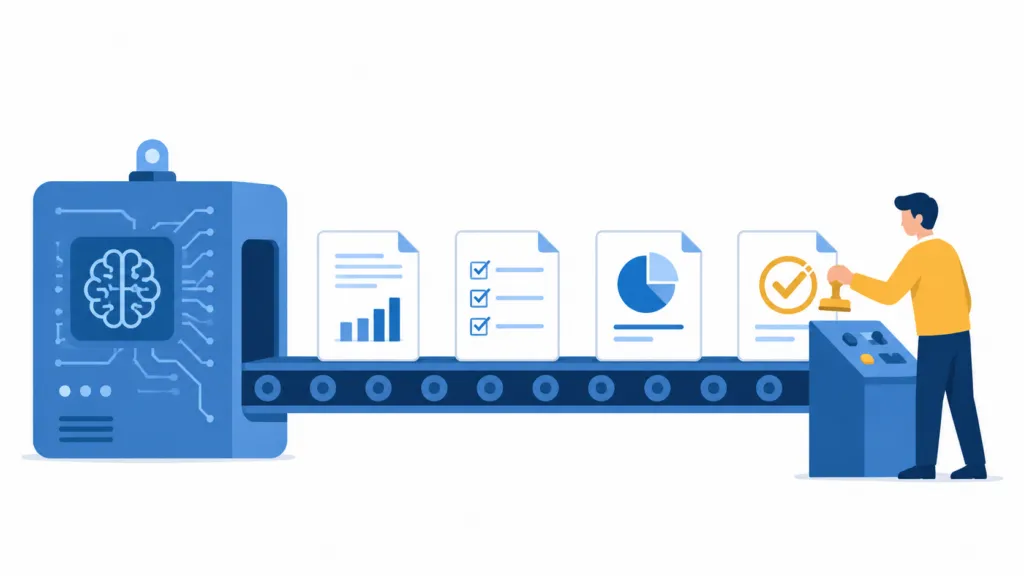
Here is where the economics work. Our AI systems already produce high quality content, plans, and reports at scale. The account manager only needs to add 10 to 20% on top of that to make the engagement obviously worth it for the client.
How Does an AI-Native Business Compare to a Traditional Business?
The differences show up in every layer of the operation. The traditional model treats AI as an assistant. The AI-native model treats AI as the production engine and treats humans as the premium layer on top.
| Workflow Element | Traditional Business | AI-Native Business |
| Default work execution | Humans do the work, AI assists | AI does the work, humans supervise |
| Knowledge base | Lives in heads and scattered docs | Cleaned, structured, accessible to AI |
| Tools and software | Designed for humans clicking buttons | Machine-controllable through APIs and MCP |
| Expert intuition | Tribal knowledge held by senior staff | Documented decision frameworks with examples |
| Where humans focus | Across the entire workflow | Trust, exceptions, relationships, judgment |
| Scaling constraint | Hiring and training new people | Knowledge base coverage and tool integration |
The productivity numbers behind this shift are real. The NBER customer support study found a 14% productivity boost for support agents using AI. The boost climbed to 34% for newer or less experienced workers.
Stanford summarizes the broader pattern across functions. Productivity gains run roughly 14 to 15% in support, 26% in software development, and 50% in marketing output. A small AI-native team can now support revenue that used to require triple the headcount.
What This Means if You Already Run an Established Business
If you have been running your business for years, this advice still applies. It might even apply more urgently.
Mark Cuban put it bluntly. In five years there will be two types of businesses, those doing a really good job of integrating AI, and those that have gone out of business.
The advantage AI-native startups have is that they do not carry process debt. They are not protecting any sunk costs in old workflows. They start from a blank page and ask, given everything AI can do, what should this business be doing now?
You can do the same thing in an established business. The hard part is almost always cultural. Your team has spent years getting good at the current process, and asking them to redesign it from scratch can feel like a critique of their work.
Here is the good news. Established businesses have something AI-native startups cannot manufacture. You have years of customer data, brand history, and expert judgment that can be pulled out of your team’s heads and structured for an AI.
That kind of input is your moat, if you actually do the work to capture it.
How TJ Digital Helps Businesses Prepare for 2028
At TJ Digital, we build AI-native marketing systems for small and medium-sized businesses. Every client gets a Brand Ambassador, an AI project containing the documents that define their brand voice, customer base, services, and competitive landscape. That gives the AI the context it needs to produce content that sounds like the client.
We are open about how we do it. AI handles the production. Humans handle the judgment, the relationships, and the strategy.
Email me at TJ@TJRobertson.com to talk about what an AI-native marketing campaign would look like for your business. You can begin with our Two-Week Strategic Assessment while you wait for an open campaign slot.
What Is the First Step to Becoming an AI-Native Business?
Run the exercise of imagining no human in your company can touch a computer. Then ask what context, tools, and decision frameworks the AI would need to do every job. The first practical step for most businesses is documenting expert judgment, because that is the input AI cannot generate on its own.
Will AI-Native Businesses Replace Human Workers?
Not in the way most people fear. The model redesigns work so that AI handles baseline production while humans concentrate on judgment, relationships, and exceptions. We are still hiring every month at TJ Digital, and we hire for roles where humans uniquely add value.
How Is AI-Native Different From AI-Assisted?
AI-assisted means humans do the work and use AI to speed it up. AI-native means AI does the work by default, and humans step in only where their judgment, trust, or relationship value is required. The two operating models lead to very different cost structures and very different scaling curves.
Can a Small Business Afford to Restructure Around AI?
Yes, and small businesses often have the easiest path because they carry less process debt. The investment is mostly time spent documenting your knowledge and decision frameworks. The tools that connect AI to your existing systems are now cheap or free for most use cases.