
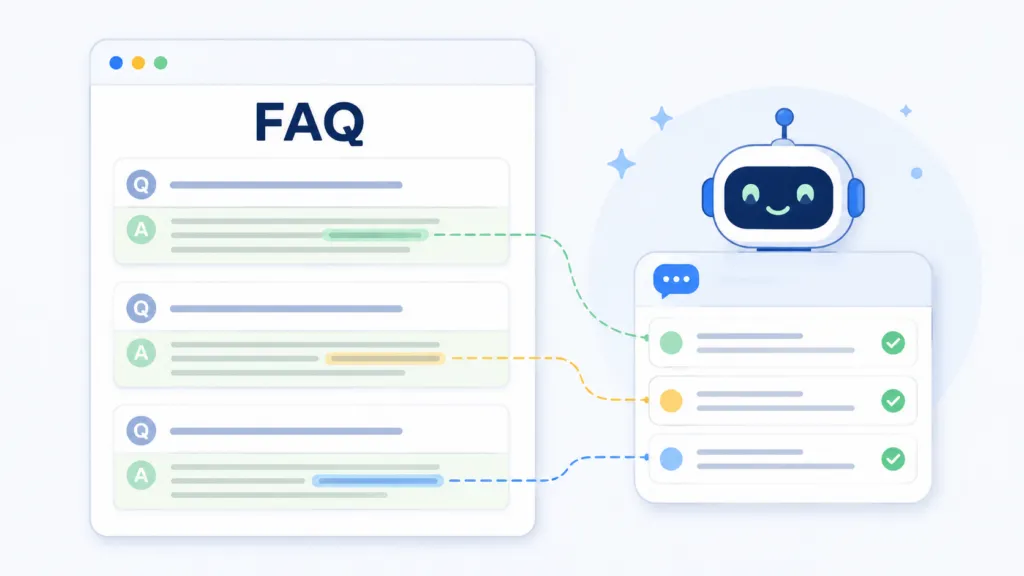
If you want AI tools like ChatGPT and Perplexity to recommend your business, there’s one page you should have on your website. I’m talking about an FAQ page. At TJ Digital, we run AI search campaigns for more than 40 client websites, and the FAQ page is consistently one of the most influential pages we build for AI visibility.
Build it the right way and you can strongly influence how AI describes your business and who it recommends you to.
Table of Contents
ToggleWhat’s the difference between an AI FAQ page and a traditional FAQ page?
The FAQ pages most SEO agencies built before AI search were designed to chase keywords nobody actually searched for in that format. A personal injury firm might list a question like “What should I do after a car accident?” alongside 19 other unrelated ones.
When someone searches that query on Google, the top results are dedicated articles on that exact topic. So traditional FAQ pages with that question buried among 19 others mostly sat there for years doing nothing.
AI search changed the math. ChatGPT and other large language models go to your FAQ page to figure out who you are, how you work, and whether you’re a fit for the person they’re helping. They’re treating your FAQ like a knowledge base about your specific business.
Here’s the simplest way to think about it. AI is a brand new sales rep for your business, and the FAQ page is the briefing document that loads them up with everything they need before they go talk to a customer.
@tjrobertson52 AI literally searches for your FAQ page before deciding whether to recommend you. But the FAQ page most businesses have? Useless. Build one that answers the questions YOUR customers actually ask and watch AI start selling for you 🤝 #SEOTips #SmallBusiness #MarketingHack #AIBusiness #SEO #GEO #AISearch
♬ original sound – TJ Robertson – TJ Robertson
| Old SEO FAQ Pages | AI-Optimized FAQ Pages |
| Built to chase keyword searches | Built to brief AI on your specific business |
| Generic industry questions | Specific questions about how you work |
| Long, fluffy answers for human readers | Short, factual answers (40 to 80 words) |
| Sat unused on most websites | Get cited directly in AI-generated answers |
| Treated as filler content | Treated as a knowledge base |
What questions should an AI FAQ page include?
The questions on your FAQ page should be the ones real prospects ask when they’re deciding whether to hire you. Pull them from your sales calls, support emails, online reviews, and the conversations you have with customers. Look at the questions you answer over and over again.
Once you have the list, throw out any question you can’t answer well. What you’re left with is a mix of softball questions you love answering and common objections where you have a confident, honest response. Then add a handful of questions about your process and how clients work with you.
A few categories worth covering:
- Softball questions that highlight what you do best
- Common objections about pricing, timelines, or results
- Process questions about how an engagement actually works
- Fit questions about who you do and don’t work with
- Outcome questions about what clients can expect
Each answer should be 40 to 80 words. State the direct answer in the first sentence, then add supporting context with concrete details. AI search engines reward specifics and ignore generic marketing claims, so a phrase like “fast turnaround” gets nowhere while “first draft within 5 business days” gets cited.
How does AI use your FAQ page when researching a business?
When somebody asks ChatGPT for a recommendation, the AI checks several places before answering. For local businesses, it usually starts with your Google Business Profile and directory listings. Then it goes to your website to confirm what it found and pick up details that aren’t on a directory.
That’s where the FAQ page comes in. AI tools scan it for direct, specific answers about your business. If the FAQ has a question that matches what the user asked, the AI will often cite your answer almost word for word in its response.
This is why generic FAQ content doesn’t work anymore. AI cross-references what you say across your site, your Google Business Profile, your reviews, and third-party sources. When those sources contradict each other, the AI either skips your business or picks one source at random.
For a deeper look at how AI search works, we break down the full research process AI tools run before recommending a business.
How should you structure an FAQ page for AI search?
Treat your FAQ page like a mini knowledge base. Use clear H2 or H3 headings phrased exactly the way a user would ask the question, grouped under thematic sections like pricing, onboarding, and results. Skip vague headings like “General Questions.”
Every answer should follow the same shape:
- Direct answer in the first sentence
- One or two sentences of supporting detail
- Concrete numbers, process steps, or examples where possible
Add FAQPage schema markup so AI crawlers can read the questions and answers as structured data. It’s a small technical addition that meaningfully increases the chances AI will pull your answers into its responses. We add it to every FAQ page we build for clients.
For more on the broader technical setup, see our guide on structuring your site for AI. And our breakdown on preparing for agentic AI walks through where this is all headed next.
What other questions come up about FAQ pages for AI?
How many questions should an FAQ page for AI have?
Aim for 15 to 30 questions on a single FAQ page. Fewer than that and you’re probably missing common objections. More than that and you’re usually padding with low-value questions AI won’t use anyway.
Should every business have an FAQ page for AI search?
Yes. The FAQ page is the most direct way to shape what AI says about your business. Without one, the AI has to piece together a picture from scattered content across your site, your Google Business Profile, and third-party sources.
How often should an AI FAQ page be updated?
Update it whenever your services, pricing, or process changes. At a minimum, review it every six months and refresh any answers that have gone stale. Outdated answers train AI to give wrong information about your business.
Can you use the same FAQ page for AI and your human visitors?
Yes, and you should. The same clear, specific, well-structured answers that help AI cite your business correctly also help human visitors decide whether to hire you. Writing two separate FAQ pages defeats the purpose.
Need an FAQ page built for AI search?
At TJ Digital, we build AI-optimized FAQ pages as part of every AI SEO campaign, alongside the broader site structure work that gets your business mentioned and recommended in AI search. Get in touch to talk about what your FAQ page should look like.