
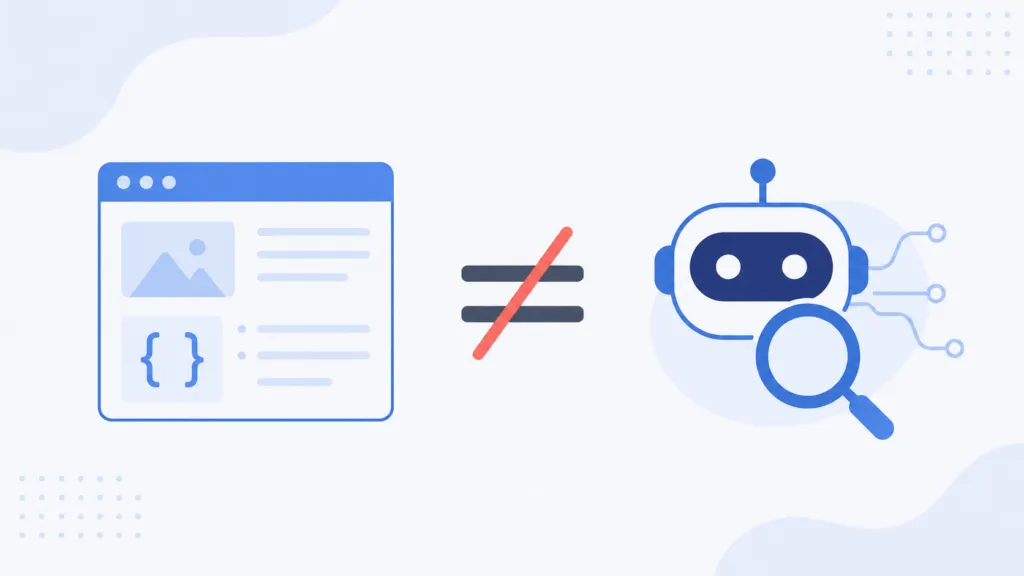
Schema markup does not help you rank in AI search. That’s the conclusion from the first large-scale study on the topic, published by Ahrefs in May 2026. They tracked 1,885 pages that added JSON-LD schema against roughly 4,000 control pages and found no meaningful increase in AI citations on any platform.
At TJ Digital, we run AI search campaigns for over 40 client websites and track thousands of AI-generated responses daily. We’ve never seen structured data move the needle for AI visibility. This study confirms what we’ve been seeing in practice for months.
If you’ve been following advice from GEO influencers on LinkedIn or TikTok telling you to add structured data to rank in AI, the data is now clear. That advice was wrong.
Table of Contents
ToggleWhy Did Everyone Think Schema Mattered for AI Search?
This is probably the most commonly repeated piece of AI search advice out there. “If you want AI to notice you, add structured data to your pages.” And to be fair, there was a surface-level reason people believed it.
An early analysis of 6 million URLs found that pages cited by AI overviews were almost three times more likely to have JSON-LD on them. That looks like proof at first glance.
But Ahrefs understood something the LinkedIn crowd didn’t. Correlation does not equal causation.
Pages with structured data tend to be well-maintained, technically sophisticated websites. They also publish in-depth content, earn lots of links, and have strong domain authority. Schema is a proxy for site quality. Pages that have schema are more likely to be optimized and maintained, and therefore more likely to be cited by AI. That doesn’t mean the schema caused the citations.
@tjrobertson52 Everyone says schema markup = more AI citations. Ahrefs tested 2,000 pages and found… nothing. Correlation was never causation 👀 What do you actually think moves the needle? #GEO #AISearch #StructuredData #SEO2026
♬ original sound – TJ Robertson – TJ Robertson
What the Ahrefs Study Actually Found
Ahrefs identified about 1,885 pages that previously did not have structured data and then added it between August 2025 and March 2026. They measured how often those pages were cited by ChatGPT, Google AI Mode, and Google AI Overviews against a matched control group.
The results:
- Google AI Mode citations: +2.4% (statistically zero)
- ChatGPT citations: +2.2% (statistically zero)
- Google AI Overviews citations: -4.6% (a slight negative correlation)
Adding schema didn’t boost citations on any platform. The differences on AI Mode and ChatGPT were indistinguishable from noise. And Google AI Overviews actually showed a small decline.
The Ahrefs authors put it bluntly. They couldn’t tell whether schema did a tiny bit of good or nothing at all.
| Platform | Citation Change After Adding Schema | Statistically Significant? |
| Google AI Mode | +2.4% | No |
| ChatGPT | +2.2% | No |
| Google AI Overviews | -4.6% | Yes (but very small) |
Does Schema Actually Hurt Google AI Overviews?
The slight negative correlation in Google AI Overviews deserves context. Both the treated pages and the control pages were already losing citations during the study period, likely due to Google adjusting how it uses AI Overviews.
The extra 4.6% gap could reflect unrelated factors like page freshness, recrawl timing, or changes in Google’s topic selection. Ahrefs warns this is not proof that schema is harmful. The absolute difference was only about 12 daily citations on average.
Both groups declined together, and if schema had zero effect, you’d expect nearly identical slopes. The slight extra drop on the treated pages might hint at a tiny downside, but it could just as easily be coincidence.
Adding JSON-LD didn’t improve AI Overview citations. The small negative trend isn’t enough to conclude that schema “hurts” your AI presence.
How AI Models Actually Choose What to Cite
If schema doesn’t drive AI citations, what does? AI answer engines like ChatGPT, Google Gemini, and Perplexity use retrieval-augmented generation (RAG) pipelines. They search the web, retrieve candidate documents, then extract and synthesize answers from them.
Sources are chosen based on content quality and fit with the query. The main factors these systems weigh:
- Domain authority and trust. Established domains with high trust scores, expert authors, and strong backlink profiles get cited more. One analysis found that sites with very high domain trust account for a disproportionate share of AI citations.
- Content relevance. The content has to closely match the query intent. AI systems use semantic embeddings to find relevant passages, so depth and topical coverage matter more than exact keyword matching.
- Freshness. For platforms that use live search (Gemini, Perplexity, ChatGPT’s browse mode), pages updated within the last 30 days earn roughly 3.2x more citations than stale pages.
- Extractability. AI engines favor content that’s easy to parse. Clear, answer-first writing, structured formats, bullet lists, and concise paragraphs all help models pull facts from your page. Declarative sentences without hedging language are easier to cite.
This is something we talk about constantly at TJ Digital. The businesses that show up in AI search are the ones doing the fundamentals well. Strong content, clear structure, fresh information, and real authority signals. There’s no shortcut that bypasses those.
What Actually Gets You Cited by AI
If you want to improve your AI search visibility, skip the schema-first approach and focus on the tactics that have proven results.
- Lead with direct answers. Place the key answer in the first few lines of every section. Front-loading your content yields significantly more citations, especially for smaller domains. Use question-based headings (H2s and H3s) that mirror what people actually ask in ChatGPT or Google.
- Go deep on topics. Longer, in-depth pages that address multiple facets of a topic earn more citations. AI models fan out queries across several angles, so content that covers related subtopics comprehensively is more likely to get picked up. One study found pages averaging around 2,900 words received about 5.1 citations compared to much lower rates for thin content.
- Keep your content fresh. Pages updated within 30 days earn citations at roughly 3.2x the rate of stale pages. If your most important pages haven’t been touched in six months, you’re leaving visibility on the table.
- Build real authority signals. Include clear author bylines with credentials. Cite reputable sources. Get listed on review sites. Maintain active profiles on platforms like Reddit, LinkedIn, and industry directories. AI models interpret widespread brand mentions and expert signals as trust indicators. This is a big part of what we do for clients through our AI citation strategy.
- Don’t forget traditional SEO. If you’re not ranking on page one of Google for a query, AI systems probably aren’t finding you to cite in the first place. Strong SEO makes you eligible for the candidate set. AI optimization makes you stand out within it.
- Structure your content for machines. Use clear heading hierarchies, bullet points for lists, and tables for comparisons. Write self-contained sections where each chunk makes sense on its own. We’ve written extensively about how to structure pages for AI search, and these formatting fundamentals consistently make the biggest difference.
Should You Still Use Schema at All?
Yes. Schema is fine. You just shouldn’t expect it to be the thing that gets you into AI search results.
Schema can help with traditional SERP features (rich snippets, FAQ accordions, recipe cards). It helps machines correctly interpret key data on your pages. Article, FAQPage, and HowTo schema all serve a purpose for general content clarity.
Schema is a supporting tactic, not the main driver. If someone is telling you that structured data is the key to ranking in AI, they’re either repeating advice they heard on social media or they’re trying to sell you something. For those of us who’ve been doing the actual work and running the experiments, this study was no surprise at all.
The truth is, if structured data actually made AI cite your pages more often, it would be really easy to prove. And there are a lot of incentives for people selling these services to prove it. But that data has never emerged. And unless something changes in how these AI systems work, it never will.
We Track AI Citations for Every Client
If you want to understand where your brand actually stands in AI search and which tactics will move the needle for your business, we can help. We track AI citations across ChatGPT, Google AI Mode, and Perplexity for every client, and we build strategies around what the data shows. Reach out to TJ directly to get started.