
Google just released an official guide called “Optimizing Your Website for Generative AI Features in Google Search.” At TJ Digital, where we track over 4,000 AI prompts per day across ChatGPT, Google AI Mode, and Perplexity for roughly 40 to 50 client websites, we’ve already been doing most of what the guide recommends.
The guide is still worth reading, mostly for what Google says you shouldn’t be doing.
The guide starts the same way all of Google’s SEO guidance starts. Write for humans. Create helpful content. Follow Search Essentials.
And while there is some truth there, it implies that their systems can read content and understand if it’s helpful. That’s not entirely true. I didn’t find any of the guidance on what you should be doing particularly useful.
The real value is in what they told us not to do. Because when Google warns you against a specific tactic, it’s usually because that tactic works well enough to be a problem for them.
Table of Contents
ToggleWhat Does Google’s Guide Say About AI Search?
The core message is simple. Generative AI features are built on the same ranking systems as regular Google Search. In Google’s framing, what people have been calling AEO and GEO is “still SEO.”
Focus on helpful content, clean technical SEO, and you’re covered.
That framing is partially true. Pages still need to be indexed and crawlable. You still need clear headings, logical structure, and well-written content. None of that has changed.
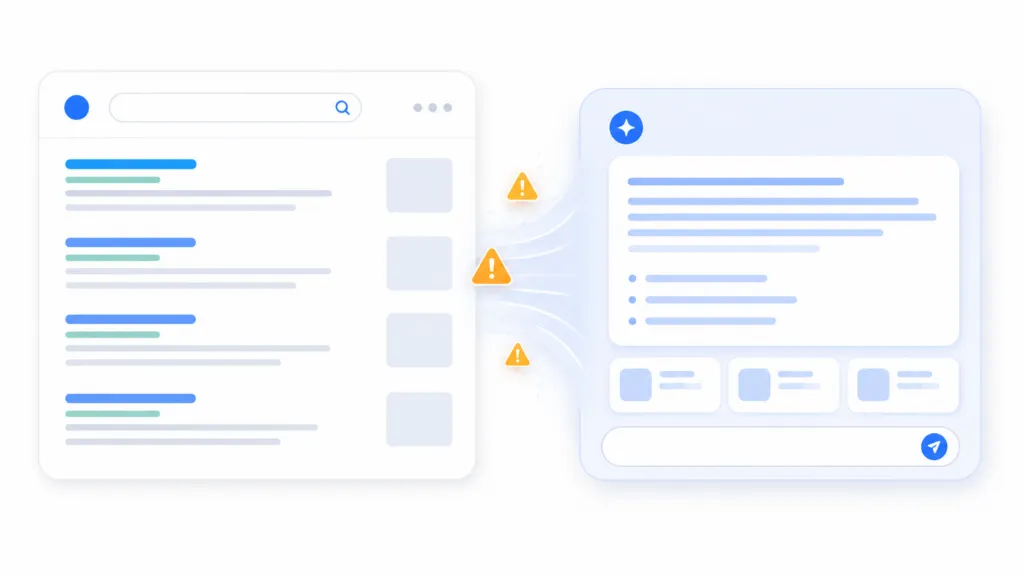
But calling it “still SEO” also lets Google sidestep the fact that AI search behaves very differently from traditional results. When someone searches in AI Mode, Google runs a dozen sub-searches and looks at hundreds of pages before synthesizing a response. The pages that get cited in those responses are not always the same ones that rank on page one of traditional results.
@tjrobertson52 Google dropped their AI ranking guide & honestly? What they told you NOT to do is the most useful part. Are you reading between the lines? 👀 #SEO #GEO #GoogleAI #AISearch
♬ original sound – TJ Robertson – TJ Robertson
Why Google Warns Against Content Variations
The most revealing part of the guide is Google’s warning about creating content variations. They specifically say you shouldn’t make a bunch of different versions of the same content targeting different demographics or use cases. According to Google, this is seen as manipulating generative search results and can trigger a scaled content abuse penalty.
Here’s what I find interesting about that. If this tactic doesn’t work, why would Google need to warn you against it? Why would they need a penalty?
The answer is straightforward. Targeted content variations are effective. When AI runs a dozen specific sub-searches, having content that matches each of those specific queries increases your chances of being cited.
Now, you can absolutely overdo this. I don’t recommend creating hundreds of similar articles, and I don’t recommend creating multiple pages that target synonymous terms or contain the same information.
But if you can share unique, substantive information on each variation, targeting 12 different demographics with 12 distinct articles works.
The key is substance. Each page needs to offer something the others don’t. Google’s spam policies define scaled content abuse as pages “generated for the primary purpose of manipulating search rankings and not helping users.” If every variation adds real depth for its specific audience, you’re on the right side of that line.
| Approach | Risk Level | Why |
| 12 variations with unique information per audience | Low | Each page serves a distinct user need |
| Same article with swapped demographics | High | No unique value per page, likely flagged as spam |
| Hundreds of thin pages targeting every keyword variation | Very high | Classic scaled content abuse |
| Single comprehensive article with audience subsections | None | Google’s recommended approach |
What Google Says About Brand Mentions in AI
Google’s guide also warns against seeking “inauthentic” brand mentions. In other words, don’t spam your brand name across the internet hoping AI picks it up.
Their stated reason is that they’re already very good at detecting spam and can just ignore those pages. And that’s partly true. Google does ignore most spammy pages.
That’s exactly why we only build recommendations on pages that are already being cited by AI models. You don’t have to guess whether a page is spammy or getting ignored. Track your AI citations and the models will show you which sources they’re pulling from.
If a page is already being cited, it’s a page worth being on.
The difference between what Google calls “inauthentic mentions” and what actually works comes down to where you’re building those mentions. Getting your brand recommended on a page that AI is already citing for relevant queries is earned visibility. Blasting your brand across random directories and low-quality blogs is spam.
Which AI Search Optimization Myths Did Google Debunk?
The most useful part of the guide is its myth-busting. Google cleared up several tactics that have been circulating in the AI SEO community. Here’s what you can safely stop worrying about:
- LLMs.txt files. You don’t need one. Google won’t treat it differently from any other file. Their crawler is the same one used for normal search.
- Markdown versions of your pages. Not necessary. Google crawls and indexes various file types, but none get special treatment in generative search.
- Content chunking. Google’s AI can parse full pages and extract relevant passages on its own. You don’t need to break your content into micro-sections.
- Structured data for AI rankings. Adding schema markup doesn’t help you rank in AI features. It’s still useful for traditional rich results, but there’s no AI-specific benefit.
- Rewriting content for AI. Google’s AI understands synonyms and intent. Keyword-stuffing or forced long-tail phrasing is unnecessary. Write naturally.
This aligns with what we’ve been telling clients for a while. The “AI search hacks” floating around online, things like invisible AI-only markup, special sitemaps, or llms.txt files, have never moved the needle in our testing.
What Google’s Guide Gets Wrong
The guide’s biggest weakness is its framing. “Just do good SEO” is incomplete advice.
Traditional SEO was about ranking for a handful of competitive keywords. AI search is about showing up across specific queries that an AI model runs behind the scenes. The strategy is fundamentally different even if the technical foundations are the same.
Google’s guide also doesn’t address the role of third-party mentions in AI visibility. Research from the SEJ found that including quotes or statistics from credible sources boosted AI visibility by up to 99% for certain positions. Well-formatted Q&A sections are also easier for AI to pull into answers.
Brand pages like your About, Product, and FAQ pages influence how AI describes your company. These are priorities that go well beyond standard SEO.
Why Microsoft’s Guide Is More Useful
If you’re looking for actionable guidance on how to actually get cited in AI search, Microsoft’s guide is better.
Where Google’s guide is conservative and mostly tells you what not to do, Microsoft’s guide provides specific, positive recommendations:
| Topic | Google’s Guidance | Microsoft’s Guidance |
| Content structure | “No special formatting needed” | Use precise headings, lists, Q&A blocks, and self-contained snippets |
| Language clarity | Not addressed directly | Avoid jargon, use synonyms, write for machine comprehension |
| Formatting for AI | “Our AI can parse full pages” | Break content into snippable sections with clear headings |
| Technical details | Standard SEO basics | Specific guidance on title/H1/description alignment |
Microsoft confirmed several things we’ve seen in our own testing. Bulleted lists and tables are easier for machines to parse than long paragraphs. Em dashes can confuse AI parsing (which is ironic, since large language models are notorious for overusing them).
Every section should be self-contained so it makes sense without context from the rest of the article. And question-and-answer formatting is highly effective for AI extraction.
The two guides overlap on fundamentals. Crawlability, metadata, and clean HTML still matter everywhere. But Microsoft gives you more to work with when it comes to formatting content that AI can actually use.
What Should You Actually Do for AI Search Optimization?
Based on Google’s guide, Microsoft’s guide, and what we’ve seen across our client campaigns, here’s what actually matters:
- Keep doing solid SEO. Crawlable pages, clean URLs, proper heading structure, fast loading, mobile-friendly design. These are the basics, and the real work starts on top of them.
- Write self-contained sections. Each section of your content should make sense on its own. AI pulls individual passages, not whole articles.
- Use Q&A formatting where it fits. Direct questions as headings with immediate answers underneath. AI lifts these verbatim.
- Use tables and lists for comparisons. Structured formats are easier for machines to parse and cite.
- Build your brand on pages AI already cites. Track which sources AI models reference for your industry, then get mentioned on those pages.
- Skip the AI search hacks. No llms.txt, no invisible markup, no keyword-stuffed rewrites. Focus on content quality and distribution.
- Create targeted content variations with real depth. If each version serves a real audience with unique information, it works. If you’re just swapping a few words, it doesn’t.
How Does This Affect Your SEO Strategy Going Forward?
Google’s guide confirms something we’ve been operating on for a while. The technical foundation of SEO hasn’t changed, but the strategy on top of it has.
The businesses winning in AI search are the ones showing up everywhere these models look. That means strong content on your own site, your brand mentioned on pages AI already cites, and a presence on the directories and discussion threads that feed into AI responses.
If you’re still thinking about SEO as “rank number one for my main keyword,” you’re solving last year’s problem. AI search rewards breadth and consistency over any single ranking position.
Get a Free AI Search Audit from TJ Digital
At TJ Digital, we track AI search visibility for every client across every major platform. We know exactly which pages, directories, and discussion threads AI models are looking at in your industry, and we build campaigns around getting you represented on as many of them as possible. Get a free audit and we’ll show you where you stand.