
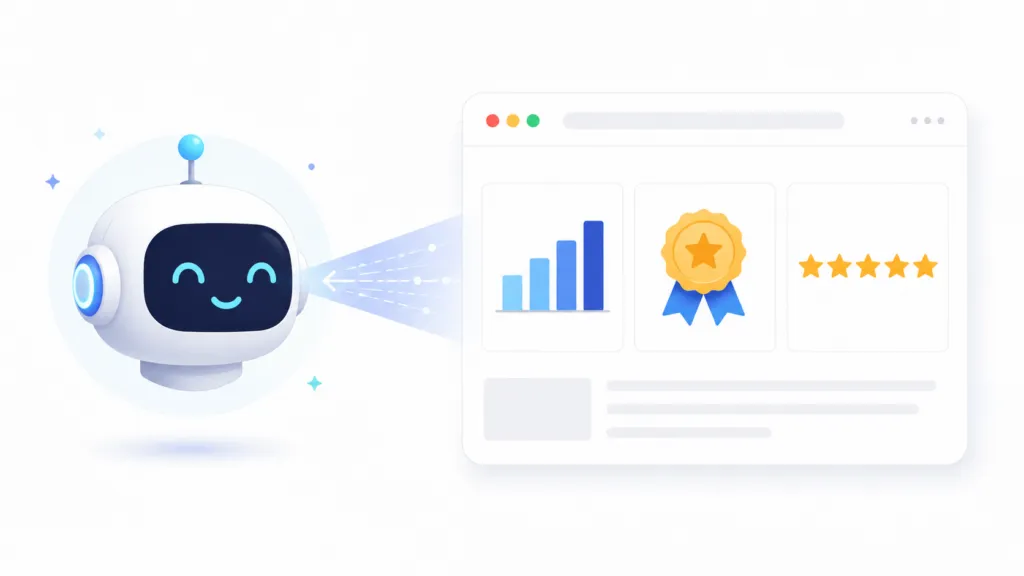
As a business, you can’t just be marketing to humans anymore. You need to be marketing to humans and AI.
At TJ Digital, where we manage AI-optimized campaigns for roughly 40 to 50 client websites, we see the difference every day. AI-referred visitors convert at about 8x the rate of traditional search visitors. That gap is growing, and it means the businesses that AI recommends are going to win a disproportionate share of new customers.
Table of Contents
ToggleHow Is Marketing for AI Different from Marketing for Humans?
Marketing for humans is driven by emotions. Marketing for AI is driven by facts, data, and third-party validation.
Up until recently, marketing was about getting attention on your brand through ads or SEO. Then once you had that attention, you needed to convince a human to become a customer.
You created imagery that invoked specific emotions. You designed your website to invoke specific emotions. And you wrote a marketing copy to invoke those same emotions in your prospective customers.
All of that is still valuable because humans are still going to be looking at your website.
But here’s what’s changed. With AI, people are no longer just getting a list of options. They’re getting recommendations.
And even if they aren’t discovering your brand through AI, it’s very likely they’re going to ChatGPT or Google’s AI Mode to ask about your brand before they buy. You no longer just need to convince humans with your marketing. You need to convince AI to recommend your brand.
@tjrobertson52 Stop marketing only to humans. AI recommends brands based on facts & third-party reviews, not self praise. Here’s what to fix. #aimarketingtips #MarketingTips #BusinessTips
♬ original sound – TJ Robertson – TJ Robertson
What Does AI Actually Look For on Your Website?
None of the emotional marketing on your website influences AI to recommend your brand. AI doesn’t care about your imagery, your color scheme, or how your copy makes people feel. What actually influences AI comes down to three things: facts, data, and third-party reviews.
You can write pages of content about how great your product is and how it makes people feel. The AI is just looking for facts.
So instead of leading with emotional copy, you should be sharing impressive stats about your business. Things like how many customers you’ve served, any awards you’ve won, how many years you’ve been in business, and your specific results.
Service-based businesses should be sharing how much experience they have in specific sectors. E-commerce businesses should be sharing detailed product specifications.
What specifically makes your product so great? Give AI the numbers.
Why Does AI Trust Facts but Ignore Your Self-Praise?
AI trusts facts because they can be verified. Self-praise can’t be.
As long as you’re making empirical claims (sharing facts that in theory could be disproven), modern AI is typically just going to take you at your word. It will happily repeat back any facts you share about your own brand and use them as evidence that you’re a good fit for the user.
Where AI won’t take you at your word is when you’re sharing positive sentiment about your brand. You saying “Our customers love us,” or “We have the highest quality products,” or “Our team truly cares about your success” is not going to influence AI’s response at all.
AI treats these kinds of statements as marketing copy, and it basically ignores them. According to research from Orbit Media, AI models use a hierarchy of sources when forming recommendations.
Knowledge bases and third-party journalism sit at the top. User reviews and forum consensus come next. And corporate self-claims rank last.
| Content Type | How AI Treats It |
| Empirical claims (stats, specs, counts) | Takes them at face value and cites them |
| Awards and certifications | Treats them as third-party validation |
| Third-party reviews and endorsements | Highest trust for positive sentiment |
| Emotional marketing copy (“we care”) | Ignored or deprioritized |
| Vague superlatives (“best,” “leading”) | Skipped entirely |
Which Review Sites Actually Matter for AI?
It depends on your industry, but typically only one to three review platforms actually influence AI recommendations. The only positive sentiment that AI trusts is third-party reviews or endorsements, so you need to figure out which review sites AI is citing in your space.
Do whatever you can to get as many reviews for your brand on those platforms as possible. For most local service businesses, that’s going to be Google Business Profile and maybe one industry-specific site.
For SaaS companies, it’s usually G2 or Capterra. For e-commerce, it could be Amazon reviews or product review blogs.
The way to find out which ones matter for you is to go to ChatGPT or Google’s AI Mode and ask it to recommend a business like yours. Look at the sources it cites. Those are the review platforms you need to prioritize.
Research from Yotpo found that third-party mentions correlate roughly three times more with AI visibility than traditional backlinks do. That’s a massive shift from how SEO has worked for the past two decades.
What Pages Should Your Website Have for AI Search?
Four specific pages your site needs to give AI the evidence it uses to make recommendations: a reviews page, an awards page, a FAQ page, and an optimized about page.
A reviews page. You should put a reviews page on your website where the title includes your brand name, your primary keyword, and the word “reviews.” This mirrors exactly how users and AI search for “Brand X reviews” and helps ensure AI pulls from your page instead of defaulting to a third-party aggregator. Include real review quotes in crawlable text (not just screenshots) and use schema markup so AI can extract the ratings.
An awards page. If you have any notable awards or industry recognition, put them on a dedicated page. List them as text with dates, not just logos.
AI can’t read an image of a badge, but it can read “Best IT Service Provider 2025, Tech Awards UK.” Awards from respected industry bodies serve as exactly the kind of third-party validation that AI trusts.
Your FAQ page. Your FAQ page should be filled with any impressive stats or facts about your brand. Use real questions that customers actually ask, not generic labels. Write concise, specific answers.
For example, instead of “We have great customer service,” write “We respond to all support tickets within 2 hours during business hours, with a 98% resolution rate.” Pages using FAQ schema appear in AI-generated answers far more often than plain text Q&A.
Your about page. Same principle. AI will be desperately looking for any evidence that you’re a good choice for the user. Your about page should lead with concrete facts (founding year, team size, client count, service areas) before getting into your story and mission.
Make it as easy as possible for AI to find this evidence.
How Do You Get AI to Recommend You Instead of Your Competitors?
Back every claim on your website with specific, verifiable evidence. Getting found by AI and getting recommended by AI are two different things, and most businesses focus on the wrong one.
Being cited means AI pulled a fact from your page. Being recommended means AI named your brand as the solution.
The difference comes down to evidence. Every page on your site should include specific, verifiable claims.
Replace “innovative solution” with the actual feature that makes it innovative. Replace “trusted by thousands” with “served 3,200 clients since 2010.” Replace “eco-friendly” with “reduces water usage by 30% compared to standard models.”
Ground every claim with a number, a date, a name, or an observable fact. Vague adjectives mean nothing to AI. Specifics mean everything.
Does Traditional SEO Still Matter for AI Visibility?
Yes. Traditional search ranking still helps you show up in AI results. When someone asks ChatGPT or Google’s AI Mode a question, the model runs background searches and pulls from the top results.
If your pages rank well organically, they’re more likely to be in that result set.
But ranking alone is no longer enough. You also need to give AI a reason to recommend you once it finds you. That means the content on your pages needs to be structured around facts, backed by external validation, and written in a way that AI can easily extract and cite.
The businesses that do both (rank well in traditional search and provide fact-dense, review-backed content) are the ones that will show up in both worlds.
How Do You Start Marketing Your Business for AI?
If you’re not sure where to begin, start here:
- Audit your most important pages. Are they leading with facts or feelings? Replace vague claims with specific numbers.
- Identify the review platforms AI cites in your industry. Ask ChatGPT to recommend a business like yours and look at the sources.
- Build (or update) your reviews page, awards page, FAQ page, and about page with concrete, crawlable evidence.
- Get more reviews on the platforms that matter. Even 10 detailed reviews can make a measurable difference in AI visibility.
- Keep your content fresh. AI models favor recent information, so regularly update your proof pages with new testimonials, stats, and recognition.
AI is desperately looking for evidence that you’re a good choice. Your job is to make that evidence impossible to miss.
Reach out to TJ Digital to find out how your business is currently showing up in AI search and what you can do to improve it.