
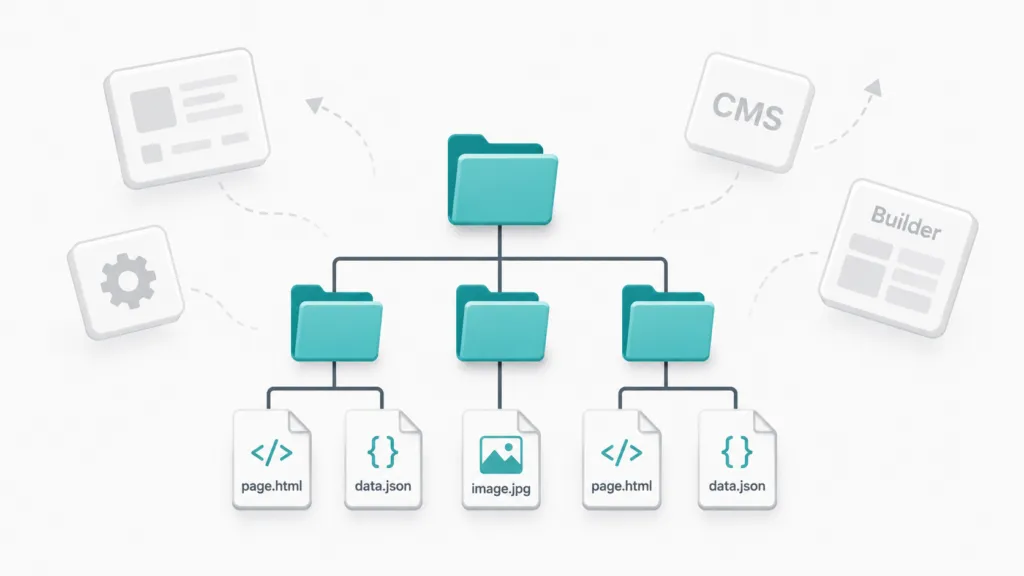
By 2027, the best website platform will be no platform. The software layer is becoming trivial, and the only thing that will matter is how your data is structured. At TJ Digital, where we manage websites for roughly 40 to 50 clients, we’ve been spending significant resources exploring this future with our development team.
I want to help you think through this based on your situation.
If you asked me a few months ago what platform to build your website on, I didn’t have a good answer. I’ve spent the last few months working through this with my team and some very smart developers outside of it. I think we can finally make some confident predictions.
Table of Contents
ToggleDoes Your Website Platform Affect SEO or AI Rankings?
No. Google doesn’t care what platform your website is on, and neither does ChatGPT or any other AI search engine.
A slow, insecure WordPress site will rank worse than a fast Wix site. But that’s about speed and security, not the platform itself. For AI-driven shopping and SEO alike, structured content and performance are what drive results, not the CMS that generated the page.
Don’t choose your website platform for SEO or AI reasons. Choose a platform based on functionality and ease of use. What does your website need to do, and how easy does the platform make it?
@tjrobertson52 By 2027, the best website platform is NO platform. The software layer is becoming trivial, what matters is your data structure. If you’re on Shopify, stay put. WordPress? Start planning your exit. #WebsitePlatform #AIWebsites #WordPress #Shopify #WebDev
♬ original sound – TJ Robertson – TJ Robertson
What Should You Do If You’re Already on WordPress?
If you’re already on an established platform like WordPress or Squarespace, there’s no urgency to move. WordPress isn’t doing a great job keeping up with AI, and I do think you’ll want to migrate within the next year. But every month you wait, migration gets a little bit easier with AI tools.
The majority of websites we’re building for clients right now are still on WordPress. It’s a low-risk platform to build on. Just assume you’ll be migrating it soon.
Within a year, I think this kind of migration will be trivial. New platforms like Cloudflare’s EmDash are already showing what a CMS built for AI looks like. But more on where to migrate in a moment.
Why Shopify Is the Best Platform for E-Commerce in 2026
Shopify is the clear winner for e-commerce right now. They’re doing a really good job keeping up with AI, partly because migrating off an e-commerce platform is already difficult, but more so because they’re investing heavily in the right direction.
Shopify co-created the Universal Commerce Protocol (UCP) with Google, which lets AI agents discover, negotiate, and complete purchases directly through platforms like Google AI Mode and Microsoft Copilot. Shopify reports that AI-driven search traffic converts about 49% more often than organic search traffic as of Q1 2026. That’s a massive advantage.
If you’re an e-commerce business, you need to be integrating UCP and making sure you’re eligible for Google’s Universal Shopping Cart. All of this is happening automatically for you on Shopify. If you’re on Shopify, I don’t think you need to consider moving away for a long time.
If you’re running WooCommerce on WordPress, you might want to consider the move. WooCommerce has no official UCP integration yet. Community plugins exist, but they require careful setup, and Shopify merchants can activate “Agentic Storefronts” right in the admin with no coding at all.
| Platform | AI Commerce Readiness | UCP Support | Automatic Updates | Best For |
| Shopify | Strong (Agentic Storefronts, built-in UCP) | Native, launch partner | Yes, fully managed | E-commerce businesses of all sizes |
| WordPress/WooCommerce | Behind (community plugins only) | No official integration | Manual updates required | Content-heavy sites, custom builds |
| Squarespace | Limited AI features | No support | Managed, but slower AI adoption | Simple brochure websites |
| Lovable (AI builder) | N/A | N/A | N/A | Prototypes and simple static sites |
However, if you have a lot of products on WooCommerce, this can be a big lift. Just make sure you’re doing what you need to adopt Universal Commerce Protocol on whatever platform you’re on.
Can You Build a Business Website on Lovable?
If you’re building a simple static website, then yeah, you probably should just build it on Lovable or a similar AI code generator. For most businesses, though, that’s not going to cut it right now.
Lovable can quickly produce basic sites, but users report it takes many iterations and manual tweaking to get a reliable result. One developer noted that you need excellent prompting skills and often multiple rounds of revision, then import the code into an editor to fine-tune. For anything involving payments, user accounts, or heavy integrations, you need a developer reviewing the output.
Lovable is promising technology, but it’s still early-stage for production business use.
What Will the Best Website Platform Look Like in 2027?
The best platform in 2027 is no platform. Or rather, the platform itself will become unimportant.
The only thing that’s going to matter is the structure of your data. The software layer is becoming trivial. It’s already pretty easy for even non-developers to spin up software to edit their own website.
As long as your website data follows typical standards (HTML pages organized inside folders), swapping out that software layer will be easy. You can connect it to whatever software you want, or vibe code your own.
This will force the platforms to adapt to the data structure instead of the other way around. More importantly, it will allow you to give AI direct access to the files on your website.
We will need some new universal standards to make sure all the platforms work with the same data structure. We’re already seeing this with new files like llms.txt, which provides a structured summary of your most important content specifically for large language models.
Early adopters like Cloudflare, Anthropic, and Vercel have started publishing llms.txt files. But those standards will need to continue being refined.
I wouldn’t be surprised to see Google take the lead on this the way they did with Universal Commerce Protocol. For e-commerce businesses, this shift will take longer than it will for a typical business. But I think this is the way.
I’m placing some big bets on this future. My team and I are aggressively spending resources toward exploring it.
How AI Is Making Website Migration Easier
If you’re worried about being stuck on WordPress, don’t be. AI is transforming site migrations. Tools like Energent.ai claim about 94.4% accuracy on messy legacy content, and platforms like CMS2CMS automate content mapping and URL redirects to preserve SEO.
One blogger recently moved 15 years of WordPress content to a static site generator with AI assistance. He estimated the project would take weeks. With AI handling the repetitive parts, it was done over a weekend.
Every month you wait, migration gets easier. Within a year, I think migrating between platforms will be almost trivial. If you’ve been putting it off, don’t stress.
Start thinking about where you want to end up.
You can start preparing now by making sure your website is ready for AI agents, regardless of what platform you’re on.
How Should You Choose a Website Platform Right Now?
What if you’re launching a brand new website?
If you’re an e-commerce business, go with Shopify. For everyone else, WordPress is still the safest option right now. It’s a known quantity with a massive ecosystem of themes and plugins.
Just assume you’ll be migrating it within the next year as better options mature.
Should you migrate your WordPress site today?
No. There’s no urgency. The tools for migration are getting better every month, and the platforms you’d migrate to are still maturing.
Stay on WordPress, keep your site fast and secure, and start paying attention to what’s coming.
What does “data structure” actually mean for your website?
It means your website content should be organized as clean HTML pages inside a logical folder structure. Think of it like a filing cabinet. AI needs to be able to read and understand every file on your website server.
If your content is buried inside a proprietary database format that only one platform can read, you’ll have problems. If it’s in clean, standard HTML and Markdown files, any tool (human or AI) can work with it.
Need Help Choosing the Right Website Platform?
We help small and medium-sized businesses figure out the right platform, the right structure, and the right strategy for where things are headed. Reach out to us directly and I’ll give you my honest take on your situation.