
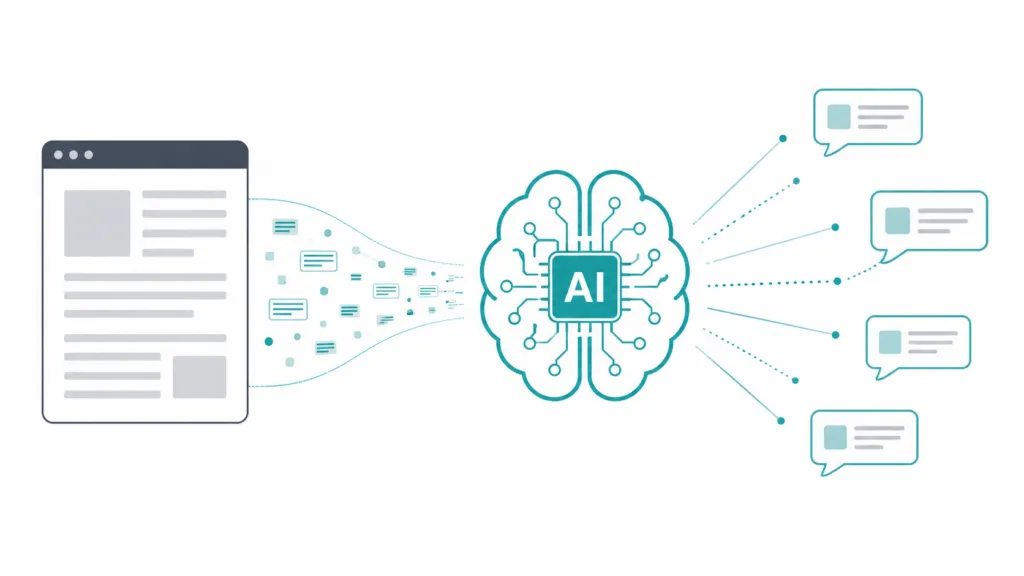
The most common question I get sounds like this. Why create content anymore if AI is just going to train on it and answer the user directly without sending anyone to my website? I recently had Claude read through all my TikTok comments, and this exact concern came up more than any other.
At TJ Digital, we track AI search visibility for roughly 40 client websites, and the data points the other way. AI has made content creation easier and more valuable than before. The reason is simple once you stop treating website clicks as the goal.
Table of Contents
ToggleWere Website Clicks Ever Actually the Goal?
Influence was always the goal. Clicks were just the delivery mechanism we had in the old economy.
If you sell a product or a service, you create content to influence someone to buy. If you run ads or affiliate offers, you are selling that influence to another company. Nobody publishes content for the pure joy of getting a pageview.
We got trained to chase clicks because for years a click was the main way to put your influence in front of a person. That training runs deep, so it feels strange to let go. But strip the click away and the goal underneath it has not changed.
You still want to change someone’s mind. The question worth asking is whether AI makes that harder or easier.
@tjrobertson52 Is it worth creating content if AI gives the answer? Website visits were never the goal. Influence was. #AISearch #ContentCreation #SEO #SmallBusiness
♬ original sound – TJ Robertson – TJ Robertson
Does AI Make It Harder to Influence People With Content?
AI makes it dramatically easier, and here is the part most people miss. When AI trains on your content or cites it in an answer, you are influencing the most powerful technology in human history. Your perspective gets baked into the system that millions of people now ask for recommendations.
A common objection follows right away. People are not using search engines anymore, so no one will ever find my content to begin with. For most queries, that is not what happens.
The AI is using a search engine on your behalf. Search engines are not going away. They are being used by AI while humans move up one level.
You still create content to be found in search. The difference is that now you are trying to be found by an AI that is searching on a person’s behalf.
That shift works in your favor. A human skims a couple of results before deciding. An AI reads through hundreds. Ranking inside that result set is now the easy part.
What Has Actually Changed About Ranking in AI Search
The mechanics of getting found have gotten easier, and the work has moved to a different place. Showing up in the set of pages an AI pulls from is no longer the hard part, because the AI looks at so much more content than a person ever would. The hard part, or what should be the hard part, is writing content that matches what the AI is actually searching for.
Even that turns out to be easier than it sounds, because almost nobody is tracking what the AI searches for. We use a tool called Peec.ai to see which pages the AI cites before it recommends a client or a competitor. Once you can see what the AI is pulling from, influencing the result set is straightforward. We broke this down further in our look at ranking in AI search right now.
The supporting data lines up with what we see day to day. According to Ahrefs, the presence of an AI Overview is associated with roughly a 58% drop in clicks to the top-ranked page. Clicks are falling. That is real. It is also beside the point if influence was what you were after.
How Do LLMs Decide What Content to Cite?
AI assistants combine a normal web search with summarization. When you ask ChatGPT or Google’s AI Mode a question, the model does not just pull from memory. It breaks your question into several related sub-searches, sends them to search engines, ranks the passages it gets back, and weaves the best ones into an answer with citations.
That behavior tells you how to write. A few patterns consistently get content pulled into AI answers:
- Front-load the answer. Put your main point in the first paragraph or heading. Research from Passionfruit found that nearly half of AI citations come from the first third of an article.
- Use clear structure. Descriptive headings, short paragraphs, and bullet lists let the AI break your page into clean, usable chunks.
- Write self-contained sections. Every section should make sense on its own, without needing context from another part of the page.
- Cover the topic fully. Because the AI fans out into many sub-queries, a thorough piece can answer several of them at once.
None of this is exotic. It is good writing made legible to a machine.
How Traditional SEO and AI Search Differ
The two overlap more than people expect. Strong fundamentals still apply, and the goal in both cases is to be the most useful, most authoritative source for the question.
| Factor | Traditional SEO | AI Search |
| What you optimize for | One keyword per page | A theme and its related sub-questions |
| How visibility works | Rank in one results page | Get cited across many sub-searches |
| Position required | Top result wins the click | A lower-ranked page can still be quoted |
| How you measure it | Clicks and rankings | Brand mentions and AI citations |
The biggest practical difference is measurement. Search Console will not separate AI-driven visibility from regular click traffic, so you need a tool built for tracking AI citations or you are flying blind. That is exactly the gap most agencies have not closed.
Should You Still Be Creating Content for AI Search?
Yes, and more deliberately than before. The brands getting cited are the ones publishing clear, structured, authoritative content and then watching what the AI actually does with it. We covered the right and wrong ways in our guide to AI blog writing.
Building a presence across the web helps too. AI pulls from sources all over the internet when it forms an answer. Across 30 million responses, Peec.ai found Reddit and YouTube to be the most cited sources overall, which means your forum activity, video transcripts, and review profiles all feed into how AI talks about your brand.
So let the AI eat your content. We have entered a new golden age of content creation, and the businesses that see it that way are the ones AI will recommend.
If you want help showing up in AI search, reach out to TJ Digital and we will show you what the AI is pulling from for your industry.