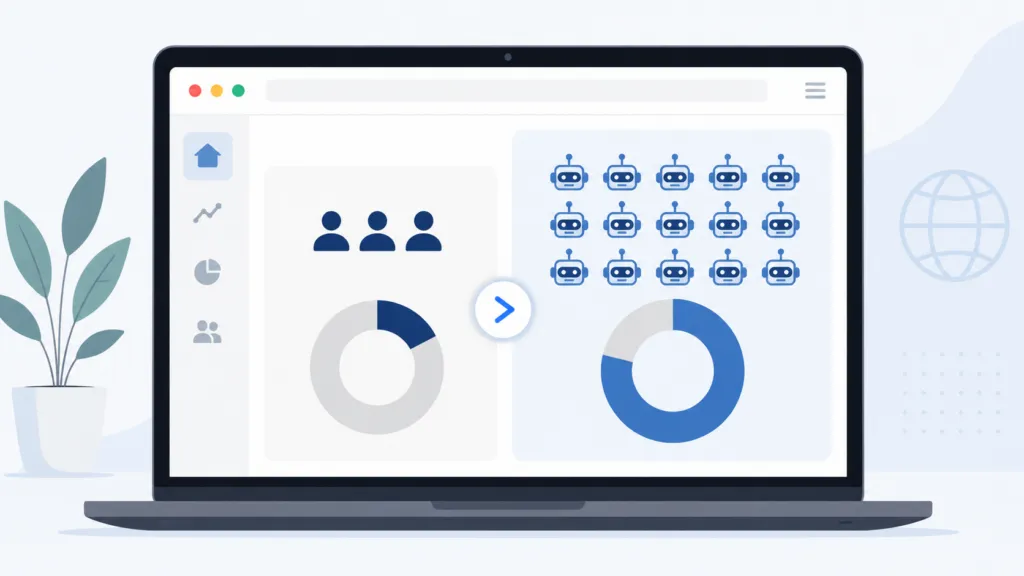
Most website traffic now comes from bots. Cloudflare Radar just published data showing that 57.5% of HTTP requests for web pages are automated, versus 42.5% from humans. That crossover happened about 18 months earlier than Cloudflare’s own CEO predicted.
At TJ Digital, where we manage AI search optimization for roughly 40 to 50 client websites, we get emails every day from business owners who realize things are changing. They see the data, and they understand we’re entering a world where the primary user of their website is an AI agent. They want to rebuild their website, integrate AI into their operations, and move before their competitors do.
That mindset puts them in the top 5% of businesses right now. But here’s what I tell every one of them. Before you start speculating or taking risks on what the web will look like a year from now, do the three things that are guaranteed to help you today and guaranteed to still matter in the future.
Table of Contents
ToggleWhy Is Most Web Traffic Now Coming from Bots?
The short answer is AI agents. These are automated programs that browse the web on behalf of tools like ChatGPT, Google’s AI Mode, and Perplexity. When someone asks an AI assistant a question, the model sends out crawlers to fetch pages, read content, and synthesize an answer.
Those crawlers are visiting thousands of pages per request. That adds up fast. According to one analysis, agentic AI traffic grew roughly 7,851% year over year, and automated traffic is expanding about eight times faster than human activity.
This is a permanent shift. Cloudflare’s CEO originally expected the crossover to happen by the end of 2027, but it happened in April 2026. Every business that publishes content online needs to account for the fact that AI agents are now the majority of their visitors.
@tjrobertson52 How to prepare for the agentic web: 57% of web traffic is bots now. Do these 3 things before you guess at the rest. #SEO #AISearch #AgenticWeb #SmallBusiness
♬ original sound – TJ Robertson – TJ Robertson
What Should You Do Before Experimenting with AI?
I do think we’re finally getting to the point where we can make confident guesses about what the web will look like in the near future. If you want to take full advantage of this moment, you probably have to take some risks. But before you take any risks, get the foundations right.
There are three things every business should have in place right now:
- An internal knowledge base that documents everything about your company in a way AI can understand
- A website that puts all your public information where AI agents can find it, structured so they don’t have to guess
- A system for tracking how AI researches and recommends brands in your industry, so you know exactly where to focus
These three priorities are the most effective form of digital marketing right now. And there’s no sign that any of them will become less important in the foreseeable future.
How Do You Build an Internal Knowledge Base for AI?
This is the first thing I recommend to every business, and it’s the step most people skip. Before you can do anything sophisticated with AI, you need to document all the information about your company in a way that’s easy for AI to understand.
That means consolidating everything into a logical structure with clear categories, consistent headings, and metadata that AI tools can parse. Write in plain language and provide concise answers with context. If someone asked an AI “What does this company do?” or “How is this product different from competitors?”, the answers should be sitting in your knowledge base, ready to be pulled.
We do this for every client at TJ Digital. We call it the Brand Ambassador, a curated set of documents covering company background, services, pricing, team credentials, brand voice, and competitive positioning. Every piece of AI-driven work we do for a client runs through this knowledge base.
You can build an AI knowledge base in a weekend, and it will immediately improve every AI interaction your business has.
The key is assigning ownership and keeping it updated. Monitor how AI tools perform when pulling from your documentation, and refine answers where the AI struggles. Over time, this feedback loop makes your knowledge base more and more useful.
How Should Your Website Be Structured for AI Agents?
All information about your company that you’re willing to share publicly should exist on your website. And it should be structured in a way that makes it trivial for AI to find.
That sounds obvious, but most websites fail at this. Here’s what AI agents actually need:
Semantic HTML and clear headings. Wrap your main title in a single H1 tag, use H2s and H3s for subtopics, and mark paragraphs with proper tags. Add descriptive alt text to every image. This lets AI crawlers identify the structure of your page at a glance.
Structured data markup. Apply schema.org markup (JSON-LD format) for your Organization, Products or Services, FAQ pages, and key personnel. This creates what’s essentially a mini knowledge graph on your website. AI models use it to precisely identify what your brand is and what you offer.
Answer-first content. Write each page or section so that it opens with a concise answer to a probable question, followed by supporting detail. AI systems are built to extract and cite direct answers. If your most important information is buried in the third paragraph, the AI will miss it.
Scannable formatting. Use bullet points for lists, tables for comparisons, and summary boxes for key facts. AI models are measurably better at extracting information from structured formats than from long paragraphs of text.
| Traditional Website Structure | AI-Friendly Website Structure |
| Long introductory paragraphs before getting to the point | Answer or key fact appears in the first sentence of each section |
| Generic headings like “Our Services” or “Why Choose Us” | Headings written as questions people actually search for |
| Information scattered across multiple clicks deep | Important pages reachable within two clicks from the homepage |
| No structured data markup | Schema.org markup for Organization, Products, FAQ, and Person |
| Content formatted as large text blocks | Content broken into bullet points, numbered lists, and tables |
| Hidden content behind tabs and accordions | All important content visible on the page by default |
One detail from the research that surprised me is that content hidden behind tabs is harder for AI to process. Make sure all important information is visible on the page without requiring a click to expand.
How Do You Track What AI Recommends About Your Brand?
This is the step that separates businesses actively winning in AI search from businesses just hoping for the best. You need to track how AI does research and ultimately recommends a brand when people are searching for your product or service.
That means running sample prompts through ChatGPT, Google’s AI Mode, Perplexity, and other platforms to see which brands get mentioned, which pages get cited, and where your competitors are showing up that you aren’t.
The metrics that matter are your brand mention count (how many AI-generated answers reference you), your share of voice compared to competitors, and which specific URLs the AI is citing. Historical trend data matters too. You want to see how these numbers change after you publish new content or update existing pages.
We track roughly 4,000 AI prompts per day across our client base. The tool I recommend for this is Peec.ai. It has the same features as the more expensive alternatives, and it costs less than 20% of the market leader.
Once you’re tracking, two things become clear fast.
The content types AI cites most often. Comparison articles, “best of” lists, how-to guides, FAQ pages, and original data or case studies consistently outperform other formats. If AI is recommending your competitors through a “Top 10” listicle, you either need to be on that list or you need to create a better version on your own site.
The third-party platforms AI pulls from. Research shows that 85% of brand discovery in AI search comes from third-party websites. Only about 15% originates from the brand’s own domain. When someone asks an AI “What’s the best CRM for small businesses?”, the AI almost always cites review sites, forums, and media articles.
Which Third-Party Platforms Do AI Models Actually Use?
This data should change how you spend your marketing time. Here’s where AI models pull their brand recommendations from, based on large-scale citation analysis:
| Source Type | Share of AI Citations | Examples |
| Editorial and news media | ~16% | Industry blogs, news outlets, newsletters |
| Review platforms | ~11% | TrustPilot, G2, Capterra, Yelp, TripAdvisor |
| Forums and social media | ~11% | Reddit, Quora, industry-specific forums |
| Directories and reference sites | ~10% | Wikipedia, Crunchbase, Google Business Profile |
Reddit is especially dominant for Perplexity, where it accounts for nearly 47% of all citations. Wikipedia fills a similar role for ChatGPT, representing about 48% of its sources.
The takeaway is simple. Identify the specific platforms that AI cites before recommending brands in your industry, and make sure your brand has a strong presence there. A detailed breakdown of how third-party mention building works is on our blog if you want the full playbook.
What Content Formats Are Most Likely to Get Cited by AI?
The format and structure of your content directly affects whether AI will cite it. Content organized for easy parsing gets favored. Here are the formats that consistently perform best:
Direct comparisons and “X vs Y” articles. These present information in clearly labeled chunks that AI can summarize and extract from. Include comparison tables with columns for features, pricing, or pros and cons.
“Best of” and alternatives lists. Each item is discrete and described with a consistent structure. AI can pull individual entries from these lists and use them in its answers.
Step-by-step how-to guides. Break instructions into numbered, labeled sections. Keep each step concise. AI models reproduce structured instructions better than any other format.
FAQ pages and Q&A sections. Direct question-and-answer pairs give AI ready-made snippets to cite. Research shows FAQ sections get roughly 3x higher citation rates in AI answers compared to the same information written as regular prose.
Original data and case studies. Unique research with specific figures stands out because AI can’t find those numbers anywhere else. Proprietary data tables, survey results, and benchmarks all increase your chances of being cited.
The common thread across all of these is structured clarity. Short definitions or answers near the top of each section, followed by deeper detail. The easier it is for AI to pick out the relevant answer through headings, lists, and tables, the more likely your page gets cited.
How Quickly Can You See Results from AI Optimization?
One of the most exciting things about this approach is the speed. Unlike traditional SEO, where you might wait three to six months to see ranking improvements, getting your brand mentioned in the sources that AI cites can have effects within 24 hours.
When AI platforms detect your brand in the sources they trust, your visibility goes up almost immediately. That speed comes from the fact that AI models run fresh searches every time someone asks a question. You don’t have to wait for a search engine to recrawl and reindex your page.
Does Traditional SEO Still Matter for AI Agents?
Yes. There’s a strong correlation between traditional search rankings and AI mentions. In large-scale analysis, brands on the first page of Google are far more likely to be named in AI-generated answers than brands ranking on page two or beyond.
The interesting nuance is that backlinks and domain authority had surprisingly little independent effect. Raw popularity alone doesn’t sway AI. What matters is prominence in the results that appear when the AI runs its background searches.
So the fundamentals of SEO still apply. Good content, relevant headings, fast load times, and proper site structure all still matter. But you also need to be thinking about how AI recommends brands in addition to how Google ranks pages.
Where Should You Start with AI Agent Preparation?
The businesses winning right now are the ones that built their foundation before chasing trends. They documented their company in a structured knowledge base, made their website easy for AI to crawl, and tracked what AI actually cites. Then they showed up in those places.
This approach works today. It will work tomorrow. And there’s nothing speculative about it.
Request a free audit of your website. I’ll walk through exactly what AI is saying about your brand right now and where the biggest opportunities are.