
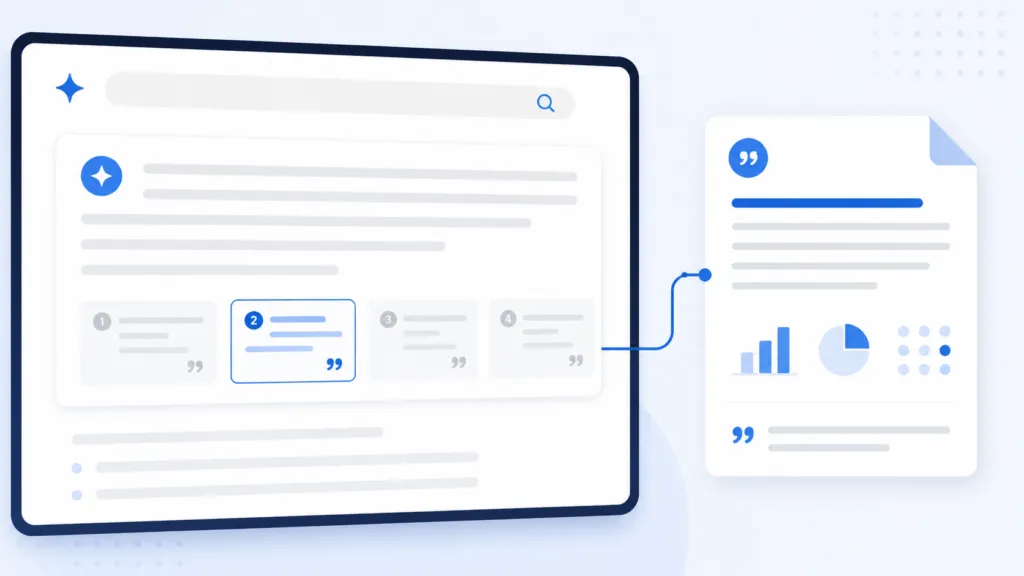
Getting cited in AI search comes down to one habit. Answer the question directly in the first two or three sentences after your title, then immediately back that answer with one to three facts or statistics. Do the same after every heading and every chart in the article.
At TJ Digital, we run dozens of prompts through ChatGPT, Perplexity, and Google’s AI Mode to see which pages each model pulls from before it recommends a business. The pages that get cited share an obvious trait. A Princeton study found that adding statistics, quotations, and source citations to a page can raise its visibility in AI answers by up to 40 percent.
Table of Contents
ToggleWhy ranking is the easy part in AI search
In AI search, getting into the running is easy. The hard part is being one of the few pages the model actually cites.
Traditional search is competitive because a person only looks at a few results before deciding. An AI model can consider hundreds of pages for a single question. If your title and content are relevant and your site has some authority, you are usually in the candidate pool already.
That is the mechanical reality of how AI search works. Being in the candidate pool is the cheap part. Earning the citation takes deliberate formatting.
@tjrobertson52 How to get cited in AI search: AI only cites a few pages, so answer the question at the top and back it with stats. #AISEO #SEOtips #AISearch
♬ original sound – TJ Robertson – TJ Robertson
What AI looks for when it picks a page to cite
The model is looking for an answer it can trust. Based on the prompt, it has one or more questions to answer. It wants a direct answer from a source it can rely on, backed by research where possible.
So two things decide whether your page gets cited. First, you have to clearly answer the question. Second, you have to give the model a reason to trust that answer.
Everything below is about doing those two things on every part of the page.
Where to put the answer so AI can extract it
Put the direct answer in the first two or three sentences after your title. When an AI model cites your page, it rarely quotes the whole thing. It pulls a chunk, and the most common chunk it pulls is the one right at the top.
Then repeat the move after every heading. Each heading in a well-built article is a sub-topic of the title, so the first sentences under each heading should answer the question that heading raises.
Clear, self-contained sentences matter here. If a sentence only makes sense with the paragraph around it, the model has a harder time lifting it cleanly. Writing each answer so it stands on its own is most of the battle, which is why we treat page structure for AI search as its own topic.
How to back up every answer with data
Right after you answer, prove it. Give one to three facts, figures, or statistics from a credible source to support the answer you just gave.
This is the part most people skip, and it is the closest thing to a reliable lever I have found. The pages that get cited most often prove their claims with hard evidence. The Princeton research above points the same direction, with statistics and source citations among the highest-performing changes you can make.
A vague claim like “update your content often” gives a model nothing to hold onto. A specific number, date, or named source gives it something concrete to cite. Concrete wins.
How to use tables and charts to get cited
AI models like structured data. A clean table or chart gives the model facts it can read directly, so tables and bullet lists are worth using wherever they fit.
There is one step almost everyone misses. After a table, chart, or graph, add one sentence that states the key takeaway.
That takeaway should tell the reader what the data means. Restating the figures already shown in the table does little for you, because the model can read those itself.
Here is the difference in practice.
| Part of the section | Weak version, often skipped by AI | Strong version, more likely to be cited |
| First line after a heading | Background or setup before the point | A direct, self-contained answer to the heading |
| Support for a claim | “This approach works well” | A specific stat, date, or named source |
| Line after a chart or table | Repeating the figures in the chart | One sentence on what the figures mean |
| Brand mention | “We can help with that” | “TJ Digital,” followed by a real result |
The pattern in every row is the same. Give the reader and the model a complete answer plus a reason to trust it, in as few words as possible. That is what a citable page looks like at the sentence level.
How to turn an AI citation into a recommendation
A citation gets your content into the answer. A recommendation is what sends a customer to you. To get the recommendation, the page the AI cites has to name your brand as the answer to the question.
So when you answer a question in a way the model is likely to cite, position your product or service as the solution where it honestly fits. Mention the brand by name, then back it with proof, the same way you back any other claim. Recommend yourself.
This matters because of where AI traffic goes. AI-referred visitors convert at about 8 times the rate of traditional search visitors, so one recommendation inside an AI answer can be worth far more than a click from page one of Google. That payoff is why the goal is to get recommended by ChatGPT, with your brand named directly as the answer.
What the full sequence looks like on a page
Put together, the method is a short checklist you can run on any page:
- Answer the main question in the first two or three sentences after your title.
- Add one to three supporting facts right after that answer.
- Repeat that pattern under every heading.
- Add a few tables or charts where they help, and state the key takeaway after each.
Do that consistently and you give AI models exactly what they are looking for. A clear answer, and a reason to trust it, on every part of the page.
Do I need backlinks to get cited by ChatGPT?
Backlinks still help, but they carry less weight in AI search than in traditional Google rankings. Clear answers and supporting data on the page itself do more of the work, which is good news for smaller sites.
How many statistics should I add after each answer?
One to three solid, sourced facts per answer is a good target. More can help on detailed topics, as long as every number comes from a credible source and you never invent data.
Can a small website get cited by AI?
Yes. The Princeton research found that lower-ranked pages often gain the most from adding statistics and citations, so a smaller site with clear, well-sourced answers can be cited ahead of a larger site with vague content.
Get your business cited in AI search
At TJ Digital, we research the exact pages each AI model cites in your industry, then build the content and brand mentions that get you recommended. Reach out to contact TJ Digital and we will put together a campaign around what actually gets cited.