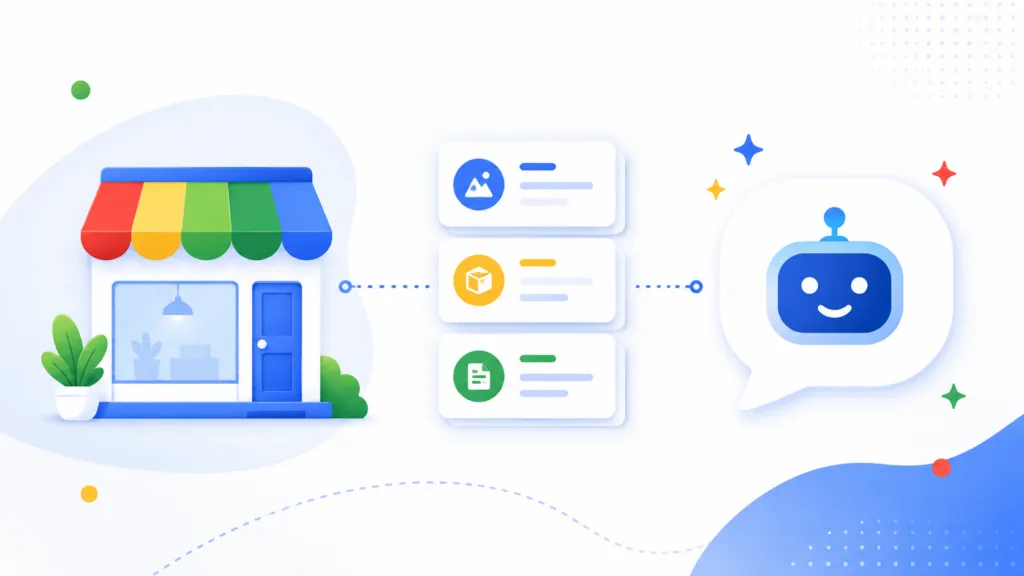
Google is building an AI chatbot that can answer your customers’ questions automatically, using information from your Google Business Profile and your website. A version of it briefly showed up inside Google Business Profile messaging before Google pulled it back, and the same technology looks like it could reach regular business websites too. Whether or not you want a chatbot, the smart move right now is to organize your business information into a knowledge base that AI can read.
At TJ Digital, we run AI search optimization for around 40 to 50 businesses, and we already build this kind of knowledge base for every client. We call it a Brand Ambassador, and it is the foundation for getting a business recommended by AI.
Table of Contents
ToggleWhat Is Google’s AI Chatbot for Businesses?
Recently, some businesses logging into their Google Business Profile saw a new messaging tab for a few hours. Google Business Profile had a messaging feature years ago, but this one was different, because the replies were powered by AI. The chats were split into two views, one for messages handled by the AI agent and one for messages that need your attention.
The AI answers routine questions on its own, things like your hours, location, and services, and it hands off anything complex to a human. Google has not officially announced the feature, and it disappeared shortly after it showed up. The local SEO community spotted it first, and a Google product manager pointed to Google’s RCS for Business, which suggests the two are connected.
@tjrobertson52 Is Google adding an AI chatbot to my business profile? Looks like it. Start building your knowledge base now. #LocalSEO #AISearch #SmallBusiness
♬ original sound – TJ Robertson – TJ Robertson
Is Google’s AI Chatbot Coming to All Websites?
The Business Profile version is aimed at local businesses, but the underlying technology does not have to stop there. Google’s RCS platform is built for companies of all kinds, and it points toward AI chatbots that could live on regular business websites, well beyond Google Business Profile. This fits a larger pattern we have covered before, where AI agents replace websites as the main way customers interact with a company.
None of this is confirmed yet. Google moves fast though, and when a feature shows up in testing, it usually means a wider release is coming.
Where Does the AI Chatbot Get Its Information?
The chatbot pulls from two places, your Google Business Profile and your website. That means every field on your profile and every answer on your site becomes source material for the AI. If a detail is missing, the AI has to guess, and a wrong guess can send a customer to a competitor.
So keep your hours, address, services, and pricing identical across your Google Business Profile and your website. Fill in every profile field you can. Make sure your site actually contains the information a potential customer would want, because gaps in your information become gaps in the AI’s answers.
How to Prepare Your Website for Google’s AI Chatbot
The best preparation is building an organized knowledge base about your business. Here is where to start:
- Gather your real questions. Pull the questions customers actually ask from calls, emails, and chats, and make sure each one is answered clearly on your site.
- Build proper FAQ pages. Give products, pricing, shipping, and policies their own clear questions and short answers.
- Use clear headings and lists. Format answers so an AI can lift them without digging through long paragraphs.
- Keep everything consistent. Your hours, location, and pricing should match everywhere they appear.
- Keep it current. Review your information regularly so the AI never repeats something outdated.
What Is the Open Knowledge Format?
Google also announced the Open Knowledge Format, a new standard for structuring your company’s knowledge so AI can read it. It is a set of plain text files, organized in folders, with a small block of information at the top of each file that tells an AI what the file contains. I would be surprised if these new chatbots cannot connect to a knowledge base built this way.
The format is very new, released in June 2026, and it is not required for anything yet. I still recommend getting started, because it looks like where things are heading. I wrote a full guide on the Open Knowledge Format if you want the details.
What Changes When Your Business Is Ready
Here is the difference between a business that has organized its information for AI and one that has not:
| Situation | Prepared business | Unprepared business |
| Chatbot answers | Accurate, pulled from a complete knowledge base | Incomplete, the AI guesses or gives up |
| Questions after hours | Answered instantly, around the clock | Missed until a person replies |
| Showing up in AI recommendations | More likely, information is rich and consistent | Less likely, information is thin or conflicting |
| Risk of wrong answers | Low, data is verified and current | High, gaps and old data become AI answers |
Do These AI Chatbots Actually Help?
Yes. A chatbot that answers instantly keeps customers engaged. They get an answer on the spot, so they are less likely to leave and check a competitor, and even the smallest business can match the response time of a much larger one.
This matters more every month, because AI is becoming the way people find and choose businesses. AI-referred visitors convert at about 8 times the rate of traditional search visitors, so being easy for AI to understand and recommend has real value.
Risks of Letting Google’s AI Answer for You
Handing your customer conversations to an AI carries real risk. The biggest one is wrong or outdated information, because the AI will repeat whatever it finds, right or wrong. An expired coupon or an old price can turn into a promise you never meant to make.
Keep a human in the loop. Watch the chat logs, keep your contact details visible, and treat the AI as an assistant that handles the first touch while you handle anything sensitive. The two-tab setup, with one view for messages that need your attention, is built for exactly this.
Why This Is Good News for Small Businesses
I think this is ultimately a good thing for businesses. Every company gets a 24/7 helper that answers common questions the moment a customer asks. That used to be something only big companies could afford.
The truth is, AI is becoming the interface between your customers and your company. If AI can easily get the information it needs about your business, it will recommend you. If it cannot, it will move on to your competitor, so the businesses that organize their information first will have the advantage.
Is Google’s AI chatbot available now?
Not officially. It appeared briefly in Google Business Profile messaging and was pulled back, so it is still experimental. The direction is clear though, and preparing now costs you nothing.
Do I need to turn on Google Business Profile messaging?
Turning it on and filling out every profile field puts you in a strong position for when AI messaging arrives. Just be ready to respond, because slow replies can hurt more than help.
Will an AI chatbot replace my website?
Not soon. For now the chatbot pulls from your website and your profile, so both matter even more. A rich, well-organized site gives the AI better material to work with.
What is an AI knowledge base for a business?
It is an organized set of documents covering your services, pricing, policies, and common questions that any AI tool can read. We build one for every client we work with. Google’s Open Knowledge Format is one way to structure it.
Get Your Business Ready for AI
Google is moving quickly, and the businesses that organize their information first will win. Get a free digital marketing audit from TJ Digital, and we will show you exactly where to start with your knowledge base.