
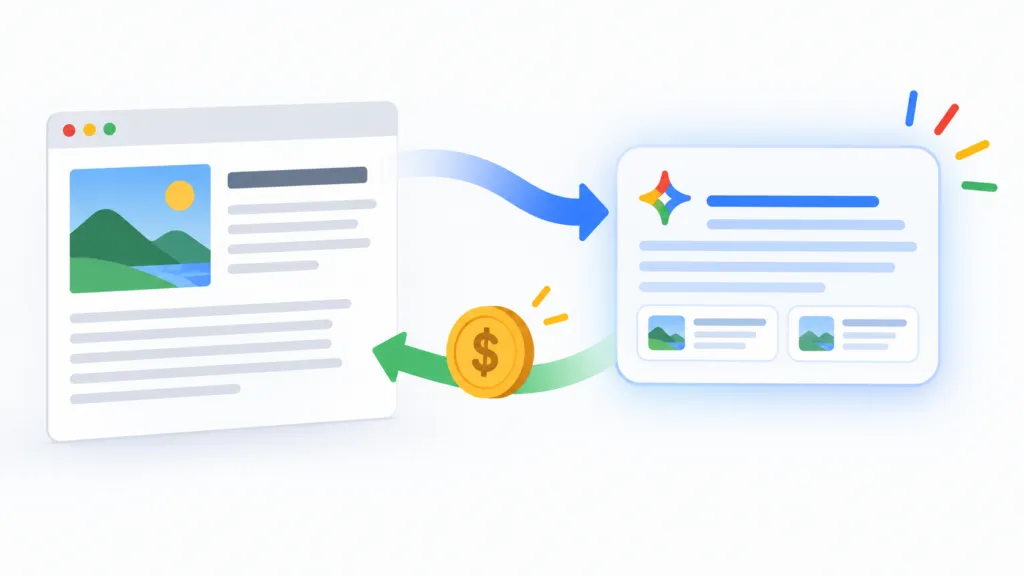
Google’s AI contribution pilot pays select publishers when their content makes a meaningful contribution to answers in AI Mode, AI Overviews, and the Gemini app. Google is paying publishers because AI answers are replacing the search traffic that used to reward people for publishing. At TJ Digital, we help more than 40 businesses show up in AI answers like these, and I see this pilot as an early test of a new incentive to keep people creating high-quality content.
The program is invite-only and still in its early stages. Even so, anyone with a website should pay attention, because this is Google showing where it thinks search is headed.
Table of Contents
ToggleWhat Is Google’s AI Contribution Pilot?
The AI contribution pilot is an invite-only program inside Google Search Console that pays websites when their content significantly shapes an AI-generated response. Most of what we know comes from publishers in the pilot who have shared screenshots, along with reporting from Digiday. Here’s what’s been confirmed so far:
- Invited sites get a new AI contribution panel in Search Console that shows a monthly earnings total with some history.
- The payments cover AI Mode, AI Overviews, and the Gemini app.
- Google has approached dozens of publishers, and the pilot reaches well beyond news outlets. Small and mid-sized publishers have shown the most interest so far.
- Google has confirmed the program is an early-stage test of how to reward high-quality content.
- Publishers can leave the pilot at any time.
- The earnings shown in the panel can differ from the final payout because of taxes and local payment thresholds.
@tjrobertson52 Is Google paying publishers for AI Overviews? Yes, but only in an invite only pilot for now. Here’s why they started. #SEO #AISearch #GoogleUpdate
♬ original sound – TJ Robertson – TJ Robertson
How Does Google Decide How Much to Pay Publishers?
The pilot works as a pay-per-value AI licensing program. Google pays based on how much value it thinks your content added to an AI answer. According to the pilot’s help text, only content that shapes an answer while it’s being generated counts.
Right now, Google is the only one deciding how much value you contributed. Google hasn’t shared the formula behind the monthly total. One executive familiar with the program described it to Digiday as a black box.
That said, several publishers in the pilot say Google has been collaborative in developing the program. Some partners have weekly calls with Google to share feedback. That tells me the payment model is still being worked out.
Why Are Publishers Upset About Google’s AI Payments?
Publishers are understandably upset because Google makes serious money from their content and appears to be offering them pennies in exchange. I don’t know exactly how much Google is paying, but everyone assumes it’s not a lot.
One source close to the program told Digiday the early payouts have been “peanuts” compared to ad revenue. Some publishers also worry that accepting small payments now will weaken their bargaining power when negotiating better terms with Google. Google could point to the pilot as proof it already pays for content.
But Google holds all the cards right now. In the U.S., no law currently requires Google to pay publishers when its AI uses their content. And most publishers still depend on Google to send traffic to their websites, even as more of that traffic gets absorbed by AI answers.
Why Is Google Paying Publishers Now?
I think Google is paying publishers because it needs a new incentive to get people to create content and share data. For a long time, that incentive was pretty clear. If you created content, Google sent traffic to your website.
As AI gets smarter, faster, and more capable, it makes less and less sense for people to dig through websites for the information they need.
A Pew Research Center study tracked the Google searches of 900 U.S. adults in March 2025. When an AI summary appeared, people clicked a traditional search result in 8% of visits, compared to 15% without one. Users clicked a link inside the AI summary itself in just 1% of visits.
Why Does Google Need Publishers to Keep Creating Content?
Google’s AI still needs a steady supply of good content to work. Google said as much in a June post on its public policy blog, describing the goal as keeping its AI answers fresh and accurate through a process called grounding.
Google had a pretty good thing going for a long time, and now it’s being forced to adapt to AI just like everyone else. Google’s existence depends on you being able to make money by producing high-quality content. If publishing stops paying off, the content that feeds Google’s AI starts to dry up.
If you’re still running a business model that depends on traffic coming to your website, I’d urge you to adapt as well. That business model is dying. The good news is that Google is desperately looking for a new model to replace it, and this pilot is one possible answer.
Will Google Start Paying All Websites for AI Content?
I think Google is preparing for a wider rollout, though it hasn’t announced any plans yet. The earnings data lives inside Search Console, the same tool site owners already use to monitor their search performance. Putting it there makes me think Google expects to open the program to many more sites.
Google also added a generative AI performance report to Search Console in August 2026. The report shows impressions from AI Overviews and AI Mode. We’ve covered how to track AI search performance with Search Console if you haven’t set that up yet.
Is Google Testing Other Incentives for Publishers?
My guess is that this pilot isn’t the only experiment Google is running. I’d be shocked if Google isn’t looking at other ways to get people to create high-quality content.
As people spend less of their time on websites, it feels a little odd that the way we deliver information to AI models is by publishing content on a website. AI models would much prefer direct access to the data.
What Is Agentic Resource Discovery?
Agentic Resource Discovery is an open specification Google announced in June 2026 that helps AI agents find what a website offers. A site publishes a file called ai-catalog.json that describes its tools, APIs, and agents, so AI agents can discover and connect to them directly. The reward for sharing in this case is visibility.
How Do Google’s Publishing Incentives Compare?
Traditional search offers traffic, the AI contribution pilot offers money, and Agentic Resource Discovery offers visibility. Here’s how they compare:
| Incentive | What You Provide | What You Get | Where It Stands |
| Traditional search traffic | Pages Google can rank | Visitors to your website | Shrinking as AI answers more questions |
| AI contribution pilot | Content that shapes AI answers | Monthly payments Google calculates | Invite-only pilot |
| Agentic Resource Discovery | A catalog of your site’s tools and APIs | Discovery by AI agents | Open specification announced in June 2026 |
So I think we’re in a weird transition stage where Google is still trying to find the best way to reward the creation and sharing of high-quality content.
Can Your Website Get Paid for AI Answers?
Only if Google invites you, at least for now.
Can You Apply to Join Google’s AI Payment Program?
No. Google chooses who joins the pilot and has been reaching out to publishers directly.
Does an AI Overview Citation Count Toward Earnings?
No. According to the pilot’s help text, a link to your page or a fact check against it after an AI answer is generated doesn’t count toward earnings.
Should You Join if Google Invites You?
For most small and mid-sized sites, I’d say yes. The payments are extra revenue for content you’re already publishing, and you can opt out whenever you want.
How Should You Prepare Your Website for AI Search?
My advice is to work with this system while Google figures it out. Just like in the early days of search, there are going to be big opportunities for the people who are prepared to take advantage of this transition. Being prepared comes down to a few things:
- Build a system for creating high-quality content. Sites that supply fresh, accurate information consistently are best positioned for whatever incentive wins out. At TJ Digital, that system is a Brand Ambassador for each client, an AI project that knows the business and writes in its voice.
- Decide what data you’re willing to share. AI models want direct access to information, so figure out what you’re comfortable making available to them.
- Check your AI reports in Search Console. The generative AI performance report is the best data Google gives you on how often your pages show up in AI answers.
- Measure recommendations alongside traffic. If you sell a product or service, getting recommended by AI matters more than the click. Here’s why losing traffic to AI can be fine for most businesses.
At TJ Digital, we help small and medium-sized businesses get recommended by AI through content systems, recommendation building, and AI visibility tracking. We’re at capacity right now, so join our waitlist and I’ll personally reach out when we have room.