
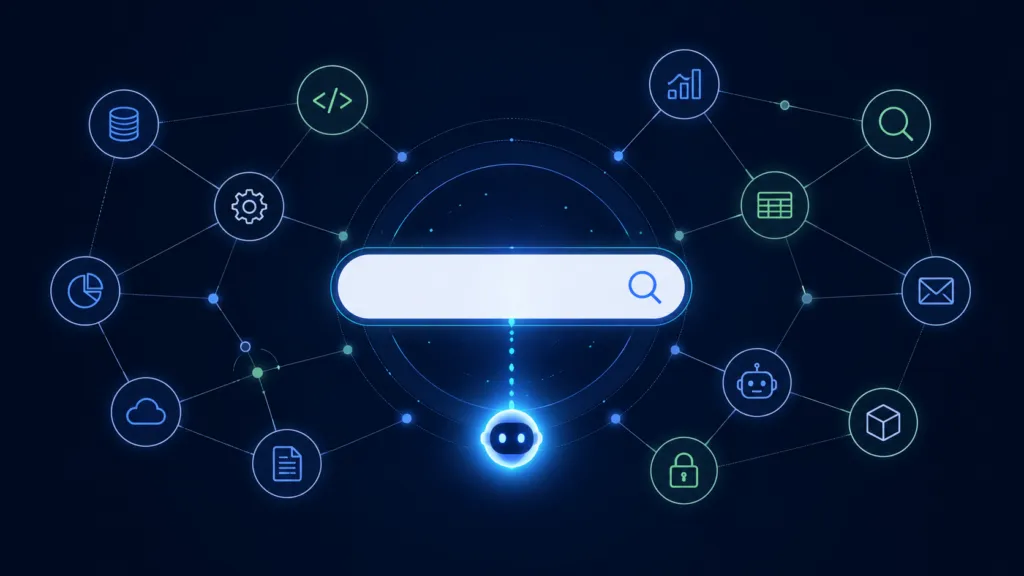
Google just built a second search engine, and this one is not for you. It is for AI agents. The new protocol is called Agentic Resource Discovery, or ARD, and it lets AI agents find tools and other agents the same way the regular Google helps people find websites.
At TJ Digital, we manage AI search optimization for roughly 40 to 50 client websites and track around 4,000 AI prompts a day across ChatGPT, Google AI Mode, and Perplexity. We watch every move the major platforms make, because they tell us where the work is heading. ARD is one of the clearer signals we have seen. The web is splitting into two layers, one for humans and one for machines, and Google is now indexing both.
Here is what ARD actually is, why Google built it, and what it means for your business.
Table of Contents
ToggleWhat Does Agentic Resource Discovery Do?
ARD is a search engine for AI agents to find tools and agents made for AI agents.
That is worth slowing down on. The regular Google helps people find websites and information. ARD does something separate. It helps an AI agent find a tool it can use or another agent it can hand a task to.
Say an agent needs to analyze keyword density on a page. Instead of having that capability hardcoded into it ahead of time, the agent can ask ARD in plain language, get back a matching tool, verify who published it, and start using it right then. No setup. No integration done in advance.
Google announced the specification as an open standard built with partners across the industry. Any company can run a registry or build an agent that uses it. That openness matters, and I will come back to it.
@tjrobertson52 Google’s new search engine for AI agents isn’t for people. It’s for agents to find other agents and tools. #AI #SEO #Google #AIagents
♬ original sound – TJ Robertson – TJ Robertson
How Does ARD Work?
ARD runs on two simple pieces. Google calls them catalogs and registries.
A catalog is a file you host on your own domain. It sits at a predictable address, something like yourdomain.com/.well-known/ai-catalog.json, and it lists every AI-accessible capability you offer. Each entry has an ID tied to your domain, a short description, the type of tool, the address an agent uses to call it, and a few example questions the tool can answer.
A registry is the search engine part. Registries crawl these catalog files across the web and index every capability they find. When an agent needs something, it sends a plain-language request to a registry. The registry matches that request against the example questions in everyone’s catalogs, ranks the results, and returns the best matches along with proof of who owns each one.
Google describes the full flow in four steps:
- Publish your catalog. You host the ai-catalog.json file on your domain.
- Discover. An agent queries a registry in plain language, or fetches your catalog directly if it already knows about you.
- Verify. The agent confirms the publisher’s identity, which works because the catalog lives under your own verified domain.
- Connect. The agent calls your tool directly and gets to work.
Because trust is anchored to domain ownership, an agent can be reasonably confident a tool listed under yourdomain.com actually belongs to you. That is the same principle that makes a verified domain meaningful for email or a website today.
ARD vs Traditional SEO: What Is the Difference?
SEO optimizes your pages so people find you. ARD exposes your tools so AI agents can find them. They serve different users and they work in completely different ways.
Traditional SEO is about ranking web pages for human search queries. You optimize titles, content, and structured data so a person scanning Google results clicks through to your site. ARD has no ranking algorithm in the SEO sense. An agent picks a tool based on how well your example questions match its request and whether it can verify you. You are optimizing for machine readability, which means giving agents clear endpoints, clear descriptions, and accurate metadata.
Here is how the two compare:
| Traditional SEO | Agentic Resource Discovery | |
| Who it serves | Human searchers | AI agents |
| What it exposes | Web pages and content | Callable tools and agents |
| How you get found | Ranking in search results | Matching an agent’s plain-language request |
| The file involved | sitemap.xml | ai-catalog.json |
| What you optimize | Titles, content, links | Tool descriptions, example questions, endpoints |
One detail in that table does a lot of work. The example questions you write for each tool function a lot like a title tag does in SEO. They are the text an agent matches against, so vague descriptions get your tool skipped the same way a vague title tag buries a page.
You need both approaches. People still find you through search, and that is not changing soon. Machine readability sits alongside SEO and makes you findable to agents too. It strengthens your discovery and adds a second way to be found.
This is the same shift we wrote about with LLMs.txt and WebMCP. Those standards help agents read and use your website. ARD goes one layer higher and exposes the tools and agents you offer. They stack together, each handling a different job.
Why Did Google Build a Search Engine for AI Agents?
Google built ARD because the way people interact with businesses is changing, and agents are moving to the center of it.
We are heading toward a world where you describe a goal to an AI agent and it handles the work for you. Instead of visiting several websites, reading pages on each, filling out forms, and making calls, you tell an agent what you want and let it go. The agent reads the sites, fills the forms, and makes the contact on your behalf.
The data backs this up. Bain & Company found that 30% to 45% of US consumers already use generative AI to research and compare products before buying. That number is climbing, and as it does, the agent becomes the buyer. When the agent is the buyer, your business has to be readable to a machine, because a person is no longer the one clicking through your website.
Google saw this coming and built the infrastructure for it. Pretty soon, agents are going to use ARD to find tools and other agents to complete tasks. The businesses whose capabilities show up in that search engine get used.
Should Your Business Build Tools for AI Agents?
For most small businesses today, the honest answer is not yet, and here is the thinking behind that.
ARD is only relevant right now if you actually host tools or agents that other agents can use. Most businesses do not, so there is nothing to publish in a catalog yet. Publishing an empty menu does nothing.
What is changing fast is how easy these tools are to build. AI has made it realistic for an ordinary business to stand up a working tool or agent, and that was not true even a year ago. I think within a few years, having an agent for your business, or several, is going to be as important as having a website is today. We are moving away from a world where customers interact with you and your website directly, and toward one where agents are the interface everyone uses.
So the move for most business owners is to understand the shift now and start getting the foundation in place. That means making your website readable and usable by agents first. The tools and catalogs come after you have something worth exposing.
There is also a real first-mover advantage here. Most of the launch partners had not even published a catalog days after Google announced the spec. The window is open. If your competitor has a tool an agent can find and you do not, the agent picks them by default.
Common Questions About Agentic Resource Discovery
Is ARD the same as MCP?
No. MCP gives an agent a standard way to call a tool it already knows about. ARD is the layer in front of that, the part that helps an agent find the right tool in the first place. You can think of ARD as the search step and MCP as the connection step.
What is an ai-catalog.json file?
It is the file you host on your domain that lists your AI-accessible tools and agents. It works like a menu an agent can read, telling it what you can do and where to call each capability. You keep it updated as your AI-enabled services grow.
Does ARD replace SEO?
No. SEO gets your pages in front of people, and ARD exposes your tools to AI agents. They cover two different jobs and work best together. You still want human visitors from search while also being readable to agents.
Do I need to set up ARD today?
Only if you already host tools or agents that other agents can use. Most small businesses do not yet, so the first step is making your website readable and usable by agents. The catalog comes once you have a working tool worth listing.
What Should You Do About ARD Right Now?
Start with the layer underneath ARD. Make your website something an AI agent can read, understand, and act on. That work pays off no matter how fast the tool-and-agent layer arrives, and it is the foundation everything else sits on.
If you want to go deeper on the technical setup, SEO consultant Suganthan Mohanadasan published a detailed walkthrough titled “I Shipped Agentic Resource Discovery on This Site (And a Client Found Me)” on his blog at suganthan.com. He explains exactly how to publish a catalog and why the listed tools have to actually work, and a real client found him through it.
We help small and medium-sized businesses get ready for this shift every day, and the businesses preparing now are the ones agents will default to later. Reach out to TJ Digital and we will show you where your website stands and what to do next.