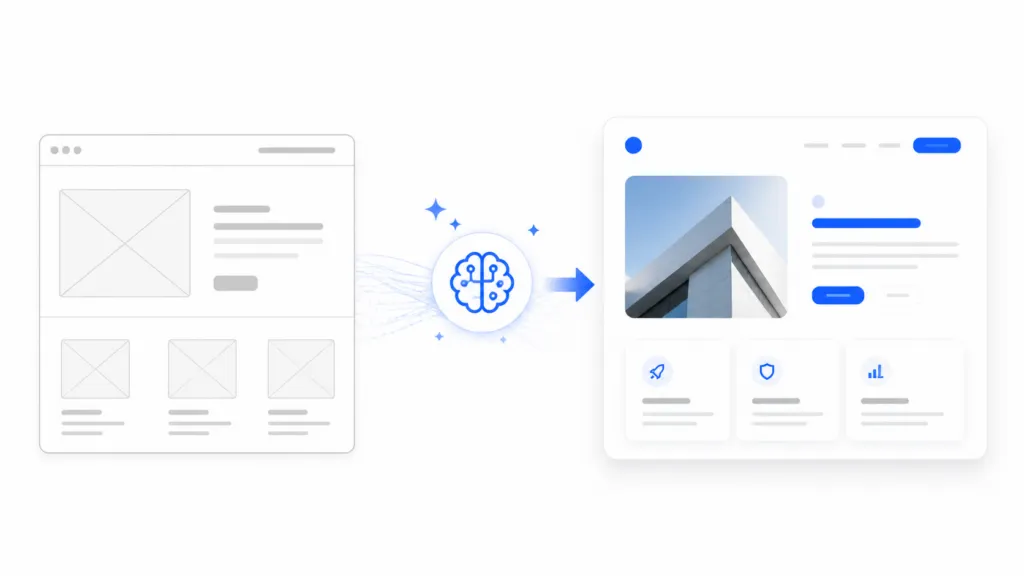
AI design tools are changing web development faster than any shift I’ve seen in 17 years of digital marketing. GPT Image 2 and Claude Design can now produce beautiful, functional websites with almost no manual coding. The remaining challenge is the CMS layer that lets a business actually run, update, and maintain that website over time.
At TJ Digital, where we manage roughly 40 to 50 client websites, we test every major AI design tool the moment it releases. What we’re seeing is a clear divide.
Front-end design is largely solved. The platform that connects AI to a real, maintainable CMS will be the next big winner.
Table of Contents
ToggleWhat GPT Image 2 Changed About AI Design
GPT Image 2 is the latest version of ChatGPT’s image generation model. It can produce high-fidelity UI mockups, brand graphics, and even legible text inside designs. That last part matters because earlier image models struggled to render readable text, which made them awkward for actual design work.
A single prompt in ChatGPT can now produce a polished image asset that used to take hours in Photoshop or Figma.
OpenAI also seems to be testing a new pro model in stealth. People testing it report that it’s remarkably good at front-end design and coding.
You can drop in a screenshot of a website and the model will replicate it almost perfectly. By the time you read this, that model may already be public.
@tjrobertson52 GPT Image 2 dropped and design work is never going back. Biggest AI image jump yet and that’s not even the main story. 👀 #AIDesign #ChatGPT #WebDesign #DesignTools
♬ original sound – TJ Robertson – TJ Robertson
How Claude Design Compares to GPT Image 2
Anthropic released Claude Design just days before GPT Image 2 launched. The two tools take different approaches.
Claude Design generates editable HTML, CSS, and interactive prototypes from text prompts or uploaded images. It’s built for developer handoff, meaning the output is structured code you can deploy directly.
The catch is that Claude Design cannot generate images. You have to import your own.
GPT Image 2 generates the visuals natively. You don’t need to upload anything to get a usable design.
The designers I talk to are starting to use both. GPT Image 2 for visual exploration and graphic generation. Claude Design for building working prototypes and shipping code.
| Capability | GPT Image 2 | Claude Design |
| Generates images | Yes | No (must import) |
| Generates HTML and CSS | Yes (with pro model) | Yes |
| Interactive prototypes | Limited | Yes |
| Best for | Visual exploration, brand graphics | Developer handoff, deployable code |
| Available in | ChatGPT | Claude Labs |
Why AI-Generated HTML Isn’t Enough on Its Own
Here’s where things get interesting. AI can now produce beautiful, functional HTML websites in minutes. That was unthinkable two years ago.
But you’re left with a folder of HTML files. There’s no obvious way to organize them, update content, or maintain the site as the business grows.
For a static site like a single landing page or brochure, AI-generated HTML might be enough. For a real business website with blog posts, product pages, forms, and ongoing content updates, you need a CMS.
Without one, every content change means re-prompting the AI or hand-editing files. That doesn’t scale.
This is the same gap I covered in more depth when I wrote about building websites with AI earlier this year. The visual layer is solved. The operational layer is the bottleneck.
Why WordPress Isn’t Keeping Up With AI
WordPress still runs about 40% of the web. It has a massive plugin ecosystem and decades of momentum behind it. But it wasn’t built for AI agents to do the development work, and it isn’t adapting fast enough.
WordPress runs on PHP and MySQL, with plugins hooking directly into core execution through actions and filters. For an AI agent trying to make a safe change, that environment is hard to reason about. Update one thing and three others might break in ways the agent can’t predict.
The result is a growing gap between what AI can do for web design and what WordPress can support without heavy human supervision.
Why EmDash Is the Most Promising AI-Native CMS
Cloudflare EmDash is the most promising AI-native CMS I’ve seen so far. Here’s what makes it different.
- Built in TypeScript on the Astro framework
- Runs serverless
- Each plugin runs in its own sandboxed environment
- Built-in MCP server, so AI agents can manage content directly through structured tool calls
Content is stored as JSON instead of static HTML. That makes it dramatically easier for AI agents to read, update, and restructure pages without breaking anything.
EmDash is still early. The plugin ecosystem is tiny compared to WordPress. Most advanced features like ecommerce, full SEO suites, and form builders would have to be rebuilt in TypeScript.
We’re already migrating tjrobertson.com to EmDash, and we expect to start building client sites on it for businesses that want to bet on where things are heading. WordPress remains our primary platform for now.
There’s also a real possibility that Anthropic, OpenAI, or Google bakes CMS-like functionality into their existing products. OpenAI already partnered with Wix on an AI Website Builder. Google’s Gemini Canvas can turn research into a basic web page from a prompt.
None of those is a full CMS yet, but the trajectory is there. I’m sure there are already a thousand other startups trying to be this platform too.
What This Means for Small Business Websites
Here’s the short version. If you’re a small business owner, the changes happening right now are good news for you.
For years, a real, custom-built business website meant either an expensive agency or hiring a developer. Now, AI design tools can produce the front end at a fraction of the cost.
The CMS layer is being rebuilt around AI workflows. Within the next year or two, building and running a high-quality business website will be cheaper and faster than it has ever been.
The tradeoff is choosing a platform. WordPress still has the largest ecosystem and works for most business sites today. EmDash is the bet on where things are heading.
Most of our clients will stay on WordPress for now, but we expect that mix to shift over the next few years.
The bigger question for any business owner is whether AI agents replace websites entirely. That’s the longer-term shift worth preparing for, regardless of which CMS you build on today.
Can GPT Image 2 Build a Complete Website?
Not on its own. GPT Image 2 generates images, including UI mockups and brand graphics. The broader ChatGPT pro model handles the working HTML and CSS.
Together, they can produce both visual design and deployable code from a single prompt. You’ll still need a CMS, hosting, and a way to manage content over time before you have a real website.
Is Claude Design Free to Use?
Claude Design is part of Anthropic’s Claude Labs. Access depends on your Claude plan, with the base capabilities available to most paid users. Anthropic has been adding features quickly, so check their site for the current state.
Is EmDash Ready for Production Use?
EmDash launched in beta on April 1, 2026, so it’s still very new. We’re using it for content-driven sites where we’re comfortable doing custom development. For sites that depend on established WordPress plugins like WooCommerce, membership systems, or complex page builders, it’s not ready yet.
Should Small Businesses Build Websites With AI Alone?
For a simple landing page or brochure site, AI tools can produce a usable result with minimal cost. For a real business website that needs to drive leads, rank in search, and grow with the business, you still benefit from someone who knows what to build and what to optimize for. The tools are getting better, but choosing the right strategy is still the harder problem.
Get a Second Opinion on Your Website Strategy
Reach out to TJ Digital for a free marketing audit. I’ll review your site personally and walk through what I’d change to position it for both AI search and traditional search.