
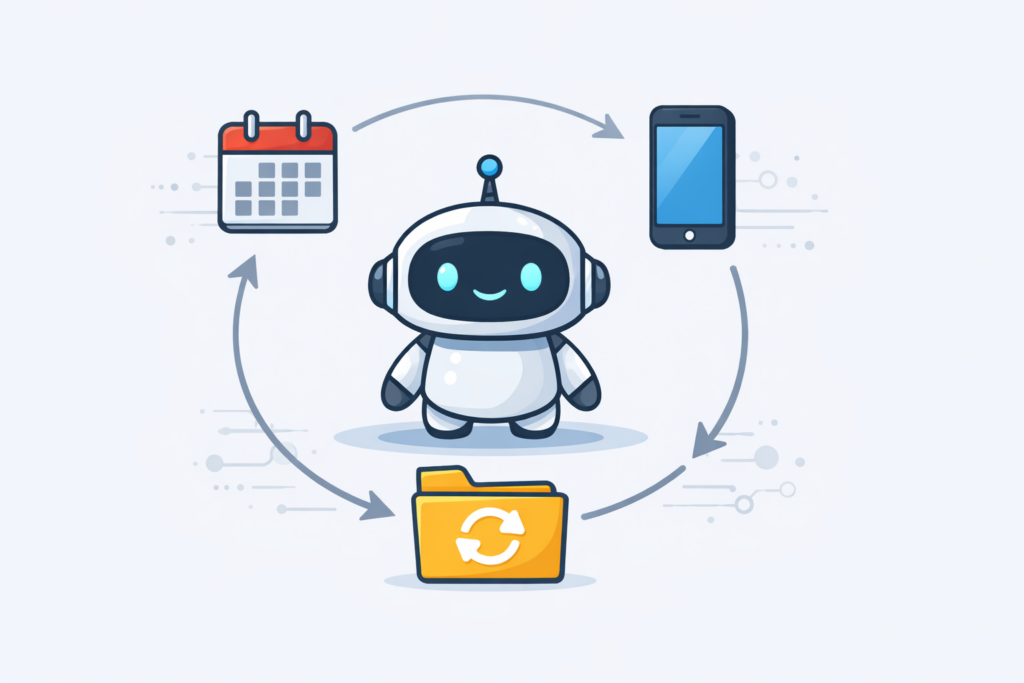
Fully autonomous AI agents, ones that work 24 hours a day as genuine members of your team without any human prompting, are closer than most people think. Three features separate where we are now from that reality: scheduled task execution, remote communication access, and the ability to update their own knowledge. At TJ Digital, we’ve been building AI brand ambassadors for clients that contain hundreds of pages of business context, so we’ve felt the gap between “capable AI tool” and “truly autonomous agent” firsthand.
Two of those three features just arrived. Anthropic added task scheduling and remote access to Claude within the same week. The third, self-updating knowledge, is still missing from every major platform.
Table of Contents
ToggleWhat Does “Fully Autonomous AI Agent” Actually Mean?
@tjrobertson52 We’re 3 steps from fully autonomous AI agents. Two just dropped. One doesn’t exist yet 👀 #AIAgents #Anthropic #ClaudeAI #AIAutomation #TechTok
♬ original sound – TJ Robertson – TJ Robertson
A fully autonomous agent does three things without you prompting it:
- Scheduled execution: the agent runs tasks on its own, on a set cadence, without you having to ask
- Remote communication: you can interact with it through whatever channel you actually use, like your phone or messaging apps
- Self-updating context: it can add new information to its own knowledge base without manual intervention
We already have the technology to close this loop, as the open-source project OpenClaw demonstrated earlier this year. The remaining work is making it reliable, secure, and convenient enough for mainstream business use. That’s where the major model providers come in.
How Claude’s Task Scheduling Works in Cowork
Anthropic now lets you schedule recurring and on-demand tasks in Claude Cowork. You define a task once, set a cadence (daily, weekly, hourly), and Claude runs it automatically in its own session using all your connected tools and plugins.
Practical examples include a daily email and Slack summary, a weekly report pulled from Google Drive, or any other repeatable workflow that you currently trigger manually.
To set one up, type /schedule in a chat or use the Scheduled sidebar. Claude walks you through naming the task, describing it, and picking the frequency. You can review past and upcoming runs from the Scheduled page.
One real limitation worth knowing: scheduled tasks only run while your computer and the Claude Desktop app are awake. If your machine sleeps, the task is skipped. True 24/7 autonomous operation will require hosted infrastructure, which none of the major providers have fully delivered yet.
Task scheduling is the logical starting point for autonomy. You need an agent that can trigger itself before you can call it autonomous.
Can You Control Claude Code from Your Phone?
Yes. Anthropic’s Remote Control feature for Claude Code lets you communicate with Claude through your phone even when the session is running on your desktop. You run claude remote-control on your desktop, scan a QR code, and your phone becomes a live mirror of your Claude Code session.
If we want AI agents to become real members of our team, we need to communicate with them where we communicate with everyone else. Right now that’s primarily through our phones. Remote Control is a step toward agents being reachable via email, Slack, or wherever your team actually operates.
Technically, this works through an outbound connection to Anthropic’s API with no ports opened on your machine. Your code, file system, and local context all stay on your machine. Only messages and tool outputs travel through an encrypted bridge. It’s currently available for Claude Code Pro and Max subscribers.
Why AI Agents Still Can’t Update Their Own Knowledge
This is the piece that would change everything, and it doesn’t exist yet in any major platform.
Every AI model has some form of memory. But in its current state, memory is essentially a simple notes file. It can hold your preferences and some context about ongoing projects. It cannot hold hundreds of pages of brand documentation, process guides, product specs, or anything approaching the depth an actual team member would have.
At TJ Digital, our AI brand ambassadors often contain hundreds of pages of context: brand voice, service details, client history, competitive positioning, and specific instructions for different types of tasks. We store all of it in Google Docs so updates happen in real time.
The problem is that we’re still manually adding new information. Every time a client updates their services, pricing, or messaging, someone has to go in and update the brand ambassador documents. That’s a bottleneck that won’t go away until agents can update their own knowledge base.
OpenClaw already solves this. Its agents maintain a file called HEARTBEAT.md that contains instructions and a task checklist. You can tell the agent to update that file in plain language: “Add a daily calendar check to your heartbeat routine.” The agent edits the file and that change takes effect going forward. The agent also triggers itself on a regular interval to check for outstanding tasks, a mechanism they call a “heartbeat.”
That’s the architecture: the agent reads new information, writes it to its own knowledge store, and integrates it into future reasoning without a human in the loop. Once Anthropic or another major provider ships a secure, reliable version of this, the autonomous agent picture is basically complete.
If you want to understand how AI brand ambassadors work and why long-term context matters, this breakdown of our AI SEO process goes deeper.
Anthropic vs. OpenAI vs. Google: Autonomous Agent Features Compared
| Feature | Anthropic (Claude) | OpenAI | |
| Task scheduling | Yes (Cowork, desktop-dependent) | Limited | Limited |
| Remote / mobile access | Yes (Claude Code) | Via ChatGPT app | Via Gemini app |
| Team collaboration tools | Yes (Cowork) | Copilot integrations | Gemini Enterprise |
| Self-updating knowledge | No | No | No |
| Enterprise partnerships | Growing | Accenture, BCG, McKinsey | Google Workspace |
| Primary focus | Reliability, safety | Scale and ecosystem | Cloud and suite integration |
No one has all four. OpenAI has the broadest enterprise momentum through consulting partnerships. Google has deep integration across Workspace and BigQuery for corporate teams. Anthropic is adding autonomy features faster than most people are tracking and is where my money is for getting to fully autonomous agents first.
In practice, most businesses will probably end up using all three: Microsoft and Google agents inside productivity apps, OpenAI agents for workflows backed by expert services, and Anthropic for trusted or sensitive work. Whoever ships reliable self-updating context first is going to have a meaningful edge.
Security and Reliability Risks of Autonomous AI Agents
Speed to autonomy matters, but autonomous agents introduce risks that standard AI tools don’t.
An AI with broad tool access can cause real damage through ordinary operation. According to Help Net Security, 80% of organizations have already reported AI agent misbehavior such as unauthorized system access or data leaks. Security researchers have also documented prompt injection attacks and “shadow AI,” where employees feed sensitive company data into unvetted models without IT approval.
The reliability problem is subtler. An agent that partially completes a multi-step task and fails silently can corrupt data without triggering any obvious error. Imagine an agent that creates a customer record but fails to complete the associated billing entry. No crash, no alert, just a data integrity problem you find weeks later.
Most enterprises are and probably should be running autonomous agents in controlled pilot configurations, not fully unsupervised workflows. The architecture needs audit trails, fine-grained permissions, rollback logic, and human review gates for higher-stakes decisions. These are engineering requirements that have to be built around the AI, not problems that better models will automatically solve.
FAQ: Autonomous AI Agents
Can AI agents run tasks without human prompting?
Yes, but with limitations. Claude Cowork now supports scheduled tasks that run automatically on a set cadence. The caveat is that Claude’s scheduled tasks require the desktop app to stay awake. Truly uninterrupted 24/7 execution requires hosted infrastructure that most providers haven’t released yet.
What is Claude Cowork?
Claude Cowork is Anthropic’s local AI agent feature, available in the Claude Desktop app. It supports scheduled and on-demand tasks, with access to connected tools and plugins. As of early 2026, it supports recurring task scheduling for automating repeatable workflows.
What is the OpenClaw heartbeat mechanism?
OpenClaw is an open-source AI framework that runs continuously on your own hardware. Its heartbeat feature triggers the agent on a regular interval to check for outstanding tasks, review emails, or surface anything urgent. This lets the agent operate proactively rather than waiting for a prompt. It also supports writing to its own instruction files, making it one of the few examples of a self-updating AI agent.
Which AI provider is closest to fully autonomous agents?
All three major providers (Anthropic, OpenAI, Google) are actively building toward autonomous agents, but none has shipped a complete solution. Anthropic has moved the fastest in early 2026, shipping task scheduling and remote access within the same week. The remaining gap for all of them is self-updating long-term knowledge.
Are autonomous AI agents safe for businesses to use?
Cautiously, yes. Autonomous agents with broad access can cause damage through normal operation if security and permissions aren’t properly configured. Most businesses should start with controlled pilot setups, audit logging, and permission limits in place before expanding agent scope.
What This Means for Your Business
Task scheduling and remote access are live. Self-updating knowledge is the remaining piece. When that last feature arrives, the combination is an agent that works around the clock, stays reachable through your normal communication channels, and keeps itself current without anyone maintaining it manually.
The businesses that already understand how these systems work, and have built the AI infrastructure around their brand, will be best positioned when that becomes the baseline. The best time to build that foundation is now.
Reach out to TJ Digital to get started. We build AI brand ambassadors designed to grow with these capabilities as they develop.