
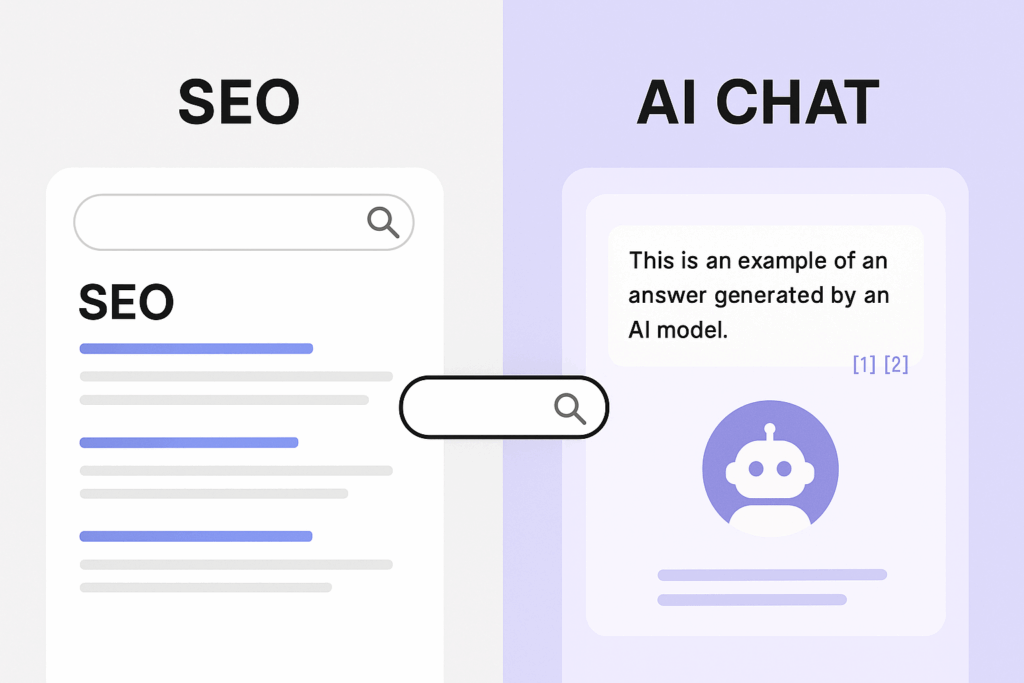
You don’t need a separate agency for AI optimization. If your current SEO agency is telling you they can’t handle GEO (Generative Engine Optimization), that’s a red flag. The strategy and process for ranking in ChatGPT is similar enough to traditional SEO that splitting this work between two agencies creates inefficiency and confusion.
Over the last few months, I’ve had about a dozen companies come to me saying they already have an agency handling their SEO and they’re just looking for someone to help with AI optimization or GEO. What I tell them is that probably doesn’t make sense.
Table of Contents
ToggleGEO Is an Extension of SEO, Not a Replacement
While ranking in ChatGPT is not exactly the same as ranking in Google, they share the same strategic foundation. Both focus on delivering helpful, authoritative content that answers user questions. The main difference is the format: traditional SEO gets you a list of links, while GEO gets your content cited in AI-generated answers.
There is a lot of work we do now to rank in ChatGPT that we wouldn’t do for traditional SEO alone. I wouldn’t be putting out press releases right now if it wasn’t for ChatGPT. We wouldn’t be so focused on things like case studies. There are directories I wouldn’t care about and blog topics I wouldn’t bother writing.
But all of these are expansions of our typical SEO campaign. It’s the same kind of work, done in tandem with everything we’ve always done for SEO. It all has to fit cohesively inside the same overall strategy.
@tjrobertson52 Can an SEO Agency Also do GEO? Your SEO agency says nothing changed with AI search? That’s a problem. Here’s what to ask them instead 👇 #SEO #ChatGPT #GEO #DigitalMarketing
♬ original sound – TJ Robertson – TJ Robertson
What Good SEO Agencies Are Already Doing for AI
A forward-thinking SEO agency should already be incorporating GEO tactics. Industry experts emphasize that SEO and GEO are complementary parts of one unified strategy, not competing disciplines that need separate teams.
Here’s what your agency should be doing differently:
Publishing Structured, AI-Friendly Content
Large language models prefer simple, structured formats like bullet points and FAQ-style content. Your agency should add FAQ sections, use clear headings, and create content that’s easy for AI to parse and quote.
Distributing Press Releases
Press releases have become surprisingly important for GEO. They’re structured, factual, and often published on high-authority domains. AI models trust official press releases as a reliable source material, making them more valuable now than they were for traditional SEO.
When you announce a new product, service, or achievement, a properly distributed press release helps ensure AI models have accurate information about your company.
Creating Detailed Case Studies
Case studies showcase your expertise through real examples and data. They give AI systems unique insights to work with beyond generic marketing copy. A case study that contains specific results (“increased productivity by 50%”) provides AI with concrete information to cite when answering related questions.
Ensuring Directory and Knowledge Graph Presence
Generative engines often draw on structured databases for certain queries. Your Google Business Profile, industry directory listings, and review site profiles all feed into what AI knows about your business. These need to be accurate and complete.
The Red Flag: “Nothing Has Really Changed”
This is not to say that traditional SEO is all you need, or that nothing has changed. I see at least one agency make this claim every day, and they’re always praised by the same section of the SEO community.
These are SEOs who want that to be true so badly because it would mean they don’t have to change anything. They can just keep doing what they’ve been doing.
If your current agency tells you that nothing has really changed and they’re essentially doing the same thing, maybe adding in a few more FAQs or structured data, I would consider finding another agency.
The overlap between Google’s top results and the sources cited in AI answers has dropped dramatically, from about 70% to under 20%. New factors, such as content structure, semantic relevance, and freshness, play a bigger role in whether AI selects your content.
Questions to Ask Your Current SEO Agency
If you’re currently paying an SEO agency, here are the questions you should ask them:
What are you doing differently to make sure we’re visible in ChatGPT and Google’s AI mode?
Listen for specifics. Are they monitoring your brand’s presence in AI answers? Are they structuring content differently? Pursuing new content types? If they claim nothing really changes, that’s a warning sign.
AI-driven search has fundamentally changed how content is retrieved and displayed. A competent agency should acknowledge these differences and explain its adaptations.
Which AI platforms do you think are most relevant to our business?
A savvy team will have investigated where your customers encounter AI results. They should be able to discuss your visibility on platforms like ChatGPT, Google’s AI mode, or Perplexity. If they only talk about Google rankings, they haven’t expanded their focus.
How do you measure success in generative search?
Traditional SEO metrics like rankings and clicks don’t fully capture AI visibility. An AI might quote your content without sending any traffic to your site. Forward-thinking agencies track new metrics such as AI citation frequency, share of voice in AI responses, and brand mentions in large language model outputs.
Can you give examples of content changes you’re making specifically for AI search?
Look for concrete actions. Are they adding structured data? Creating more FAQ sections? Publishing press releases? Integrating conversational keywords? An agency working on GEO will gladly share specific examples.
Why Splitting SEO and GEO Creates Problems
Separating SEO and GEO into silos can be inefficient because the two efforts should inform and strengthen each other. Here’s why having two separate agencies doesn’t work:
Your content strategy needs to be unified. You’re optimizing pages for both Google and AI systems. The same piece of content should rank in traditional search while also being structured for AI to cite. Fragmenting this work between separate vendors leads to misalignment or missed opportunities.
Many consultants in the GEO space came directly from the SEO world. The top strategies that get you visible in AI answers are largely the same ones that boost your traditional search rankings: creating quality content, making it easy to crawl, and earning credible mentions across the web.
Find an Agency That’s Excited About AI Opportunities
Find an agency that’s so excited about all these new opportunities that you can’t get them to shut up about it.
The right agency views GEO as an exciting expansion of what they already do, not as separate work requiring different expertise. They should naturally incorporate AI optimization into every campaign, from content creation to press releases to technical implementation.
If your agency is telling you “GEO is outside our scope” or trying to upsell a whole separate service without integration, that’s a problem. Most businesses don’t need to pay for an entirely separate “ChatGPT SEO” firm. They need their existing team to incorporate new best practices for AI-driven search.
Traditional SEO Alone Isn’t Enough Anymore
Strong SEO helps. AI systems often favor high-authority sites, which SEO cultivates. But large language models don’t strictly follow web rankings. They pull from sources they consider trustworthy or contextually relevant. Even a number one Google result can be ignored by an AI if it doesn’t fit the query.
Think of SEO as the prerequisite and GEO as the additional work needed to excel in the AI era. You still need quality content, technical SEO, and backlinks to build authority. But you also need to optimize specifically for how AI models consume and cite information.
Some SEO tactics need adjustment for AI:
Old-school SEO prized lengthy, comprehensive articles. But generative engines prefer concise, snippet-friendly content. Simply having a long blog post won’t work if the answer is buried in paragraph 12. It’s better to break information into easily digestible sections with clear labels.
In AI answers, being mentioned at all matters more than traditional metrics like click-through rate. An AI might quote your information without any click happening. The user gets the answer within the chat. Success looks different.
Why This Matters Now
AI-powered queries now average 23 words compared to about 4 words on Google. Platforms like ChatGPT and Perplexity are reshaping how over 200 million users find information. This shift in search behavior is massive, and businesses that ignore it risk losing ground to competitors actively courting AI engines.
The question isn’t “SEO vs. GEO, which one?” It’s “How do we integrate GEO into our SEO so our bases are covered in both traditional and AI search?”
When done right, you won’t need a separate agency for AI optimization at all. Your existing SEO framework will expand to cover it, keeping your business visible no matter how searchers ask their questions.
Ready to Rank in ChatGPT?
At TJ Digital, we’ve been optimizing for AI search engines since the beginning. We don’t treat GEO as an add-on service. It’s integrated into everything we do, from content strategy to press releases to technical implementation.
If your current agency can’t answer the questions in this article or seems behind on AI optimization, let’s talk. We’ll show you exactly what we’re doing differently to help our clients show up in ChatGPT, Google’s AI mode, and other large language models. Contact TJ Digital to discuss your AI optimization strategy.