
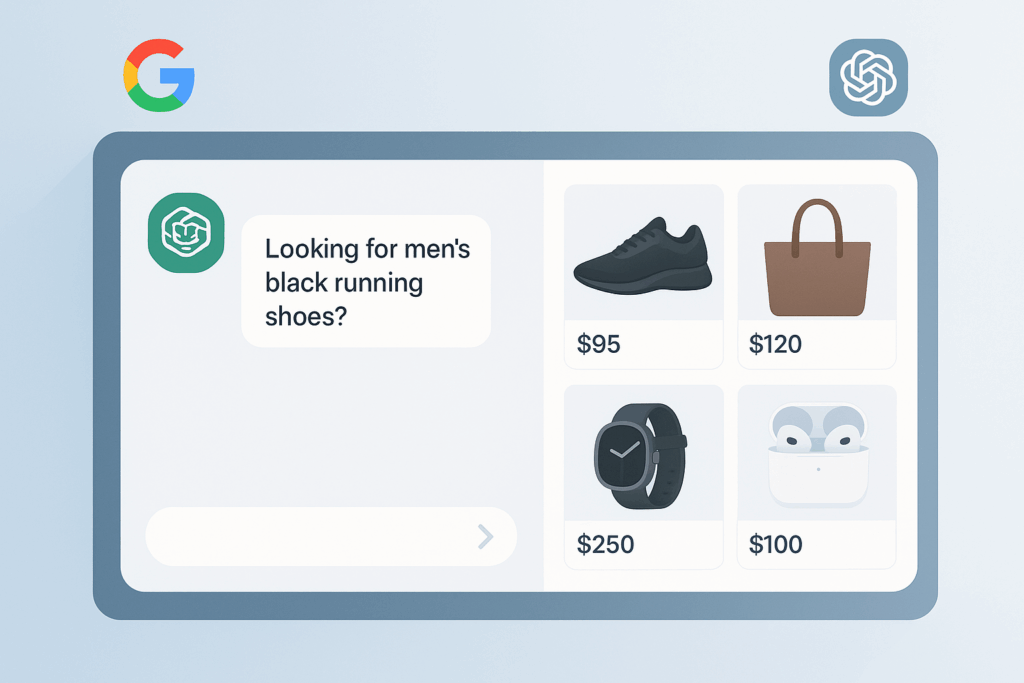
The way people find and buy products online is about to change dramatically. Within the last 24 hours, both OpenAI and Google announced competing AI shopping features that let users discover and purchase products without leaving their platforms.
ChatGPT now allows direct in-chat purchases from Shopify and Etsy stores with a 2% referral fee. Google has overhauled its AI mode to prioritize visual shopping results. Both platforms are racing to become what industry experts are calling the “operating system of the internet.”
For e-commerce businesses, this represents the first real challenge to Amazon’s dominance in product search and the beginning of a fundamental shift in how customers will find your products.
Table of Contents
ToggleWhat ChatGPT’s AI Shopping Feature Actually Does
ChatGPT’s Instant Checkout lets users find and buy products directly within chat conversations. The platform charges merchants a 2% commission on completed sales, significantly lower than Amazon’s typical 15% or Etsy’s 6.5% fee.
The process works like this: users describe what they’re looking for in natural language, ChatGPT surfaces relevant products, and customers can complete the purchase without leaving the chat interface. OpenAI handles the transaction and takes their 2% cut.
This model differs fundamentally from traditional e-commerce platforms. There are no keyword bids, no sponsored placements, and no pay-to-play search results. ChatGPT ranks products based on relevance, quality signals, and availability rather than advertising spend.
@tjrobertson52 ChatGPT + Google just changed online shopping forever. If you sell products online, you need to see this 👀 #ecommerce #chatgpt #aibusiness #shopify #entrepreneur #AISearch
♬ original sound – TJ Robertson – TJ Robertson
How Google’s Visual AI Shopping Works
Google’s approach focuses on visual discovery rather than direct transactions. The updated AI mode surfaces large product images from Google’s Shopping Graph, which covers approximately 50 billion products updated billions of times per hour.
Unlike ChatGPT, Google doesn’t process transactions or take referral fees. Product listings remain free for merchants, similar to Google’s existing free listings network. The platform monetizes through ads and merchant feeds while keeping the AI shopping experience focused on visual appeal and product discovery.
Why This Could Take Market Share From Amazon
Amazon currently holds approximately 64% of U.S. marketplace sales, and roughly 63% of shoppers start their product searches on Amazon rather than Google.
ChatGPT and Google’s AI shopping features challenge this dominance in three ways:
New organic discovery channels. ChatGPT provides product recommendations based on conversational queries without requiring merchants to bid on keywords. This bypasses Amazon’s pay-to-play advertising model entirely.
Different search behavior. AI assistants encourage longer, more detailed queries. Instead of typing “running shoes,” users might describe their specific needs, foot type, and intended use. This creates opportunities for merchants who provide detailed product information to match these nuanced searches.
Advertising revenue risk. Amazon’s most profitable business unit is advertising. If significant product search traffic shifts to ChatGPT or Google AI, Amazon could lose high-margin advertising dollars even if it maintains e-commerce volume.
However, Amazon’s logistics advantages remain unmatched. Prime’s fast shipping and easy returns keep it the default choice for many purchases, and Amazon is already expanding its fulfillment services to other retailers.
How to Optimize Your Shopify or Etsy Store for ChatGPT
To appear in ChatGPT’s product recommendations, treat your product pages like you would optimize for AI algorithms. Here’s what works:
Write natural-language product descriptions. Use clear, conversational phrases instead of bullet points. ChatGPT parses full sentences, so descriptions should anticipate how users would naturally describe what they’re looking for. Instead of “Men’s running shoe, lightweight, black,” write “Men’s ultra-lightweight black running shoe designed for marathon training.”
Add comprehensive structured data. Include complete schema.org markup for Product, Offer, and AggregateRating on every product page. These machine-readable attributes help ChatGPT ingest details like price, availability, and ratings. ChatGPT explicitly factors in quality signals when ranking products.
Display customer reviews prominently. ChatGPT uses reviews and ratings as trust signals. Integrate review apps so average ratings and review counts are visible to the AI. Social proof significantly improves your chances of being recommended.
Keep pricing and inventory accurate. ChatGPT ranks merchants partly on availability and price, so out-of-stock items get deprioritized. Use real-time inventory feeds through Shopify or Etsy APIs to ensure ChatGPT sees current stock levels.
Use high-quality product images. Provide clear, detailed photos from multiple angles. Images should be well-lit and large enough to show product details. Include descriptive alt text for each image.
The key difference from traditional SEO: ChatGPT surfaces products based on conversational relevance rather than keyword matching. Detailed, natural descriptions perform better than keyword-stuffed copy.
Integrating WooCommerce and BigCommerce Stores
Merchants on platforms other than Shopify or Etsy can connect through OpenAI’s Agentic Commerce Protocol (ACP). The integration process involves three steps:
Provide a compatible product feed. Export your catalog in the format specified by OpenAI’s Product Feed specification. This includes all product fields like titles, images, prices, availability, and identifiers. WooCommerce is building support for the OpenAI feed spec so AI assistants can discover products automatically.
Implement ACP checkout. Integrate the agentic checkout flow with your payment processor. If you use Stripe, enabling ChatGPT checkout can be as simple as adding one line of code. Other payment processors can participate using Stripe’s Shared Payment Token API or the ACP’s Delegated Payments specification.
Use platform-specific plugins. WooCommerce announced new features including an MCP merchant catalog API and built-in Stripe ACP support for version 10.3 and later. BigCommerce merchants should watch for similar integrations or use the general Stripe workflow.
The protocol is open-sourced, so developers can build connectors for any platform. The 2% referral fee remains fixed regardless of platform.
What to Do With Your Google Merchant Center Account
Google’s visual AI shopping mode requires accurate product data and compelling imagery. Here’s how to update your Merchant Center account:
Complete your product data feeds. Ensure your feed includes all required fields and rich attributes like brand, GTIN/UPC, and detailed categories. Google’s Shopping Graph updates billions of times per hour, so data freshness matters. Use supplemental feeds and attribute rules to keep information current.
Invest in high-quality visuals. Provide high-resolution product images with clean backgrounds for main shots, plus lifestyle images when possible. Google’s new shopping interface elevates larger product images for a more visually rich experience. Use Google’s Product Studio tool to generate or enhance images. The platform now offers AI video creation from existing photos.
Maintain data accuracy. Google updates prices and stock roughly every hour. Use automated feeds or the API to push changes immediately. Incorrect pricing or out-of-stock flags hurt visibility in AI-generated shopping panels.
Focus on visual storytelling alongside data integrity. The shift from text search to image-driven discovery means great product photography directly impacts your ranking.
The “Operating System of the Internet” and What It Means
As AI assistants become the default interface for search and shopping, individual websites are losing direct traffic. ChatGPT and Google AI increasingly act as the “front end” of the web, routing user queries through themselves rather than sending visitors directly to merchant sites.
This centralization is already happening. Google’s AI Overviews reach over a billion users monthly, and many users consume AI-generated answers without clicking any links. Some businesses report approximately 20% drops in organic traffic as users get their information from AI summaries.
For e-commerce businesses, this shift changes the goal. Instead of optimizing to drive clicks to your website, you’re optimizing to appear inside AI recommendations. Your product feed becomes your storefront, and every mention in an AI answer becomes critical for visibility.
The long-term implication: AI shopping algorithms act as gatekeepers. Products either get recommended by the algorithm or remain effectively invisible. INSEAD professors Nathan Furr and Andrew Shipilov observe that “the balance of power will likely shift away from retailers and towards brands and AI-agents.”
What This Means Beyond E-commerce
E-commerce is just the starting point. The trend is clear: OpenAI and Google want to keep users on their platforms for as many tasks as possible.
We’re moving quickly into a world where most people won’t visit individual websites or use discrete tools. Instead, they’ll accomplish tasks directly through AI assistants like ChatGPT or Google’s AI mode.
This pattern will extend beyond shopping. Service businesses, local companies, professional services—any business where customers currently use search engines to find options—will soon face the same shift. Recommendations from AI will increasingly determine which businesses get customers and which get overlooked.
The businesses that survive this transition will be those that understand how AI algorithms make recommendations and optimize accordingly. That means providing complete, structured information about your business everywhere online, gathering authentic customer reviews, and ensuring AI platforms can easily understand what you offer and why you’re the best choice.
Get Ready for AI Shopping Now
Whether you sell products on Shopify, Etsy, WooCommerce, or any other platform, the time to prepare is now. ChatGPT’s open API means any merchant can participate, and Google’s visual shopping updates are already live.
Start by optimizing your product data for conversational search. Write detailed, natural descriptions. Add complete structured data markup. Collect customer reviews. Keep your inventory and pricing accurate. Use high-quality images.
Then monitor how AI platforms are discovering and ranking your products. Track traffic from ChatGPT and Google AI through your analytics. Pay attention to which products get recommended and why.
The shift from traditional search to AI-driven shopping is happening faster than most businesses realize. The merchants who adapt now will have a significant advantage over those who wait.If you need help optimizing your e-commerce business for AI shopping, contact TJ Digital. We specialize in AI optimization strategies that help businesses show up where their customers are searching—whether that’s in ChatGPT, Google’s AI mode, or the next AI platform that emerges.