
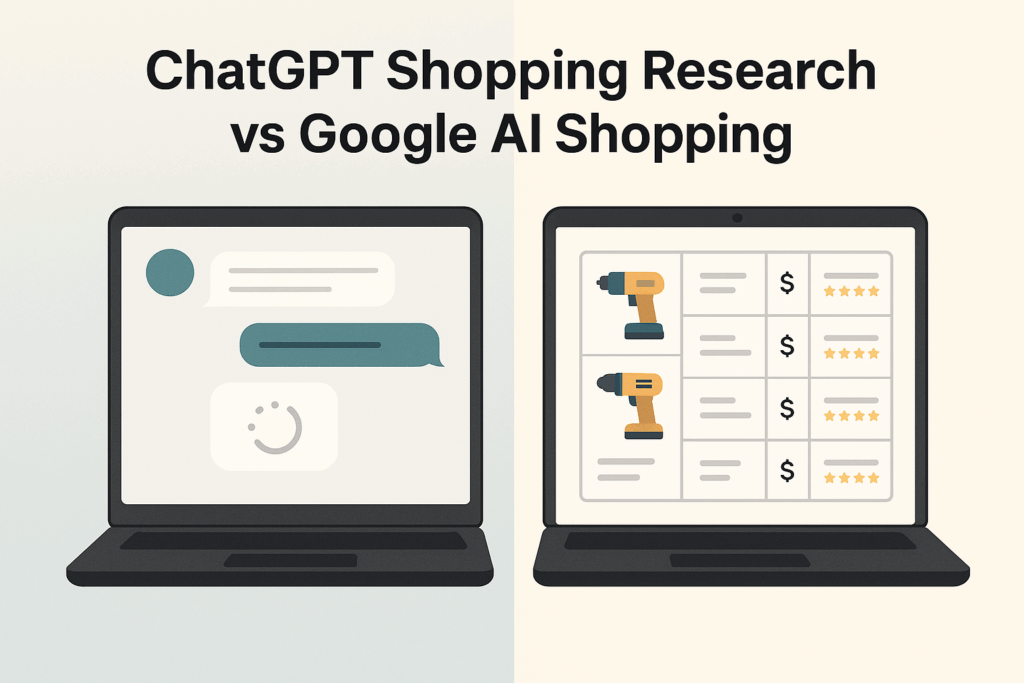
OpenAI and Google are both trying to create the best AI shopping experience. They’ve taken very different approaches. ChatGPT’s Shopping Research offers a deep, conversational process for complex purchases. Google’s AI Shopping prioritizes speed and reliability. For most users, Google will deliver a better experience because it has the better algorithm. ChatGPT’s search logic is still too basic to properly evaluate quality and authority, which means its recommendations often feel random.
Table of Contents
ToggleHow Does ChatGPT Shopping Research Work?
ChatGPT’s Shopping Research is an interactive, question-driven shopping assistant. You can enable it from the tools menu or just ask a product-related question and ChatGPT will suggest initiating Shopping Research.
Once enabled, you enter a specialized chat interface. ChatGPT asks clarifying questions about your budget, who the item is for, and the features you want. As it searches the web for product data, it presents options you can interact with by marking suggestions “Not interested” or “More like this.”
After a few minutes, ChatGPT compiles a personalized buyer’s guide listing top products, key differences, and trade-offs. Retail TouchPoints describes it as OpenAI’s deeper push into commerce.
The experience is pretty cool, but the process takes a while and the output is very verbose.
@tjrobertson52 ChatGPT Shopping Research vs Google AI Shopping – I tested both. Google’s algorithm actually understands quality. ChatGPT’s still too easy to game 🤷 #AITools #ChatGPT #GoogleAI #TechTok #Shopping
♬ original sound – TJ Robertson – TJ Robertson
Is Google AI Shopping Faster Than ChatGPT?
Yes. Google’s AI Shopping delivers answers almost instantly. ChatGPT’s Shopping Research takes several minutes.
Google’s AI Mode in Search produces an organized shopping answer with prices, reviews, inventory, and comparison tables right away. It combines Google’s massive Shopping Graph with Gemini AI to show side-by-side product options immediately.
ChatGPT’s approach is a multi-turn conversation. OpenAI explicitly notes that if you want detailed comparisons, Shopping Research will “take a few minutes” to produce results. It asks questions, waits while gathering data, and synthesizes everything into a report.
Google’s streamlined approach wins on speed.
Which AI is Best for Complex or Expensive Purchases?
ChatGPT’s Shopping Research is designed for high-consideration, complex purchases. If you’re buying a $2,000 laptop or a premium camera and you don’t mind spending a few extra minutes on a guided Q&A, ChatGPT can help you weigh detailed trade-offs based on your specific constraints and preferences.
Google’s AI Shopping focuses on fast answers. It handles complex, multi-constraint queries well thanks to its Shopping Graph, but it doesn’t ask clarifying questions in real-time. You get a quick overview of top options rather than a personalized exploration.
For nuanced buying decisions where you want thorough comparisons, ChatGPT’s slow, interactive approach adds more value. For quick research or simpler decisions, Google is the better choice.
Why Do ChatGPT Shopping Results Feel Random?
This is the core problem with ChatGPT Shopping Research right now.
As I’ve noted from monitoring ChatGPT’s search algorithm, it’s very basic. ChatGPT can’t yet understand authority and quality the way Google does. It’s essentially just doing semantic searches and returning whatever result is most prominent across the internet.
This makes it easy to game. Sites optimized for AI scraping can surface high in ChatGPT’s results even if they’re not reputable sellers. There’s no effective notion of “authority” in the algorithm. If a low-quality website happens to match your query well, ChatGPT might recommend it.
The result? Recommendations just feel random.
Are ChatGPT Shopping Recommendations Reliable?
They’re mixed. OpenAI says Shopping Research cites “reliable sources” and avoids low-quality sites. In practice, the underlying algorithm can’t distinguish quality from prominence.
OpenAI acknowledges the limitations: Shopping Research “might make mistakes about product details like price and availability.” They advise users to verify on merchant sites before buying.
Until ChatGPT’s model learns to better vet sources, take its recommendations with caution. Always double-check prices and read full reviews independently.
Does Google AI Shopping Prioritize Trusted Brands?
Yes. Google’s mature shopping algorithms and AI tools surface well-known, reputable brands and retailers more consistently than ChatGPT does.
Google’s Shopping Graph is built from merchant product feeds and structured data, which favors established vendors. It’s much harder to game Google’s results with SEO tricks. You’re far more likely to see actual trusted brands in Google’s shopping results.
Google’s algorithm is far from perfect, but it’s optimized for trust and verifiability in a way ChatGPT’s shopping tool simply can’t match yet.
How to Enable Shopping Research in ChatGPT
Enabling Shopping Research is straightforward:
- Ask a shopping question. In a ChatGPT session, ask a product-related question (like “best cordless drill under $100”). ChatGPT will suggest initiating Shopping Research.
- Use the tools menu. Click the (+) Tools button and select Shopping Research from the list. On some versions, you can type /shopping to launch it directly.
- Follow the prompts. Answer the AI’s clarifying questions about your needs and budget, then let it compile your buyer’s guide.
What Does This Mean for Businesses?
Both OpenAI and Google are investing heavily in AI shopping experiences. For businesses, this reinforces what we’ve been seeing across AI platforms: showing up in AI results is becoming just as important as ranking in traditional search.
ChatGPT’s algorithm may be easier to game today, but that’s not a sustainable strategy. Google’s approach rewards trusted brands and authoritative content. As ChatGPT’s algorithm matures, it will likely move in the same direction.
The businesses that will win are those building genuine authority through quality content, positive reviews, and strong brand presence across the web. These same signals help you show up in AI-powered search results, whether the user is on Google or ChatGPT.
The Bottom Line
ChatGPT’s Shopping Research offers a deep, conversational experience for complex decisions. Google’s AI Shopping excels at fast, authoritative answers.
For most people, Google will be the better choice. It’s faster, more reliable, and better at surfacing trusted brands. ChatGPT’s flashy interface can give confidence, but under the hood, it’s still doing a broad web search without Google’s well-tuned ranking.
Use ChatGPT for detailed buyer’s guides on big-ticket items where you want thorough comparisons and don’t mind spending extra time. Use Google AI Shopping for quick research that prioritizes established brands.TJ Robertson is the founder of TJ Digital, an AI optimization agency helping small to medium businesses show up in AI-powered search results. Contact us for a free digital marketing audit.