
Digital marketing is changing fast. Everything is becoming search. Traditional search engines, large language models like ChatGPT, TikTok, and YouTube. It all comes down to your content being chosen by the algorithm.
The most successful brands in this new world are those with the best content pipelines. Not the biggest budgets. Not the fanciest production studios. The best systems for creating helpful content quickly.
Here’s how to build one.
Table of Contents
ToggleStep 1: Redefine Quality
Stop thinking of quality as professional and polished. Start thinking of quality as authentic and helpful.
Professional, polished content feels like an advertisement. It also takes about 10 times longer to create. That’s a problem when algorithms reward consistency and volume.
The data backs this up. According to AdWeek, raw content wins on engagement, trust, and relatability, while polished content mainly projects professionalism. 86% of consumers say authenticity is important when deciding what brands they like and support.
Behind-the-scenes storytelling, founders speaking candidly, and customer testimonials. These connect emotionally and build loyalty far better than slick corporate videos.
Polished content still has a role in formal industries. But for most businesses, leaning into imperfection is cheaper to produce and lets you publish more frequently.
@tjrobertson52 How to create high quality content quickly: record it, don’t write it 🎥 One video = 10+ pieces of content across every platform #contentmarketing #marketingtips #contentstrategy #2026
♬ original sound – TJ Robertson – TJ Robertson
Step 2: Build Your Question Bank
Develop a list of questions people commonly ask before becoming a customer of your business.
If you’re struggling to come up with more than a handful, you’re not segmenting enough. Think about all the ways you can slice your audience:
- By demographic: Questions from small businesses differ from enterprise questions. Questions from beginners differ from experts.
- By location: “Does this work in Vermont?” is a different search than “Does this work in Florida?”
- By use case: A homeowner asks different questions than a contractor.
Each variant becomes a content prompt.
Where to find these questions:
- Support tickets
- Sales call recordings
- FAQ emails
- Online forums in your industry
- Reddit threads
- “People also ask” sections in Google
Writing content that directly answers these questions positions your brand as a helpful resource. It also satisfies user intent, which is exactly what search algorithms reward.
For maximum visibility, structure content as straightforward Q&A with real questions as headings. Add FAQ schema markup so AI search tools can easily digest your answers.
Step 3: Extract Knowledge from Experts
Here’s where most businesses get stuck.
You need to get the answer to each question from someone who actually knows what they’re talking about. Usually, that’s you, a founder, or a key employee. The problem is that these people are busy.
Asking a high-value person to sit down for several hours to write a high-quality article is not sustainable. You won’t be able to produce content at a high enough volume.
The solution: Remove friction. Don’t ask experts to write. Ask them to talk.
My favorite method is recording a short video. Just talk into your phone camera about a topic you know well. Two minutes. No script.
Other options:
- Record a voice memo
- Have someone interview the expert on multiple questions at once (if possible, record video of that interview)
One marketer put it well: “Don’t ask SMEs to ‘write content.’ Record short calls where they explain a topic in their own words. Turn that into posts and articles. They actually sound authentic.”
The key insight is bundling. Cover 2-3 related questions per interview. One hour with an expert yields material for multiple pieces. This batch approach maximizes their time and gives you an inventory of raw material to work with.
Step 4: Repurpose and Distribute
This is where the pipeline becomes powerful.
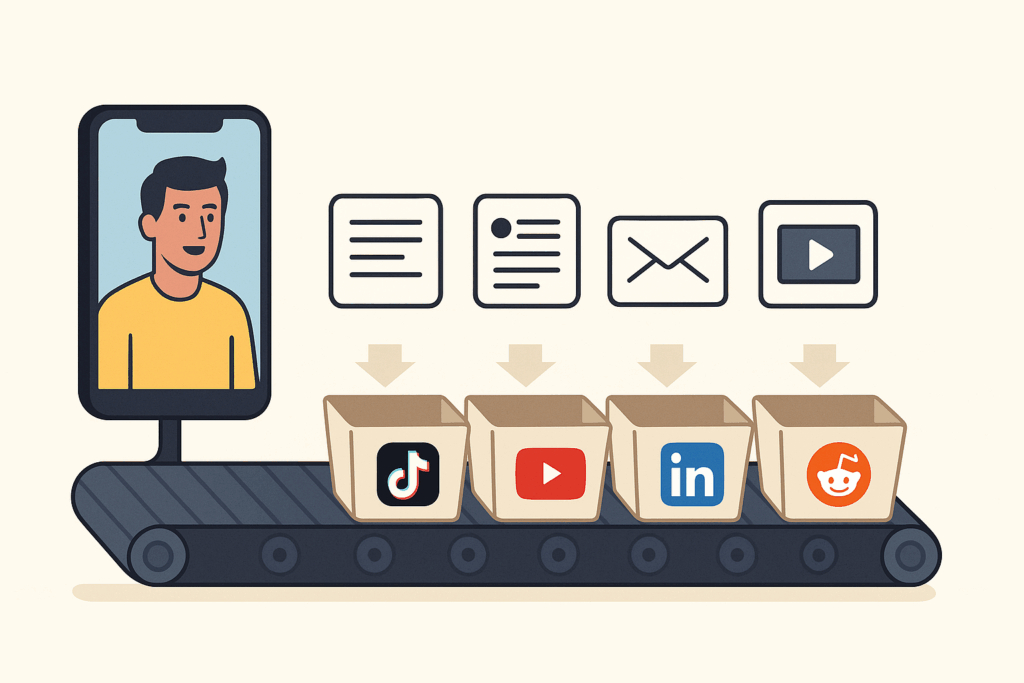
Take that video or transcript and repurpose it across every platform the algorithms care about.
Use AI to transform one piece of content into many:
- Blog post for your website
- LinkedIn post
- Reddit post (in relevant subreddits)
- Medium article
- Email newsletter
- Twitter/X thread
AI platforms can transcribe your video and rewrite key insights into different formats while maintaining your voice. You can prompt it to “rewrite this into an 800-word blog article” or “summarize into LinkedIn carousel bullets.” The result is a draft you fine-tune in minutes.
Distribute video across platforms:
- TikTok
- YouTube Shorts
- Instagram Reels
Each platform has its own algorithm. But here’s what matters: algorithms like Google and ChatGPT are also looking at all these platforms. According to Go Fish Digital, Google’s AI Overviews often blend together articles, TikTok clips, Reddit threads, and more.
The key to being found now is to show up as many times as possible when these algorithms are looking online.
What If You Don’t Have Video?
Use Google’s NotebookLM.
NotebookLM can auto-generate a narrated video from your textual content. Upload sources like blog posts or transcripts, click “Video Overview,” and it creates an AI-narrated slide video. It pulls relevant images, diagrams, quotes, and data from your documents.
You can choose formats (explainer, brief), styles (whiteboard, cartoon), and give it a steering prompt to focus on certain topics.
Fair warning: It’s experimental. Google notes there may be inaccuracies or glitches, so review the output. But it’s a legitimate way to turn written content into video when you have nothing else.
Why Ubiquity Matters for SEO and AI
Traditional SEO still works. Quality content, keywords, links, and technical optimization. Keep doing that.
But with generative AI disrupting search, a “publish and pray” strategy isn’t enough anymore.
The solution is ubiquity. To rank in Google’s AI Overviews, you need to own as many surfaces as possible. Your website, TikTok, Reddit, YouTube, Pinterest, and industry forums.
This wide presence sends signals both to Google and the knowledge bases behind ChatGPT and other LLMs. ChatGPT culls data from Reddit, news, and social feeds. If you’re not there, you’re invisible to it.
Think like a multi-channel buyer. People check TikTok, Reddit, and chatbots in addition to Google. By showing up everywhere with helpful content, you maximize visibility across both traditional search engines and AI-powered platforms.
The Complete Content Pipeline
Here’s the system in summary:
- Redefine quality as authentic and helpful, not polished and professional
- Build a question bank by segmenting customer questions across demographics, locations, and use cases
- Extract expert knowledge through quick video recordings, voice memos, or interviews
- Repurpose with AI into blog posts, social content, and newsletters
- Distribute everywhere, including video platforms, Reddit, and LinkedIn
- Show up repeatedly so algorithms find you no matter where they look
This is how you create high-quality content quickly. Not by hiring more writers or increasing production budgets. By building a system that turns five minutes of talking into a dozen pieces of content spread across the internet.
The brands that figure this out will dominate 2026. The ones still trying to polish every piece of content will be too slow to compete.
Need Help Building Your Content Pipeline?
At TJ Digital, content repurposing is one of our core services. We take human input like a short-form video or transcript and turn it into up to 10 different high-quality pieces of content that sound like they were written directly by you.
Once the system is built, it’s incredibly powerful. You spend five minutes recording a video. We handle the editing, repurposing, and distribution across every platform that matters.
If you’re not sure where to start, we offer a free digital marketing audit. No credit card required. I’ll review your website and online presence, then put together a video and document outlining what I believe would be most effective at getting you more customers.