
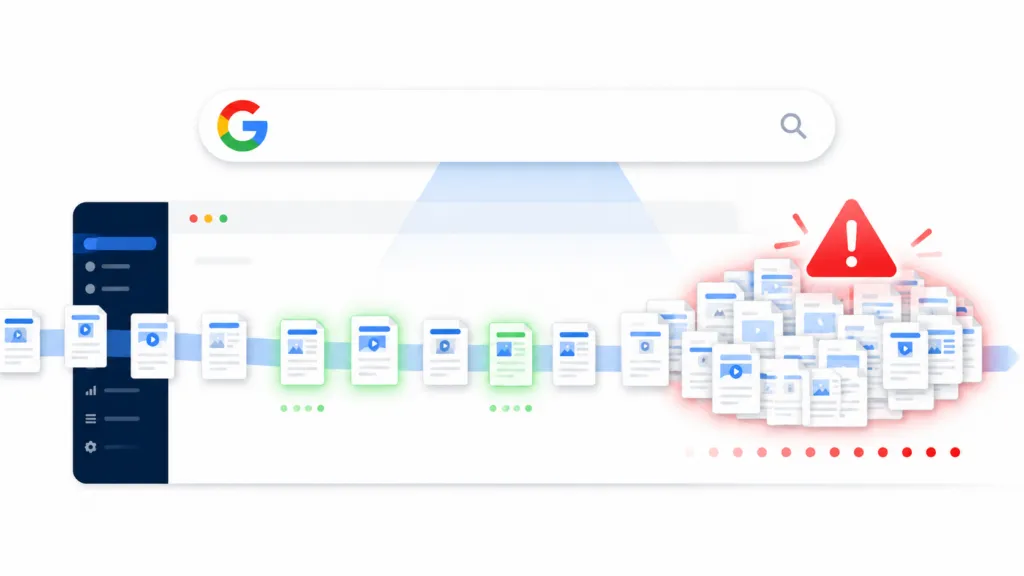
Google does not penalize a page for being written by AI. The penalty that catches AI content is scaled content abuse, which means publishing large volumes of pages mainly to manipulate search rankings. At TJ Digital we run AI-assisted content for roughly 40 to 50 websites, and not one of them was hit by Google’s March 2026 spam update targeting low-quality AI content.
The useful question is how much content your site can publish before you land on Google’s radar. That answer comes down to your authority and your size. Most of the business owners who ask me about this are one or two orders of magnitude away from tripping anything.
Table of Contents
ToggleCan Google Tell If Your Content Was Written by AI?
No. The truth is that Google does not know whether any single page was written by AI, and it is not trying to find out. Its spam systems look for patterns of people abusing or manipulating search results.
In practice those patterns look like a sudden spike in published URLs, hundreds of pages built on one template, pages with no identifiable author, and visitors who bounce straight back to the results. Google has said its SpamBrain system keeps working on spam however that spam is produced.
Google’s guidance on AI content states that appropriate use of AI or automation does not violate its guidelines. The line Google draws is about intent and value. Content produced mainly to manipulate rankings breaks the rules whether a person or a model wrote it.
An AI detector score on a single blog post tells you nothing about your risk with Google. The pattern Google evaluates runs across your whole site.
@tjrobertson52 How much AI content is too much for Google? Most sites aren’t even close to the line. #SEO #AIContent #ContentMarketing
♬ original sound – TJ Robertson – TJ Robertson
Why Does Google Care About Content Published at Scale?
Because publishing at scale works. If your website has even a little authority and you publish a lot of content targeting what people are actually searching, you will usually see a large increase in traffic. You will also see a jump in how often AI tools recommend you.
That effectiveness is exactly why Google watches for it. Google’s scaled content abuse policy covers using generative AI to produce many pages without adding value for users. Publishing aggressively puts you on the radar for that policy.
Are AI Content Penalties Manual or Algorithmic?
As far as I can tell, every one of these penalties so far has been a manual action. Someone at Google becomes aware of what a site is doing and places a scaled content abuse penalty on it by hand. The damage runs from a ranking demotion to full deindexing of the offending pages.
That may not hold much longer. David Quaid made the point on Edward Sturm’s podcast that Google is going to have to start dealing with this algorithmically. Under that model the algorithm picks up on scaled content abuse patterns and penalizes the site with no action from a human at Google.
If that shift happens, the buffer that comes from not being noticed goes away.
How Much Content Is Too Much Content?
There is no fixed page count that triggers a penalty. Your ceiling is set by two factors. The first is your authority and the second is your size.
AI can produce high quality content for your website. It would be silly not to take advantage of that. The work is figuring out the pace your site can carry.
How Does Site Authority Affect How Much You Can Publish?
Authority here means the signals that tell Google your site is established:
- How many links point to your website
- How many people search for your brand by name
- How much traffic your website gets today
A well-known brand already ranking for competitive terms can publish far more than a new, smaller brand. Established sites get more benefit of the doubt.
Why Does the Number of Indexed Pages Matter?
Your size means how many of your pages are currently indexed in Google. The pages report in Google Search Console gives you that number. I’ve written more on reading Search Console data if you want the full walkthrough.
Google reads new publishing against your existing footprint. Adding 1,000 pages to a site with 100 indexed pages looks strange. Adding 1,000 pages to a site with 50,000 indexed pages looks like a normal month.
| Indexed pages | Pages added in a month | Growth | How it reads |
| 100 | 1,000 | 1,000% | An obvious anomaly |
| 1,000 | 1,000 | 100% | Aggressive enough to draw scrutiny |
| 50,000 | 1,000 | 2% | A normal month |
| 50,000 | 30,000 | 60% | The pattern penalties target |
This is why the same publishing plan is safe for one site and reckless for another. Google reads your new pages relative to what you already have indexed.
Should You Worry About Publishing One Page a Day?
No. I talk to a lot of website owners who are nervous about adding a single page a day, and that nervousness is misplaced.
The websites getting slapped right now are adding hundreds or even thousands of pages a day. One page a day on a site with a few hundred indexed pages is steady, ordinary growth.
Are Most Websites Publishing Too Much Content or Not Enough?
For the vast majority of websites, the problem is underpublishing. Most sites I audit are not producing enough content to compete for the terms their customers are searching.
I broke down the pacing arithmetic in a separate post on how much content to publish. The short version is to grow your indexed page count steadily instead of in bursts.
What Else Should You Know About Google and AI Content?
Does Google have an AI content detector?
No. Google has said its systems analyze patterns and signals to identify spam content however it is produced. There is no public Google tool that scores pages for AI authorship.
Will Google penalize a single AI-written blog post?
No. One page written with AI assistance is not a spam signal on its own. Penalties in this category apply to sites publishing large volumes of low-value pages.
How do I know if my site has a scaled content abuse penalty?
Check the manual actions report in Google Search Console. A site hit with this penalty gets a notice there describing aggressive spam techniques such as scaled content abuse.
Does editing AI content protect you from a penalty?
Editing helps when it adds real value, like original data, first-hand experience, or specifics a model could not produce on its own. Lightly rewording thin content does not.
How Do You Set the Right Publishing Pace for Your Site?
Every site has a different ceiling, and yours depends on the authority and size you have today. TJ Digital builds content strategies for small and medium-sized businesses at a pace their site can actually carry. Reach out through our contact page and tell me where your site stands right now.