
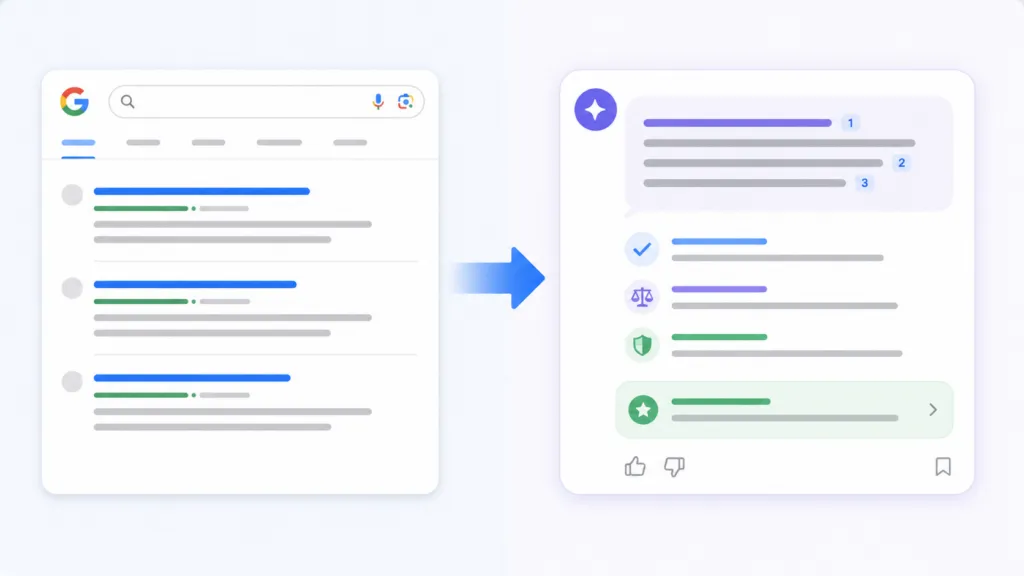
Yes, what most people are calling GEO is just SEO now. Search is changing, so SEO is changing with it. Anyone telling you that GEO is a separate discipline from SEO is either still doing 2018-style SEO or trying to charge you twice for the same work.
At TJ Digital, we run roughly 4,000 AI prompts per day across ChatGPT, Gemini, and Perplexity for our clients. That is how we measure visibility in AI search. It is also the bulk of what we do for clients now. We just call it SEO, because that is what SEO is becoming.
Table of Contents
ToggleWhy I Don’t Use the Term GEO
The term GEO implies that traditional SEO is still its own thing and now there is this new discipline you also need to do. From where I sit, that is not what is happening. The way people search for and find information is shifting, and SEO is shifting with it.
Right now we are in an awkward transition phase. When you do a search online, you get some mixture of an AI response and traditional search results.
My prediction is that by the end of 2026, almost every search experience is going to be AI-driven. Google will still link to websites when the links are useful. The response itself will be generated by AI on top of those results.
If that is where search is going, then SEO is whatever you do to get recommended in AI search. We do not need a separate term for it.
People still doing meta tag optimization and waiting for keyword rankings without thinking about AI citations are doing legacy SEO. It is a bit like someone in 2020 still using 2005 SEO tactics and calling it SEO.
@tjrobertson52 People keep asking if I do GEO. I do… I just call it SEO. Most “GEO experts” haven’t kept up with how AI search actually works. #SEO #GEO #AISearch
♬ original sound – TJ Robertson – TJ Robertson
What Has Actually Changed About SEO
Here is the honest answer to anyone saying AI SEO and traditional SEO are the same thing. They are not. The strategies are different because the mechanics of search are different.
In traditional SEO, a person types a query directly into Google and gets back about ten ranked links. They click on one or two of those, usually from the top three results. If it is a big decision, they might run a follow-up search.
In AI search, the human never interacts directly with the search engine. The AI does. The user enters a prompt, and the AI breaks down the intent. Then it runs anywhere from three to twelve specific, less competitive searches in a traditional search engine behind the scenes.
That process is sometimes called query fan-out. For each of those searches, the AI looks at hundreds of pages across the top twenty results, not just the top three.
Then the AI ranks those passages. It is looking for the most trustworthy and relevant passage from any page across all those searches. It pulls that passage back into the conversation and shows the user a synthesized answer with citations.
That is a very different game from ranking on a list of ten blue links. If you want a deeper walkthrough, I wrote a separate piece on how AI search works and what each step means for your strategy.
Why Ranking in AI Search Is the Easy Part
This is one of the most counterintuitive things about AI search. Ranking is actually really easy now.
Because the AI is running a dozen specific sub-searches and reviewing hundreds of pages on each one, you do not need to rank in the top three for a competitive head term to be considered. You need an ounce of authority and content that is somewhat relevant to one of those sub-queries.
That is the good news for smaller businesses. The big keywords are still dominated by the same big sites. AI search is reading hundreds of pages, and a lot of them are deep, specific pages that never had a shot at the top of Google. We have written about how this changes the math in the post on ranking in AI search.
Why Getting Recommended Is What Matters Now
Out of the hundreds of pages an AI reviews for a given prompt, only a handful actually get cited in the response. Of those, only one or two get the brand recommendation. That is the prize.
When the AI pulls a passage from your page and stitches it into the response, the only thing that really matters for your business is whether your brand shows up as the recommendation in that passage. If your page is cited but a competitor is named in the passage, the AI just helped your competitor close the sale.
This is the part most agencies have not adjusted to. They still see a citation as the win. The citation is the entry ticket. The recommendation is the result.
Traditional SEO vs SEO Today
Here is a side-by-side of how the work has shifted.
| Aspect | Traditional SEO | SEO Today (AI Search) |
| User behavior | Types one query, clicks 1 or 2 of top 10 links | Types a prompt, AI runs 3 to 12 background searches |
| Pages reviewed by the search system | Top 3 links the human clicks | Hundreds of pages across the top 20 of each sub-search |
| What the user sees | Ranked list of blue links | Synthesized answer with a few citations |
| Goal | Rank on page 1 | Get cited, then named in the recommendation |
| Primary signals | Keywords and backlinks | Topical depth, brand mentions across the web, content the AI can pull a clean passage from |
| Ease of being included | Hard, especially for competitive terms | Relatively easy if you have basic authority |
| Ease of being recommended | Just need to rank well | Hard, requires consistent brand signals across many sources |
The pattern is consistent. Being included in AI search is easier than ranking ever was. Being recommended is much harder than ranking ever was.
What This Means for Your SEO Strategy in 2026
If your agency cannot tell you how often your brand is being recommended in ChatGPT, Gemini, and Google AI Mode, they are running the SEO playbook from five years ago. That playbook is losing ground every quarter.
Here is what actually moves the needle now.
- Content built around the questions buyers ask AI when they are close to a decision
- Brand mentions across the third-party sources AI pulls from before forming its answer
- Structured pages AI can extract clean passages from
- Daily monitoring of which prompts your brand is showing up in and which ones it is not
We get into the specific tactics in our piece on GEO myths debunked, which covers what still works, what does not, and what the data actually shows.
Hire an SEO partner who has rebuilt their workflow around how search actually works in 2026. The agencies selling GEO as a separate service are usually charging you for work a modern SEO should already be doing.
Book a free audit with TJ Digital to see exactly where your website stands in AI search and what is worth doing about it. We will look at your AI visibility, your traditional rankings, and tell you what would actually move the needle for your business.
Will Google Replace Traditional Search Results with AI?
Almost certainly, and the timeline is tighter than most people think. Gartner predicted this shift back in 2024, forecasting a 25% drop in traditional search engine volume by 2026. Google has since confirmed that direction publicly through its own leadership. The blue link era is winding down fast.
Do I Need a Separate GEO Specialist for My Website?
No. A specialist sold to you under the GEO label is usually doing a subset of what a modern SEO should already be doing, and you are paying for it twice. The right move is finding an SEO partner who has updated their methods for AI search.
What Is Query Fan-Out in AI Search?
Query fan-out is when an AI takes a single user prompt and turns it into multiple, more specific searches that run in the background. Instead of one broad search like “best CRM for small business,” the AI might run a dozen sub-searches around features, integrations, pricing, and use cases. The AI then pulls content from across all those results and synthesizes one answer.
How Long Will Traditional SEO Tactics Still Work?
Some basics like clean technical SEO, descriptive URLs, and keyword research in headings still matter and probably will for a long time. The tactics losing ground are the ones built around chasing rankings on a list of ten blue links, since fewer and fewer searches end with a person clicking those links.