
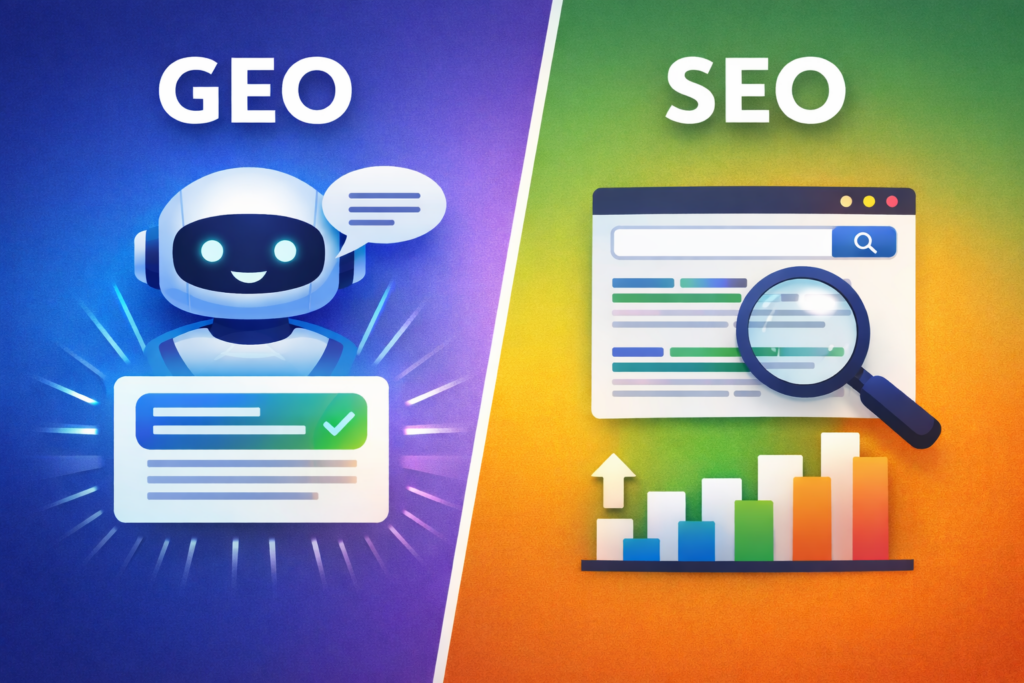
Generative Engine Optimization (GEO) is the practice of optimizing content so AI platforms like ChatGPT, Google’s AI Mode, and Perplexity cite or recommend your brand when answering questions. Traditional SEO focuses on ranking high in search results to earn clicks. GEO focuses on being included in the AI’s answer itself.
At TJ Digital, about 9 out of 10 new clients come to us asking about GEO. Large language models already convert users to customers at roughly 8 times the rate of traditional search engines, so this shift matters. But most of these clients already have an SEO agency and think they need a second team for AI optimization. I always tell them the same thing: it doesn’t make sense to have an SEO team and a GEO team. We’re going to be doing the same projects.
That said, if your SEO agency tells you nothing has changed and they’re doing the same thing they’ve always done, that’s a problem. Something has changed. This article breaks down what’s different, what’s the same, and what you should be doing about it.
Table of Contents
ToggleWhat Is Generative Engine Optimization?
GEO is the process of getting your brand mentioned, cited, or recommended by AI-powered search tools. These include ChatGPT, Google’s AI Mode, Perplexity, and others.
In traditional SEO, the goal is to rank high enough in Google’s results that users click through to your site. In GEO, users often get their answer directly from the AI without clicking anything. Your goal shifts from earning clicks to earning mentions.
If the AI recommends your brand when someone asks for a solution, that mention can drive leads even though no one visited your website.
60% of Google searches now end without a click. This is largely because AI Overviews and other features deliver answers directly on the results page. Google’s AI Overviews grew from roughly 6% of queries in 2024 to about 13% in 2025. ChatGPT’s share of search jumped significantly over that same period. Organic click-through rates roughly halved.
This is why GEO matters. But it doesn’t mean you abandon SEO. It means you expand it.
Key Differences Between GEO and SEO
Here’s a side-by-side comparison of how traditional SEO and GEO differ in practice:
| Traditional SEO | GEO | |
| Primary goal | Rank high in search results, earn page visits | Get cited or mentioned in AI-generated answers |
| User path | User searches, scans results, clicks a link | User asks AI a question, gets an answer directly |
| Success metrics | Rankings, clicks, organic traffic | AI citation rate, brand mentions in AI answers, indirect conversions |
| Content structure | Can be longer-form, narrative copy | Shorter sections, answer capsules, tables, bullet points that AI can extract easily |
| Keyword targeting | Target head terms people type into Google | Target both head terms and the conversational sub-queries AI generates (query fan-out) |
| Ranking requirement | Need to be near the top of page 1 for visibility | Can get cited from page 2 or even from third-party sites, directories, and forums |
| Link building | Backlinks are a primary ranking factor | Backlinks still matter, but brand mentions (even without links) also influence AI recommendations |
Despite these differences, the core work is the same. Create content that matches what people are searching for. Make sure it’s well-structured. Build authority for your brand online.
Do You Need a Separate Team for AI Optimization?
No. And this is where a lot of businesses are wasting money right now.
I recently had a conversation with David Quaid, an SEO with over 20 years of experience. We both landed in the same place: GEO is an extension of SEO, not a separate discipline.
Some companies come to me and say, “We already have a great SEO team. Now we just need someone for GEO.” I always tell them that probably doesn’t make sense. While there are new opportunities because of ChatGPT and other large language models, the process and strategy are very similar.
There is a lot of work we do to rank in ChatGPT that we wouldn’t do for traditional SEO. I wouldn’t be putting out press releases right now if it wasn’t for ChatGPT. We wouldn’t be so focused on case studies. There are directories I wouldn’t care about and blog topics I wouldn’t bother writing. But all of these are expansions of a typical SEO campaign. It’s the same kind of work, done alongside the SEO work we’ve always done.
Multiple experts recommend integrating GEO with your existing SEO team rather than building a second team. Splitting them tends to duplicate effort and misalign strategy.
The bottom line: upskill your existing SEO staff on AI search tactics. Keep everything under one strategy, one team.
Can You Rank in AI Without Ranking #1 on Google?
Yes. This is one of the most important things to understand about how AI search works, and it’s one of the biggest practical differences from traditional SEO.
In Google, ranking 9th or 10th is almost as useless as ranking 114th. Very few people scroll past the first few results. But in AI search, a page ranking 9th can end up as the first recommendation in the AI’s response.
AI models don’t just look at the top Google results. They search in ways that humans would never search. This process is called query fan-out. When you ask an AI a question, it doesn’t run a single search. It breaks your question down into multiple sub-queries and searches for each one separately.
A study of this process found that pages ranking for these fan-out queries were 161% more likely to be cited in AI answers. Even pages that only ranked for the sub-queries (and not the main term) had roughly 49% higher citation odds.
Here’s an example. We were looking at query fan-outs for a home remodeler. The AI was searching for things like “home remodeling company in Bethesda, Maryland, with experience in German kitchens.” No human would ever type that. But the AI did. If you had a page that matched, you’d get cited.
I told a new client this recently. They sell another company’s product and have a page about that company on their site. They said they never cared about the page because they’d never outrank the company itself in Google. I explained that they don’t need to outrank them. They just need to show up on the page. Now they’re part of the AI’s response.
What Kind of Content Gets Cited by AI?
AI models tend to cite content that is fact-dense, well-structured, and direct. We’ve found that certain writing styles and structures get cited significantly more than others.
Fact density matters most
AI doesn’t know if facts are true or relevant. But seeing numbers, statistics, and quotes seems to encourage citing that content. One study found that incorporating statistics raised AI visibility scores by 20-40%. Adding quotations from experts increased citation rates by 37%.
Answer capsules at the top of the page
72% of pages cited by ChatGPT included a brief, factual summary near the top. This is called an answer capsule. It’s a short paragraph that directly answers the question the page is about. Write it as if the AI is going to pull this paragraph directly into its response, because it probably will.
Tables, lists, and structured formatting
AI models parse structured content far more easily than long paragraphs of text. Listicles accounted for 50% of top AI-cited content. Pages with tables were cited 2.5 times more than pages without tables. Microsoft has publicly confirmed that bulleted lists and tables are easier for their AI to process than dense paragraphs.
Original data and proprietary research
Over half (52%) of ChatGPT-cited pages included unique data or proprietary research. If your page has data that doesn’t exist anywhere else, the AI has to cite you. Case studies, survey results, and benchmarks give AI a reason to reference your brand specifically rather than a competitor.
Page title and URL slug
When an AI retrieves content, it pulls based heavily on the page title and URL slug. Getting your target keyword in both of these is still one of the highest-impact things you can do. The meta description also appears to play a role. The best practice right now is to answer the user’s likely question directly in your meta description so the AI is confident your page has what it needs.
Why Is There So Much Misinformation About AI Optimization?
This is something I feel strongly about, and it’s something David Quade and I discussed at length. There are two types of misinformation hurting businesses right now.
Agencies that claim nothing has changed
I see at least one SEO agency make this claim every day. They’re always praised by the same corner of the SEO community, because those SEOs want it to be true. It would mean they don’t have to change anything.
If you’re paying an SEO agency, ask them what they’re doing differently to make sure you’re visible in ChatGPT and Google’s AI Mode. If they tell you nothing has really changed, consider finding another agency. Find one that’s excited about these new opportunities.
90% of the time when I look at what a prospective client’s current SEO agency is doing, the client doesn’t even know what they’re doing. The agency says they’re “optimizing” or “doing things in the back end.” Here’s a simple test: if they’re not creating content, optimizing existing content, or building links and recommendations, they’re not doing anything that’s going to help you rank.
Tools that overstate what they can measure
On the other side, there’s a wave of tools claiming to measure your brand’s AI visibility with proprietary algorithms. An investigative report testing several popular platforms found frequent errors. One tool listed a brand at the wrong rank compared to the actual AI response. Another doubled a metric’s value overnight without explanation. Optimization suggestions from these tools were often generic and even contradicted each other.
LLMs don’t have a “trust score” for your brand. They don’t evaluate your authority the way these tools suggest. The idea that you need a special dashboard to manage your AI presence is, in most cases, selling a solution to a problem that doesn’t exist in the way they describe it.
To spot misinformation, manually verify AI outputs for a few queries rather than trusting a tool’s summary. Be skeptical of claims like “our algorithm measures brand trust via LLMs” unless the methodology is clearly explained. Always treat AI-generated metrics as supplemental signals, not as definitive data.
How to Start Optimizing for AI Search
If you want to show up in AI-generated answers, here’s what to focus on. Most of this is good SEO practice with a few additions.
- Get your target keyword in the page title and URL slug. AI retrieves content based heavily on these two elements. This is still one of the highest-impact actions you can take for both traditional search and AI search.
- Open each page with a direct answer. Summarize the key point in the first one or two sentences. 72% of ChatGPT-cited pages include this kind of answer capsule near the top.
- Pack your content with facts. Use numbers, statistics, and specific claims. “62% of B2B CMOs” is far more useful to an AI than “many businesses.” Stat-heavy content sees 20-40% higher AI visibility.
- Use tables and bullet points. Pages with tables are cited 2.5 times more often. Use tables for comparisons and bullets for lists.
- Include original data when you have it. Case studies, survey results, and benchmarks give AI a reason to cite your brand specifically.
- Target long-tail, conversational queries. Think about the follow-up questions AI would ask when breaking down a user’s prompt. Cover those on your page, even if they have zero search volume in Google.
- Build your brand’s presence across the web. Directories, press releases, third-party articles, Reddit, YouTube. The AI pulls from all of these. It doesn’t have to be on your domain. As long as the page recommends your brand, that’s enough.
- Don’t create a separate team for this. Treat AI optimization as an extension of your existing SEO and content work. One strategy, one team.
Should You Hire an AI Optimization Agency?
You need one agency that handles both SEO and AI optimization well. The work overlaps too much to split it.
At TJ Digital, we call this AI SEO. It’s traditional search engine optimization with an emphasis on the things that help you get recommended by ChatGPT, Google’s AI Mode, and Perplexity. We’re not claiming to have cracked some secret algorithm. There are no AI optimization experts yet. This industry is brand new and changing rapidly. But we test constantly, track what’s working now, and adjust our strategy every month based on what the data shows.
Right now, most of the tactics that help you show up in AI answers are the same tactics that help you rank in Google. But there are important additions, and agencies that aren’t experimenting with those additions are already behind.
Everything I covered in this article, from query fan-out targeting to answer capsules to building brand presence across third-party sites, is part of what we do for our clients every month.
Get a Free AI Optimization Audit
Want to see how your website and content perform in AI search? We offer a free digital marketing audit that includes AI optimization recommendations. No credit card required. Just practical insights you can use to start getting recommended by the platforms your customers are already using.