
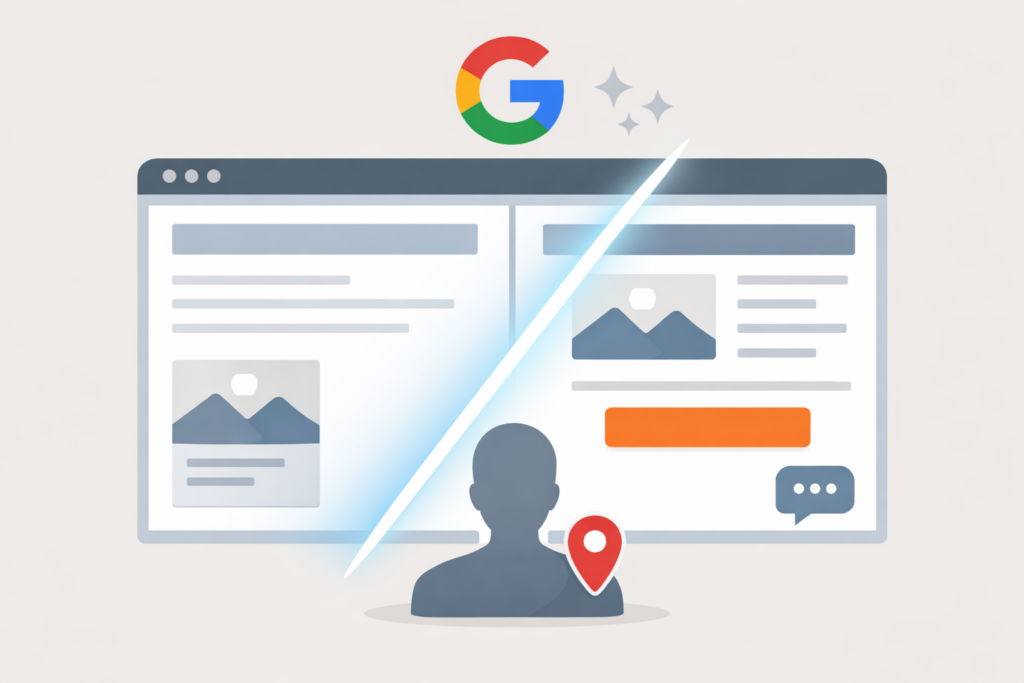
Google just filed a patent describing a system that would replace your website’s landing pages with AI-generated versions, personalized for each individual user. A lot of SEOs and business owners are worried about it. I think it’s worth paying attention to.
At TJ Digital, one of the most reliably effective tactics we use for clients is building separate landing pages for different cities, demographics, and use cases. It works, consistently. This patent describes Google doing exactly that automatically, using AI, for every website in their index. Whether that’s a threat or an opportunity depends on where your website stands today.
Table of Contents
ToggleWhat Does Google’s AI Landing Page Patent Actually Describe?
@tjrobertson52 Google just patented AI-generated landing pages that could REPLACE yours 😳 Sounds scary but it might actually help small brands compete. Fill your site with content NOW — that’s the move either way. #SEO #googleaigemini #digitalmarketingtips #smallbusinesstips #AI #AINews
♬ original sound – TJ Robertson – TJ Robertson
The patent, US12536233B1, was filed in January 2026. The full title is “Machine-Learned Content Page Generation and Landing Page Scoring System for Search Result Optimization.”
The core mechanic works like this:
- A user searches for a product or service on Google
- Google scores your existing landing page using signals like bounce rate, conversion rate, and click-through rate
- If your page falls below a certain threshold, Google generates a new landing page for that specific user instead of sending them to yours
- The AI-generated page pulls from your website’s content: your product info, images, descriptions, and data
- The new page is designed to look like yours (same colors, logo, links) but the structure and content are rebuilt from scratch to match that user’s context
That context matters a lot. Google can use the user’s location, past search queries, device, browsing preferences, and even things like loyalty status or past purchases to customize what gets shown. So the same product page a user in Denver sees could look completely different from what a user in Chicago sees, even if they typed the same search term.
The patent also describes the option to embed an AI chatbot directly on the generated page, pulling answers from your site’s content in real time.
Why Is Google Doing This?
Google’s stated goal is to improve user experience on pages that aren’t doing their job. If your landing page is generic, slow, or just not connecting with the person who landed on it, Google wants to fix that, with or without your input.
From Google’s perspective, this makes sense. They care about what happens after the click. If people bounce from your page immediately, that’s a signal the result didn’t satisfy their intent. This system is Google’s attempt to solve that problem at scale.
It’s also worth noting what Search Engine Journal points out: the patent’s examples focus almost entirely on e-commerce and paid shopping ads. This is not currently a system designed to rewrite every piece of organic content on the web. It’s targeting low-converting retail and shopping pages, particularly in paid placements.
How Does Google Personalize the AI-Generated Page?
The patent describes two primary data sources driving each generated page: your site’s data (products, text, images) and the user’s account profile (their query, location, past searches, preferences).
A few examples of how this plays out:
- A user who has been searching for “laptops for 3D modeling” might land on a page that specifically surfaces specs relevant to GPU performance, even if your original page doesn’t lead with that
- Someone searching from a specific city might see localized product availability or pricing
- A returning customer might see a page reorganized around the categories they’ve bought from before
Each component of the page is annotated with dynamically generated content based on the specific query. Google isn’t just swapping in different text. It’s rebuilding the page architecture around what that individual user is most likely to respond to.
Google AI Landing Pages vs. Traditional SEO Landing Pages
| Factor | Google AI-Generated Page | Your Optimized Landing Page |
| Personalization | Built per user, per query | Built per audience segment |
| Brand control | Google controls copy and layout | You control everything |
| Who it applies to | Underperforming pages (below threshold) | Any page |
| Current scope | Shopping/paid ads, primarily e-commerce | All organic and paid results |
| Opt-out | No opt-out described in patent | N/A |
| Conversion potential | Theoretically higher (personalized) | High, if well-built and intent-matched |
| Brand messaging accuracy | Google’s interpretation of your brand | Your exact messaging |
Could This Actually Level the Playing Field for Small Brands?
This is where I have a genuinely different take from most of the people reacting to this patent.
Most websites are not well-optimized. Not because business owners don’t care, but because most small and mid-size brands just don’t have the resources to build a perfectly targeted landing page for every city, use case, or buyer profile. We do this for our clients at TJ Digital because it converts, but we also know it’s a significant investment. If Google’s AI generates a high-converting, personalized page using your content as the raw material, a small business suddenly gets the same treatment as a well-funded competitor.
That’s a real opportunity, assuming Google’s models are actually good enough to pull it off. The current models still make too many mistakes for this to be reliable at scale. Gemini 4 or 5 is probably where this becomes viable. AI is not going to stop improving, and eventually Google will be able to generate a better landing page than most businesses have built themselves.
Should You Be Worried About Google Replacing Your Landing Pages?
That depends on your situation.
If you run a larger brand that has invested heavily in your website’s design and messaging, yes, you should pay attention to this. Handing control of your landing pages over to Google means Google decides how your brand is presented, what offer to lead with, and what copy the user sees. That’s a real loss of control over something you’ve carefully built.
For those brands, the best move right now is what it’s always been: build pages that actually convert. The patent makes clear that Google only replaces pages that fall below its scoring threshold. If your page fully satisfies search intent, loads fast, and converts well, Google has no reason to touch it.
For smaller brands with limited resources, this might end up being a net positive. The version of your page Google generates would still use your products, your images, and your data. Your brand assets are still there. The content would just be arranged and rewritten to match the user’s context.
That said, the patent describes no opt-out mechanism. Google makes the replacement decision on its own, and there’s currently no equivalent of a noindex tag for this system. If it launches, it runs automatically based on your page’s performance signals.
What Should You Do to Prepare for AI-Generated Search Results?
Here’s the thing: none of this changes the core advice.
Whether or not Google ever deploys this system, the best thing you can be doing right now is filling your website with content about your company. I covered the specific pages worth prioritizing in my guide on preparing your website for AI search, but the short version is this: the more your site functions as a deep, organized knowledge base about your business, your products, and your industry, the better you’ll perform across every direction this could go.
If Google’s AI does start generating pages from your site’s content, richer source material means better output. If it doesn’t, that content helps you rank, helps AI platforms like ChatGPT cite you, and helps users who land on your site find what they need.
A few practical steps:
- Improve your page performance metrics. Pages Google would replace are pages with high bounce rates and low conversions. Strong on-page experience keeps your score above whatever threshold Google sets.
- Add structured data. Schema markup (Product, FAQ, HowTo) makes it easier for any AI system to extract and correctly represent your content. Our technical SEO checklist covers the schemas worth prioritizing.
- Cover your company thoroughly. About pages, team bios, case studies, detailed product specs, FAQ sections. Give AI models, including Google’s, a lot to work with.
- Keep an eye on Google Search Central for any announcements about rollout. This is still a patent. Patents don’t always become products.
Will Google Actually Deploy AI-Generated Landing Pages?
The honest answer is we don’t know. A patent is not a product roadmap. Just because Google has described this system in legal detail doesn’t mean it’s being built right now or that it will ever launch in the form described.
What we do know: Google already scores your pages on engagement metrics. They already personalize search results. They’re actively building out Gemini’s capabilities. The technical groundwork is being laid whether or not this specific patent becomes a live feature.
My take is that Google will deploy something like this eventually. The current models aren’t reliable enough to do it well at scale, but that window closes every few months. Either way, the response is the same: build a website that thoroughly represents your business and actually serves the people who land on it.
Frequently Asked Questions
Does Google’s AI landing page patent apply to all websites?
Based on the current patent, no. The examples and scope described focus on e-commerce pages and paid shopping ads with low conversion rates. There’s no indication the system would apply broadly to organic blog content or service pages.
Can website owners opt out of Google’s AI landing pages?
The patent describes no opt-out mechanism. Google determines whether to replace a page autonomously, based on its landing page score. Keeping your pages well-optimized and high-converting is currently the best way to avoid replacement by default.
Will Google’s AI landing pages use your brand’s design?
According to the patent, yes. The generated page is meant to mirror your site’s visual identity including colors, logo, and navigation so the transition feels seamless to the user. The content and layout are what change, not the brand assets.
What signals does Google use to score landing pages?
The patent references metrics like bounce rate, conversion rate, and click-through rate as inputs for the landing page score. Pages that fall below a certain threshold are candidates for AI replacement.
How soon could Google deploy this system?
There’s no announced timeline. The patent was filed in January 2026, and a patent doesn’t guarantee a product launch. Current AI models may not yet be reliable enough for this to roll out at scale, but the technical groundwork is clearly being laid.
At TJ Digital, we help small and mid-size businesses build websites that perform well with both traditional search and AI platforms. If you want to know how your site stacks up, request a free audit and we’ll take a look.