Google just confirmed what I’ve been predicting would happen by the end of 2026. Traditional search is breathing its last breath, and it’s happening faster than I expected. At TJ Digital, where we track over 4,000 AI prompts per day across ChatGPT, Google AI Mode, and Perplexity for roughly 40 to 50 client websites, we’ve been preparing for this shift for over a year.
Most of our clients are already seeing results within the first three months because so few agencies are actually doing this work yet.
At Google I/O 2026, Liz Reid, Google’s head of search, said it plainly. Google Search is AI search “through and through.” The person who runs Google Search is telling you directly that the entire experience is now powered by AI.
This article breaks down what actually changed, why traditional SEO metrics are becoming less reliable, and what your business should be doing right now.
Table of Contents
ToggleWhat Did Google Announce About Search at I/O 2026?
This was the biggest change to Google Search we’ve ever seen at a single event. Google rolled out several major features, all built on top of their Gemini 3.5 AI model.
The most visible change is the new search bar. Google has switched to what they’re calling an “intelligent” search bar that accepts much longer, conversational queries. You can now include images and files with your searches.
Google’s own data shows that AI Mode queries are about three times longer on average than traditional searches, and 16% of searches now include voice, images, or video.
Beyond the search bar, Google announced three new AI-powered features:
- AI-generated apps inside search results. Gemini can now build custom mini-applications in response to your query.
- Persistent dashboards that continue to exist after you leave the search page.
- Long-running search agents that monitor topics for you over time and send notifications to your phone.
These features are interesting, but the real SEO impact comes from something less flashy.
@tjrobertson52 All search will be AI search. Google said so at I/O. Rank tracking is breaking down. Here’s what to do instead. #SEO #GoogleIO #AISearch #GoogleSearch
♬ original sound – TJ Robertson – TJ Robertson
How Does AI Change Which Websites Appear in Google?
This is the change that matters most for businesses. Yes, blue links to websites still exist in search results. The difference is how those blue links get selected.
Previously, a human typed a query and interacted directly with Google’s algorithm. The results they saw were the raw rankings.
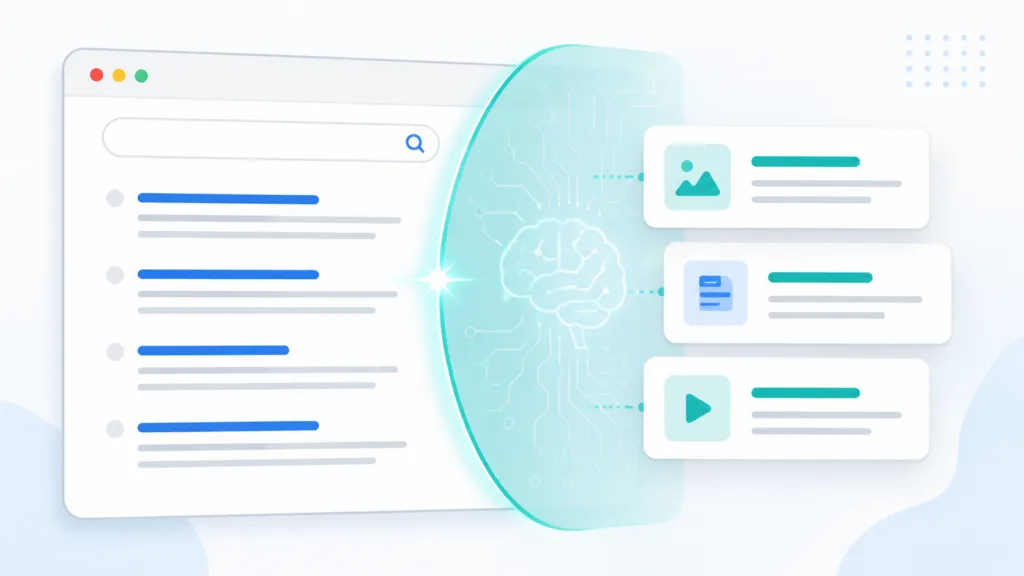
Now there’s an AI layer between the user and those rankings. The human passes their query to an AI, and that AI interacts with the algorithm, curates the results, and decides which ones to show.
The human never sees the raw website rankings anymore. An AI is looking through those rankings, filtering them, and presenting only what it considers most relevant to the specific query.
Google confirmed this shift by announcing that AI Mode now has over one billion monthly users. This is no longer a feature being tested in the margins. It is how Google Search works.
Why Is Keyword Rank Tracking Becoming Less Reliable?
When an AI agent sits between the user and the algorithm, tracking your position for a specific keyword stops telling you what you need to know. You could rank number three for a term and still never appear in the AI-curated results that the user actually sees.
The data problem goes beyond rank position. Google has reduced the number of results returned per page and quietly disabled the ability to pull 100 results at once.
One analysis found that roughly 88% of websites saw drops in reported impressions in Search Console, and about 78% saw fewer tracked keywords. Google says this is from filtering out bot queries rather than actual lost traffic, but the practical effect is the same. The old data pipeline is drying up.
Google has also confirmed that AI Overviews and AI Mode results are not broken out separately in Search Console. So even the data you do have doesn’t tell you where your traffic is actually coming from.
| Traditional Search Tracking | AI Search Tracking | |
| What you measure | Keyword rank position | Whether your brand appears in AI responses |
| Data source | Google Search Console, rank trackers | Prompt simulations across AI platforms |
| Query type | Short keyword phrases | Long, conversational prompts |
| Stability | Relatively consistent over time | Varies by prompt phrasing and context |
| Competitive insight | See who ranks above/below you | See which brands get recommended |
What Should Businesses Do About Google’s AI Search Changes?
The game has shifted from tracking keyword positions to tracking which websites are actually being cited in AI responses and figuring out how to get your brand into those citations.
There are two primary ways to influence AI recommendations for your brand.
The first is finding the pages that AI models are already citing when someone asks about your product or service, and getting your brand mentioned on those pages. These could be blog posts, listicles, review sites, or industry directories. If a page is already being used by AI to form an answer, adding your brand to that page puts you directly in the response.
The second is creating content that is better than what’s currently being cited. If the AI is pulling from a competitor’s comparison article or buying guide, you can write a more thorough, more accurate version. When your page outperforms what’s already ranking, AI models will start citing yours instead.
The good news is that ranking in AI search is still relatively easy right now. Most SEO agencies are still doing things the traditional way, which means businesses that start optimizing for AI search today face very little competition.
Does Traditional SEO Still Matter in 2026?
Yes. Google’s own guidance is clear on this point. AI search still relies on Google’s core indexing and ranking systems.
The pages that get cited in AI responses still need to be indexed, crawlable, and relevant by the same standards that have always applied.
Google’s official AI optimization guide says the same fundamentals still apply. Write helpful content that answers real questions. Keep your pages technically sound, mobile-friendly, and fast.
Adding relevant images and video also matters now more than before, because AI search can present multimodal answers.
Early data also shows that clicks from AI-generated summaries tend to be more valuable than traditional search clicks. Users who click through from an AI response spend more time on site and engage more deeply. Understanding how AI search works helps explain why this traffic converts better.
The difference is that doing good traditional SEO is now necessary but not sufficient. You also need to be tracking and optimizing for how AI models select, synthesize, and present your content.
How Long Does AI Search Optimization Take to Show Results?
Expect three to six months before you start seeing measurable improvements in AI visibility, with full impact typically showing between six and twelve months. This is similar to traditional SEO timelines.
But there’s a significant first-mover advantage right now. AI Mode already has over a billion monthly users, and that number is growing. Content you optimize today will compound in visibility as AI search adoption continues climbing.
Most of our clients at TJ Digital see initial results within the first quarter because competition in AI search optimization is still so thin.
What Else Should Business Owners Know About Google AI Search?
Will blue links completely disappear from Google?
Nobody knows exactly when the entire search results page will be replaced by an AI-generated response, and Google hasn’t announced a timeline. What they have said is that we’re “entering that chapter,” which suggests a gradual transition rather than a hard cutoff. For now, blue links still appear, but they’re being curated by AI rather than shown raw.
Do you need special technical changes for AI search?
No. Google has explicitly said there are no special technical tricks required for AI search, and they even debunked tactics like llms.txt and proprietary markup files as low-value. The same fundamentals still apply, meaning crawlable pages, clear structure, and helpful content.
Is it too late to start optimizing for AI search?
It is the opposite of too late. This is still early, and the window where you can get ahead of competitors who haven’t started yet is open right now. As more agencies and businesses catch on, competition will increase and results will take longer to achieve.
Start Tracking Your AI Search Visibility Now
If you don’t know whether your business is showing up in AI search results today, you’re flying blind. Contact TJ Digital for a free digital marketing audit that includes an AI search visibility check across ChatGPT, Google AI Mode, and Perplexity.