
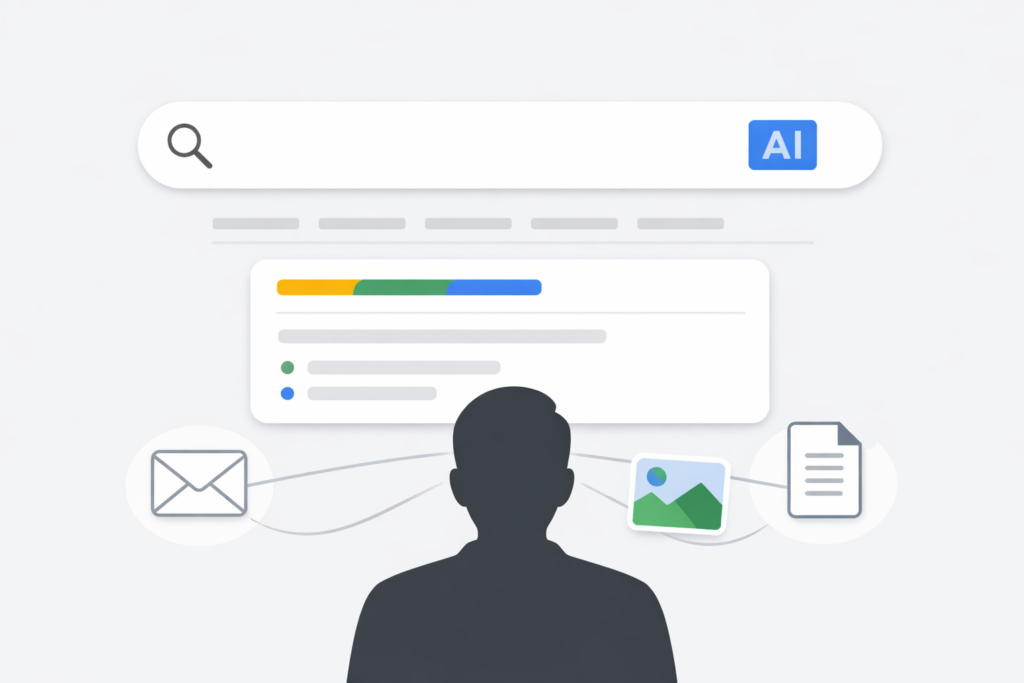
Google just rolled out a feature called Personal Intelligence, and it’s a big deal for anyone who cares about how their business shows up online. When someone performs a search in AI mode, Google now pulls from that user’s emails, workspace files, browsing history, and photos to personalize the results specifically to them.
At TJ Digital, we track these shifts closely for all of our clients because understanding how AI models structure their results is the single most effective way to increase your visibility online. This matters more than ever now that large language models convert users to customers at roughly 8x the rate of traditional search engines. Personal Intelligence is the latest signal that traditional keyword-based SEO is fading fast, and the businesses that adapt now will have a serious advantage.
Here’s what you need to know and what to do about it.
Table of Contents
ToggleWhat Is Google Personal Intelligence?
@tjrobertson52 How Google’s Personal Intelligence changes SEO—keyword research is dying and AI mode is coming faster than you think 👀 #SEO #GoogleAI #DigitalMarketing #AIMode
♬ original sound – TJ Robertson – TJ Robertson
Personal Intelligence is a new feature in Google’s AI mode that connects your Gmail, Google Photos, and other Google apps to your search experience. When you search for something, Gemini (Google’s AI) can reference your personal data to give you a customized answer instead of a generic one.
For example, if you search “what time is my flight,” Google can pull the confirmation email from your inbox and give you the exact answer. If you search for restaurant recommendations, it might factor in places you’ve been or dietary preferences it’s picked up from your data.
The feature launched in January 2026 and is currently available to U.S. English Google accounts with an AI Pro or Ultra subscription. It’s strictly opt-in. You have to manually connect your Gmail and Google Photos through your search personalization settings.
Will People Actually Use This?
Some people will hear “Google wants access to my emails” and immediately say no. That’s fair. But here’s the thing: Google already has that data. They’re not collecting anything new. They’re just using what they already have to make search more useful.
And Google has stated that your private data won’t be used to train their AI models. Your emails and photos are accessed on-demand to answer your specific query, then that’s it.
I think when people see how useful the results are, adoption will grow quickly. Personal Intelligence could be the thing that makes AI mode genuinely more useful than traditional search, even with the hallucinations that still pop up.
AI Mode Is Becoming the Default
You might be thinking, “This only affects AI mode. The regular search results page is fine.” But Google has made it very clear that AI mode is where they’re headed. It’s their primary AI-driven search interface now, and it’s replacing the traditional ten-blue-links page.
I’ve been saying AI mode will become the default search experience by the end of 2026. But seeing how hard Google has been pushing it in recent weeks, I think it’s coming sooner. Google has already been integrating AI Overviews (those generated summaries at the top of search results) with AI mode, so users can click a follow-up in an Overview and jump straight into a full AI conversation.
If you’re still thinking of AI mode as a side feature, you’re going to be caught off guard.
What This Means for Keyword Research and Rank Tracking
This is where it gets real for SEO.
If every user is getting personalized results, the idea of a fixed #1 ranking becomes meaningless. Two people searching the exact same phrase will see different answers because Google is factoring in their personal context.
Keyword research and rank tracking were already losing relevance. Personal Intelligence accelerates that. It makes less and less sense to try to rank for specific search terms when the results are different for every person.
Google’s own guidance reflects this shift. They’ve been pushing businesses to focus on helpful, people-first content rather than gaming the system with keyword optimization. In AI mode, users ask questions that are 2-3x longer than traditional searches, and the AI breaks those into sub-queries to find the best answers. It’s matching meaning, not exact phrases.
That doesn’t mean keyword research is useless. It still helps you understand what topics your audience cares about. But the strategy shifts from “rank #1 for this keyword” to “be the most helpful, authoritative source on this topic.”
How AI Mode Finds and Cites Content
Understanding how AI mode actually works is the key to showing up in it.
When someone asks a complex question, AI mode uses a technique called “fan-out.” It breaks that one question into multiple sub-queries and searches for answers to each one separately, then combines everything into a single response.
So if someone asks “best CRM for a 10-person sales team on a budget,” Google might run separate searches for small business CRM options, CRM features for sales teams, and CRM pricing comparisons. Your content needs to be useful for those individual sub-queries, not just the original long question.
This has practical implications for how you structure your website content.
Structure pages in clear, modular sections. Use H2 and H3 headings that reflect the kinds of questions your audience actually asks. Each section should start with a direct answer. Write short paragraphs (2-3 sentences) that can stand on their own if pulled out of context.
Use tables and lists for comparisons and data. AI models are more likely to cite content that’s formatted in a way they can easily extract from.
Add FAQ sections with direct Q&A pairs. Format actual questions as headings and follow them immediately with concise answers. AI systems can lift these directly into responses.
Brand Authority Matters More Than Ever
In a personalized search world, the signals that matter most are trust and authority. Some people are calling this “answer engine optimization.” The idea is simple. If AI is going to recommend businesses, it’s going to recommend the ones it trusts.
This means your overall digital footprint matters. Your website content, your reviews, your business profiles, your social media presence, mentions on other websites. AI models pull from all of these sources to decide if you’re credible enough to recommend.
Here’s what actually moves the needle:
| Signal | Why It Matters |
| Positive reviews on Google, Yelp, etc. | AI models use review data to gauge quality and relevance |
| Consistent business info across platforms | Conflicting details reduce AI confidence in your brand |
| Mentions on authoritative websites | Backlinks and citations signal trust to both Google and LLMs |
| Structured data (schema markup) | Gives AI explicit context about your content and business |
| Active, up-to-date Google Business Profile | Direct signal to Google’s own AI systems |
One important shift. You don’t necessarily need to rank #1 anymore. As SEO researcher Jason Barnard points out, relevancy is becoming more important than position because AI will cite the most relevant reference, not just the highest-ranked one. Broad authority and relevance can outperform a higher keyword position.
Organic Traffic Is Changing Shape
Personal Intelligence and AI mode will reduce click-through rates to websites. That’s the reality. When Google answers a question directly in AI mode, many users won’t need to click through to your site.
But that doesn’t mean visibility is worthless. Being cited by name in an AI response still builds brand awareness, even without a click. And according to Google, when users do click through from AI-enhanced results, those visits tend to bring more engaged traffic with longer time on site and higher conversion rates. That makes sense. These users have already gotten context from the AI, so they arrive more informed and closer to a decision.
The metric to watch is shifting from “how many clicks did I get” to “how often is my brand mentioned in AI responses.” Share of voice in AI results is the new organic traffic.
Google Ads Are Coming to AI Mode Too
Google is already testing ads inside AI mode responses. They’ve confirmed that ads may appear below and within AI mode answers. The exact format is still evolving, but this means paid placements will soon exist alongside organic AI citations.
This makes organic authority even more important. If you’re not showing up organically in AI mode, you’ll be competing solely on ad spend, and the businesses that show up both organically and in paid placements will have a major advantage.
What You Should Do Right Now
The most effective method for increasing your online visibility going forward is to understand how these large language models work. How do they structure their search queries? What kind of websites do they trust? What content do they most often cite?
This is what we track and pay attention to for all of our clients at TJ Digital. Understanding this allows you to influence or replace the sources of information that AI models are using when they decide whether to recommend you or your competitors.
Here’s where to start:
Audit your content structure. Make sure your pages are organized with clear headings, short paragraphs, and direct answers. If AI can’t easily extract a useful snippet from your page, it won’t cite you.
Build your brand authority. Get reviews, get mentioned on reputable sites, keep your business profiles current. AI trusts the same signals that make a business look credible to humans.
Stop obsessing over individual keyword rankings. Focus on being the most useful, trustworthy source on the topics your audience cares about. That’s what AI models are evaluating, not whether you rank #1 for an exact phrase.
Add structured data to your site. FAQ schema, Organization schema, and Article schema all help AI understand your content. Industry analysis shows that most AI-cited pages use schema.
Create content that answers real questions. Not keyword-stuffed pages. Not generic fluff. Content that would actually help a real person who’s searching for what you do.
Frequently Asked Questions
Does Google Personal Intelligence use my data to train AI?
No. Google has stated that your emails, photos, and workspace files are accessed on-demand to answer your specific query. They are not used to train the underlying AI model. You can disconnect your apps at any time through your search personalization settings.
Is Personal Intelligence available for business Google Workspace accounts?
Not currently. The feature only works with personal Google accounts that have an AI Pro or Ultra subscription. Workspace business and education accounts are not eligible.
How does AI mode decide which websites to cite?
AI mode breaks complex queries into multiple sub-searches and looks for the most relevant, authoritative content for each one. It favors pages with clear structure, direct answers, schema markup, and strong trust signals like reviews and backlinks.
Should I still do keyword research if results are personalized?
Keyword research still helps you understand what topics your audience cares about. But the goal has shifted from ranking #1 for a specific phrase to being the most useful, credible source on a topic. Focus on answering the questions behind the keywords.
How SEO Is Changing in 2026
SEO is changing faster than it ever has. But with those changes come real opportunities. It’s like the early days of SEO all over again. The businesses that understand how AI search works and adapt their strategy now will be the ones pulling ahead while their competitors are still trying to rank for exact-match keywords.
If you want help figuring out what this means for your specific business, request a free audit. We’ll take a look at your online presence and show you exactly what would be most effective at getting you more customers in this new search environment.