
For most websites, publishing too much content is not the problem. After 17 years in SEO, I can say with confidence that the far more common issue is publishing too little, or publishing content that doesn’t target what people are actually searching for. At TJ Digital, we’ve helped dozens of small and medium-sized businesses build content strategies that grow their search visibility steadily without triggering any penalties.
That said, there are real risks worth understanding. Publishing volume only becomes a problem under specific conditions, and knowing those conditions will help you set the right pace for your site.
Table of Contents
ToggleCan a New Website Publish Too Many Blog Posts at Once?
@tjrobertson52 99% of websites don’t have a “too much content” problem. They have a “not enough content” problem. Here are the only 2 real risks 👇 #SEO #ContentMarketing #DigitalMarketing #SEOTips
♬ original sound – TJ Robertson – TJ Robertson
Yes. A brand-new domain has limited crawl budget and no established trust with Google. If you launch with 200 pages on a new site, most of them will not get indexed. Research from RankStudio found that a test site with 300,000 new pages had only about 8% indexed after 24 days. An established news site like the New York Times, by comparison, can add thousands of pages daily with little delay.
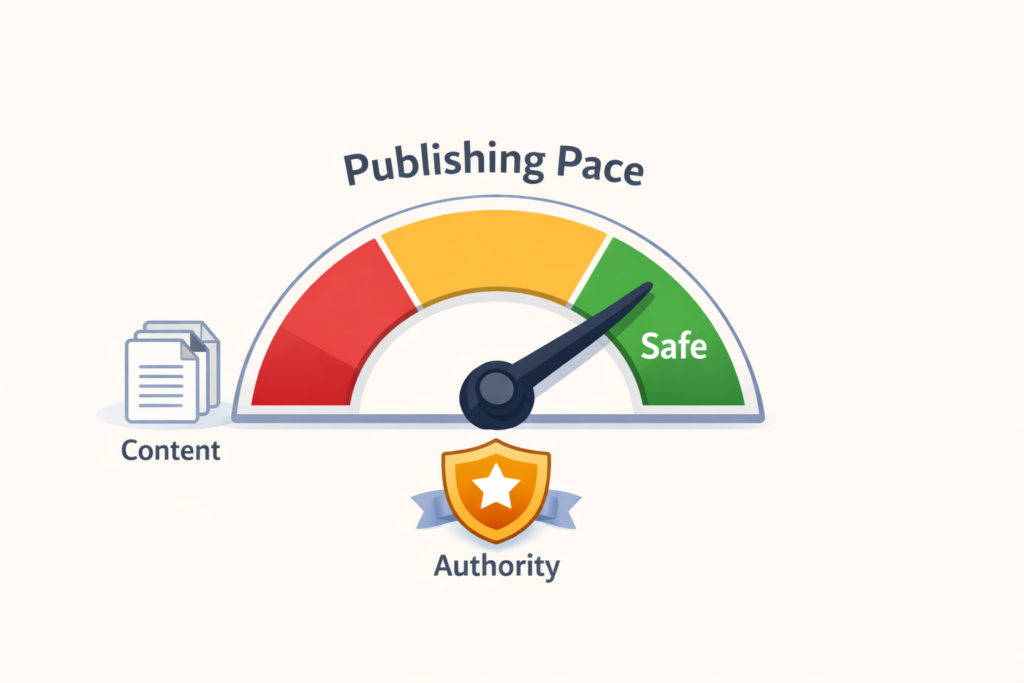
The gap comes down to authority. Google prioritizes crawling and indexing pages on sites it already trusts. New domains simply don’t have that trust yet, so a large content dump mostly goes to waste.
For new sites, the better approach is to start with a handful of well-optimized pages, build backlinks and traffic to those pages, and then expand from there.
What Are the Two Real Risks of Publishing Too Much Content?
There are two scenarios where publishing volume becomes a genuine problem:
Risk 1: Google’s algorithm doesn’t trust your site enough to index the content.
This is a crawl budget and authority issue. If your site doesn’t have enough established trust, Google may crawl your pages but hold off on indexing them. Publishing aggressively in this state means a lot of effort with little return.
Risk 2: You catch the attention of a human reviewer at Google.
This is the scarier risk, and it only applies if you’re automating content at scale. When AI-generated or templated content is produced in large enough volumes to show up in rankings, Google has a backup plan: a manual review that can result in a scaled content abuse penalty. This can be devastating. Pages get deindexed, rankings collapse, and recovering takes time.
The key point: if you’re not automating content at scale, you don’t need to worry about risk two. For most businesses, the problem is never too much content.
How Do You Know If Your Site Has Enough Authority to Publish More?
Before ramping up your output, check three things:
- Pages already indexed. If you currently have 50 pages indexed in Google, adding another 50 in a single month is too aggressive. Adding 10 to 15 is reasonable. Use site:yourdomain.com in Google or the Index Coverage report in Google Search Console to see your current indexed count.
- Organic search traffic. If your existing pages aren’t getting much traffic yet, more pages won’t solve that. Improve the pages you have before adding new ones.
- Backlink quality. Trusted brands in your industry linking to your site signal to Google that your content is worth indexing. Sites with strong inbound links get larger crawl budgets and faster indexing. Sites without them get lower crawl priority.
If all three of these are healthy, publishing more content is low-risk. If they’re weak, fix them first.
| Signal | What It Tells You |
| High % of pages indexed | Google trusts your site – safe to scale up |
| Growing organic traffic | Your existing content is working – good foundation |
| Strong backlink profile | Crawl budget is larger – new pages get indexed faster |
| Low % of pages indexed | Authority needs to grow before adding more content |
| Little or no organic traffic | Fix existing pages before creating new ones |
| Few or low-quality backlinks | Build links first, then scale content |
What Is Google’s Scaled Content Abuse Penalty?
Google’s scaled content abuse policy targets sites that generate large volumes of low-value content primarily to manipulate search rankings. There’s no fixed page count that triggers it. Even 50 pages of thin, templated content can earn a penalty. Ten thousand pages of genuinely useful, unique content might not.
Google uses its SpamBrain AI system to detect patterns: a sudden spike in URLs with low substance, content that looks scraped or templated, or pages that share structure across thousands of thin variations. When flagged, the consequences range from ranking demotion to complete deindexing.
The line is intent and quality. Google’s own guidance allows the use of AI in content creation, but explicitly prohibits using automation with the primary purpose of manipulating rankings. If the content isn’t genuinely useful to the reader, it’s a risk.
How Many Blog Posts Per Month Is Safe for a Small Website?
A useful rule of thumb: grow your indexed pages by no more than 20-30% per month. If you have 50 articles indexed, aim for 10 to 15 new posts that month, not 50.
In practical terms, most SEO consultants recommend 2-3 well-researched blog posts per week for small sites (roughly 8-12 per month). Quality matters more than volume here. Ten excellent articles will outperform 50 mediocre ones, and will be far less likely to trigger any filters.
A consistent cadence, even a modest one, establishes a natural growth pattern. As Breakline Agency notes, launching with 500 pages overnight looks suspicious. Steady, predictable publishing does not.
If you track your new posts in Search Console and most are moving to “Valid” status within a few weeks, you have room to increase your pace. If a lot of pages are sitting in “Discovered currently not indexed,” slow down and build more authority first.
Should You Update Old Posts or Write New Ones?
For sites with limited traffic, updating existing posts often delivers faster results than creating new content. Here’s why: the URL is already indexed, may already have backlinks, and Google already has some history with it. You’re building on existing equity rather than starting from zero.
Focus updates on posts that almost rank wel, sitting on page two, or with outdated information that could be refreshed. These are close to performing and can be pushed over the line with relatively little work.
New content is still important for covering new topics and expanding your site’s reach. The most efficient approach is to audit first, then expand. Fix underperforming pages, then add new targeted posts once the foundation is solid.
What Are the Risks of Using AI to Automate Content at Scale?
AI-generated content is not banned. Google has explicitly stated that automation can be used appropriately in content creation. The violation is using it to flood your site with low-value pages for the purpose of ranking manipulation.
The risks of mass-producing AI content without meaningful human review include:
- Spam policy violation, which can result in a manual action applied to your site
- Deindexing of offending pages or entire site sections
- Long-term suppression, even without a formal penalty, as low-engagement content erodes site trust over time
- SpamBrain detection flagging sudden URL spikes paired with thin content
AI used responsibly, meaning as a drafting or research aid followed by genuine human review and editing, does not carry these risks. The problem is substituting AI for the actual work of creating useful content.
The Bottom Line: Most Sites Need More Content, Not Less
If you’re an established brand already getting organic traffic, publishing more content is one of the highest-ROI things you can do. The risks described above apply to edge cases: brand-new domains without authority, or sites automating at scale without editorial oversight.
For everyone else, the bigger risk is producing too little. Most businesses aren’t creating enough content, or they’re not targeting the specific terms their customers are searching for.
Our AI SEO service at TJ Digital is built around exactly this: building out a content strategy that targets the right terms, at the right pace, in a way that earns lasting visibility in both Google search and AI platforms like ChatGPT. If you want to know where your site stands, request a free audit and I’ll put together a full breakdown of where the best content opportunities are.
Frequently Asked Questions
Does publishing too much content hurt SEO? For most sites, no. Publishing too much only causes problems when your site lacks the authority to get content indexed, or when content is automated at scale without real editorial value.
How many blog posts should a new website start with? Start small and build gradually. A handful of well-optimized pages, supported by link building and basic authority growth, is more effective than a large initial content dump.
What triggers Google’s scaled content abuse penalty? Automating large volumes of low-value content for the primary purpose of ranking manipulation. The trigger is quality and intent, not a specific page count.
Does AI-generated content get penalized by Google? Not automatically. AI-assisted content is allowed. What’s penalized is using AI to produce content at scale without genuine value for the reader.
How do I know if my site is ready to publish more content? Check your indexing rate in Search Console, your organic traffic trend, and your backlink profile. If all three are healthy, you have room to scale.