
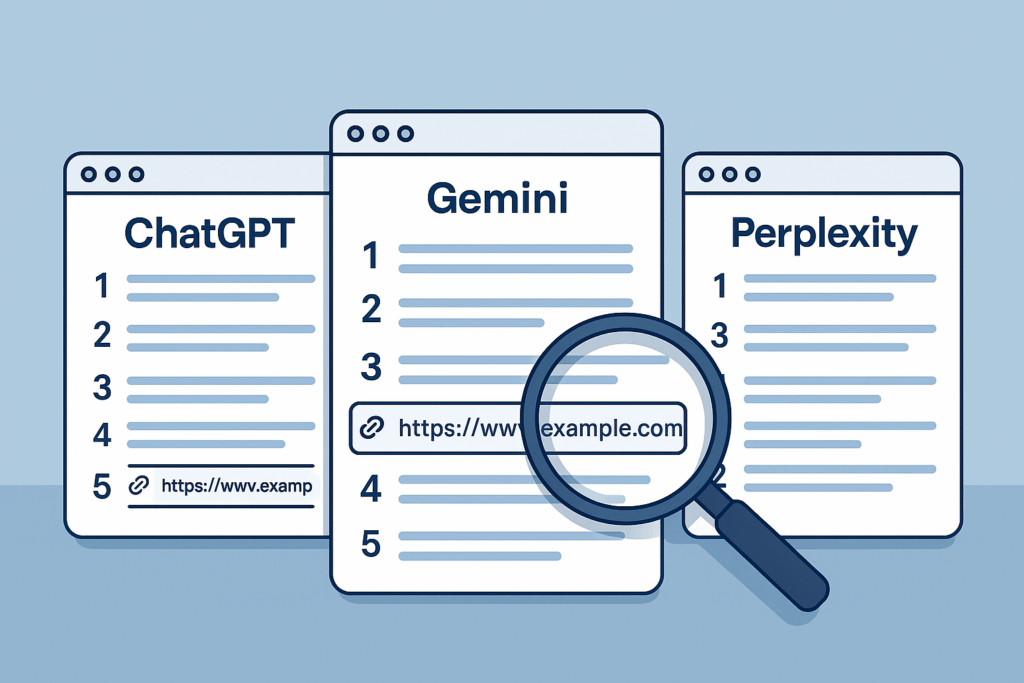
If you want your company or brand to be recommended by large language models, you need to track the pages and websites they cite. That’s the entire game right now.
When someone asks ChatGPT or Perplexity for a recommendation, those AI models search the web and read pages before giving their answer. If the pages they read recommend your brand, the AI will recommend your brand. If those pages recommend your competitor, the AI will recommend your competitor.
We’ve been tracking this for clients for about six months. We simulate roughly 4,000 prompts every day across ChatGPT, Gemini, and Perplexity. What we’ve learned: most GEO advice online is either too generic to be useful or it completely ignores the most effective strategies.
Here’s what actually works.
Table of Contents
ToggleStart by Tracking What AI Models Are Already Citing
Before you can influence AI recommendations, you need to know what pages these models are looking at. Simulate the prompts your ideal customer might type: “I’m this kind of person with this kind of problem looking for this kind of company.”
We use software called Peec.ai to automate this. Other tools like LLMRefs and RankPrompt can also work. These tools send queries to multiple AI platforms and capture which URLs appear in responses.
You can also do this manually. Ask ChatGPT customer-style questions about your product or service and look at the citations. Run 20-30 key queries each month and document which domains show up.
The critical insight: citations vary wildly by industry. Any advice claiming “ChatGPT loves this website” or “you need to be on this directory” is useless if it’s not specific to your industry. What gets cited for dentists is completely different from what gets cited for SaaS companies.
@tjrobertson52 How to Influence AI Citations: 90% of companies waste time on directories that don’t matter. Find the 1-5 that AI actually cites for YOUR industry, get on those listicles, comment on the top Reddit threads, and create content targeting the same keywords as cited pages. Way less competition than Google. #aimarketingtools #GEO #ChatGPT #DigitalMarketing #ContentStrategy
♬ original sound – TJ Robertson – TJ Robertson
Focus on the 1-5 Directories That Actually Matter
There are typically between one and five directories that large language models regularly reference when people ask about your industry. There might be other directories cited one in a thousand prompts, but a handful get referenced between 1% and 50% of relevant queries.
You might hear advice saying you need to be in all the business directories. That’s not true. Find the few that matter for your industry and get listed there. Make sure your profile is complete and accurate.
BrightLocal research found that all major LLMs use directories for business information, but they tend to favor authoritative, industry-specific sites. For dentists, that might be TopRatedDentist.com. For lawyers, SuperLawyers.com. Google Business Profile and Yelp show up frequently across industries.
The key: verify through your own tracking which directories are being cited for your specific industry, then prioritize those.
Listicles Are the Most Important Factor
For most industries, the biggest factor in whether you get recommended is your presence in listicles that AI models find. Comparative listicles account for roughly 32.5% of all AI source citations.
The most common type of listicle is one automatically generated by a directory. These are lists like “Best Window Tinting Shops in Phoenix” created by Yelp or similar platforms. Usually, one directory dominates listicle citations for any given industry.
Figure out which directory that is for your industry. Then figure out how to get to the top of their listicles. Usually, this means getting more reviews or paying for placement. Right now, paying for placement is often worth it.
Beyond directory-generated listicles, you’ll find blog posts, LinkedIn articles, and Medium articles ranking products and services. Getting added to these is harder. Many are created by competitors. But it takes 30 seconds to send an email asking what it takes to get included. Our success rate is about 5%. Most will ask for money or a reciprocal link. If the page is frequently cited by AI models, it’s probably worth it.
Discussion Threads: Target the Top 10
AI models frequently cite discussion threads, typically from Reddit or Facebook groups. Reddit is the second-most-cited platform after Wikipedia, appearing in about 40% of AI answers.
Here’s what most people miss: it’s typically the same 5 to 10 threads being cited over and over again. We might identify 500 threads that have been cited, but 80% of citations go to the top 10. These threads are usually at least a year old.
The strategy is simple. Identify the most-cited threads and leave a comment mentioning your brand. Don’t be overtly promotional. Moderators will remove obvious ads. But you can mention the brand and what you offer as part of a genuinely helpful response.
The threads with high upvotes and many comments are most likely to be cited. Add value with detailed, substantive contributions. Build credibility first by participating naturally, then reference your solution when relevant.
Make Sure Your Own Website Actually Recommends You
Sometimes AI models cite your website directly. When this happens, you want to make sure the page they’re reading actually recommends your brand.
This sounds obvious, but a lot of websites don’t explicitly recommend themselves. They describe features. They explain processes. But they never actually say “we recommend our service for X type of customer.”
When an AI cites your page, it retrieves a block of text. If that text doesn’t contain a clear recommendation, the AI won’t recommend you in its response. It doesn’t matter that it cited your website.
Structure your pages to answer questions directly. Start with a concise summary. Frame your offering in terms of the problem you solve and who should use it. Make it explicit.
The Most Effective Strategy: Create Your Own Content
Most GEO advice focuses entirely on influencing pages that AI models already cite. This is only half the game. You can also replace the pages they cite, and that’s usually easier.
The process:
- Gather a list of all articles and pages being cited by AI models for your target prompts
- Note the titles and topics of those pages
- Create content targeting those same keywords
Publish on your website, LinkedIn, Medium, YouTube, TikTok, and Instagram. The more your brand appears on trusted platforms, the more likely AI systems will cite you.
This is why AI optimization is currently easier than traditional SEO. The keywords AI models search for are much more specific than what humans type into Google. There’s less competition. Studies show that pages cited by LLMs often have lower traffic and fewer backlinks than traditional top-ranking pages.
Build a system for quickly generating content you’re proud of. Find a way to repurpose each piece 10 times across different platforms. The effort compounds.
What This Means for Your Strategy
GEO isn’t about implementing some checklist of tactics. It’s about understanding the specific ecosystem around your industry: which directories get cited, which listicles appear, which Reddit threads keep showing up.
Then systematically influence what’s on those pages or create better alternatives.
The businesses winning at AI optimization right now aren’t following generic advice. They’re tracking their specific prompts, identifying the specific sources being cited, and executing targeted strategies to appear in those sources. If you need help building these systems, that’s what we do. We track thousands of prompts daily for our clients and execute strategies to influence AI recommendations. Contact us for a free digital marketing audit.