
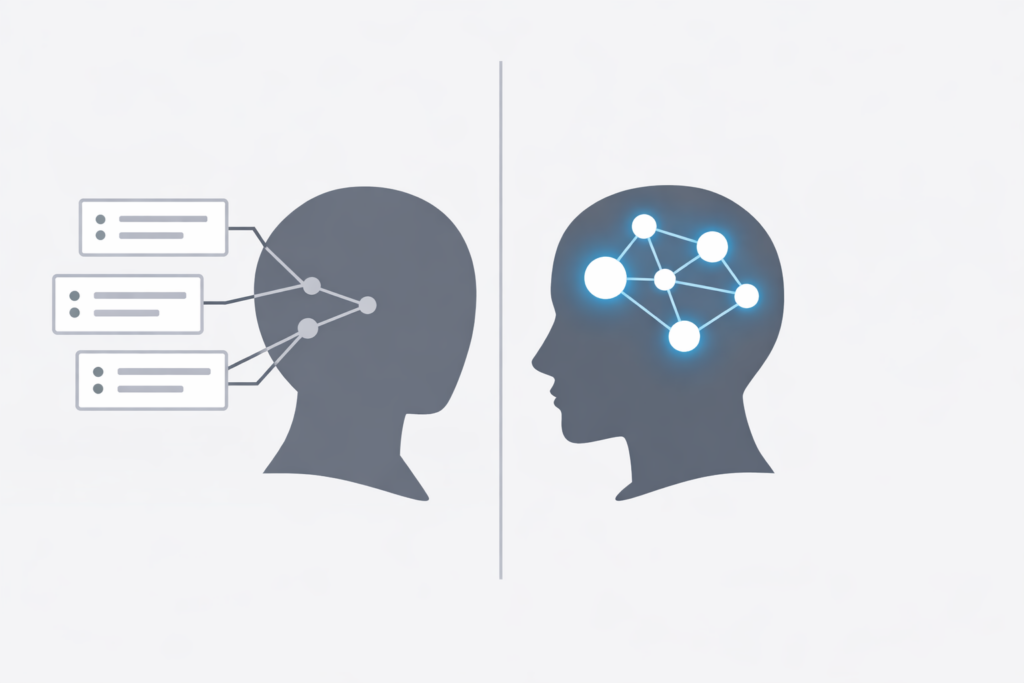
There are two ways to influence how often AI recommends your brand: the easy way and the hard way.
The easy way is showing up in the search results that AI models pull from when answering a question. When someone asks ChatGPT or Google’s AI for a recommendation, the model runs a series of background searches and then parrots back what it finds. If your brand shows up in those results, you get recommended. At TJ Digital, we track over 1,500 prompts across 30 industries specifically to understand what drives AI citations. The pattern is consistent: brands that rank well in traditional search get cited more often by AI.
The hard way is influencing what the model already believes about your brand before it even searches. This is called primary bias, and it comes from the AI’s training data. Right now, primary bias carries less weight than what the model finds in live search results. But that’s starting to change, and businesses that understand both mechanisms will be better positioned as AI search evolves.
Table of Contents
ToggleWhat Is Grounding vs. Primary Bias in AI Search?
@tjrobertson52 AI is changing how brands get recommended. There’s an easy way and a hard way to show up — and right now the easy way is also the most effective. Here’s why Google has a huge edge over ChatGPT 👇 #AISearch #AISEO #GoogleAI DigitalMarketing #SEO #MarketingTips
♬ original sound – TJ Robertson – TJ Robertson
When an AI model answers a question, it draws from two sources of information.
Grounding is the process of connecting the AI’s response to real-time, verifiable content. The model performs live searches, pulls in top-ranking pages, and generates a response based on what it finds. This is functionally similar to traditional SEO. If your page ranks well for a relevant query, the AI sees it and may cite it.
Primary bias is what the model already “knows” about your brand from its training data. Before it runs a single search, the model has a pre-existing opinion shaped by how frequently and prominently your brand appeared in the data it was trained on. Dan Petrovic, who has done extensive research on how AI models evaluate brands, describes primary bias as what skews the model’s selection rate. It’s the internal opinion the model holds before seeing any search results.
Right now, grounding does most of the heavy lifting. The model’s primary bias influences which searches it runs and how it interprets results, but the actual search results carry far more weight in the final recommendation. That said, newer models are starting to shift this balance.
How Does ChatGPT Decide Which Brands to Recommend?
ChatGPT’s recommendation process is simple: it runs background searches and synthesizes the results. But its search capabilities are still limited compared to Google’s.
ChatGPT uses Bing and other partners for live search, but it doesn’t have the decades of ranking data that Google does. It has no real way to evaluate which sources are trustworthy and which aren’t. So it tends to fall back on what it already knows from training, especially for well-known brands. BrightEdge research on AI citations found that ChatGPT surfaces an average of about 2.4 brand mentions per query, and those tend to be established names the model encountered frequently during training.
This is actually a weakness. Because ChatGPT can’t evaluate search quality very well, it leans heavily on brands it already “trusts” from training data. Smaller or newer brands have a harder time breaking through unless they’re ranking prominently in the search results ChatGPT pulls from.
OpenAI’s latest models are leaning even further into this pattern. Their most recent model updates have been tuned to rely less on web results and more on the model’s own knowledge when synthesizing answers. The result is fewer outbound links and more answers generated from the model’s internal understanding.
How Does Google’s AI Decide Which Brands to Recommend?
Google’s AI has a massive advantage here: it sits on top of the world’s most sophisticated search engine.
When Google’s AI (Gemini) generates an answer, it verifies every claim through Google Search internally. It checks facts against live search results and synthesizes answers only after confirming them against its index. This verification-first approach means Google’s AI tends to cite more brands per query and pulls from a wider range of sources. BrightEdge data shows Google AI Overviews mention roughly 6 brands per query, about 2.5 times more than ChatGPT.
This is a huge advantage for Google and one of the reasons I think they’re going to walk away with AI search. Google’s algorithm already has 25+ years of data on which sources to trust. It doesn’t need to guess. And because Google still handles over 90% of global search traffic, the businesses that rank well in traditional Google search are also the ones most likely to get recommended by Google’s AI.
For smaller businesses, Google’s AI actually creates more opportunity. With roughly 6 citation slots per query compared to ChatGPT’s 2-3, there are more openings to compete for.
ChatGPT vs. Google AI: Which Matters More for Brand Visibility?
Both platforms matter, but they serve different purposes and reward different strategies. Here’s how they compare:
| Factor | Google AI (Gemini) | ChatGPT |
| Search integration | Deep integration with Google Search and Knowledge Graph | Uses Bing and partner search tools |
| Brand mentions per query | ~6 brands per query | ~2.4 brands per query |
| Source verification | Verifies every fact via internal Google searches | Limited ability to evaluate search quality |
| Best for | Factual lookups, local queries, real-time information | Exploratory research, complex multi-step questions |
| How to get cited | Rank well in Google search results | Rank in search results AND build training data presence |
| Market reach | 2+ billion monthly users via AI Overviews | 800+ million weekly active users |
| Favors | Authoritative content that ranks well in traditional search | Established brands with strong training data presence |
For most businesses, Google’s AI should be the priority. It reaches more people, cites more brands, and is powered by a search engine your business is probably already optimizing for. But ignoring ChatGPT would be a mistake, especially as its user base continues to grow rapidly.
How to Get Your Brand Recommended by AI Search
The easiest and most effective strategy right now is showing up in the search results that AI models pull from.
When ChatGPT or Google’s AI is reasoning through a recommendation, they run background searches. If your content ranks highly for those searches, it gets fed into the AI’s context and increases your chances of being mentioned. At a practical level, this means continuing to do what’s always worked in SEO, with a few adjustments.
Rank for the Queries AI Will Search
Think about what sub-queries an AI might run when answering a question about your industry. If someone asks “What’s the best CRM software?”, the AI might search for “best CRM reviews” or “top CRM software 2026.” Make sure your content shows up for those terms.
Structure Content for Easy Extraction
AI models prefer content they can easily pull answers from. Use clear H2 headings framed as questions, lead each section with a direct 1-2 sentence answer, and include comparison tables and bullet lists where appropriate. Pages with organized heading structure are 2.8x more likely to earn AI citations.
Build Authority Through Backlinks and Mentions
AI models, especially Google’s, trust brands that are widely cited across reputable websites. This hasn’t changed from traditional SEO. Getting mentioned in industry publications, earning links from authoritative sites, and building a strong recommendation network all feed directly into AI visibility.
Get Listed on the Pages AI Already Cites
AI models pull from specific sources repeatedly. Industry directories, “best of” listicles, and review sites show up in AI answers over and over. Making sure your business is mentioned on cited pages is one of the fastest ways to increase your AI visibility.
How Do You Influence AI Training Data for Brand Authority?
This is the harder path: influencing the model’s primary bias by showing up in its training data. It requires a broader, more sustained effort than just targeting specific search queries.
AI models are trained on massive internet scrapes. Content from well-known, authoritative domains carries extra weight. So the goal is to make your brand ubiquitous across the kinds of sources these models ingest.
Publish on Authoritative Platforms
Guest articles in respected industry publications, contributions to Wikipedia, appearances in major news outlets, and presence in academic or research contexts all increase the odds that AI systems have encountered your brand during training.
Earn Media Coverage
Every mention in a reputable publication becomes a data point the AI can draw on. When journalists quote your team, review your product, or include you in a roundup, that text enters the training corpus. Over time, AI systems form an internal map of your brand from these mentions.
Get on Industry Lists
Appearing in “top 10” or “best of” lists for your category cements the association between your brand and that category in the model’s training data. When a publication lists the leading solutions in your space and your business is included, AI systems learn to connect your brand with that category.
Maintain Consistent Entity Information
Make sure your company name, products, and locations are described consistently everywhere online. AI models need clear, uniform signals to correctly identify and categorize your brand.
This is harder to justify right now because the ROI is less immediate. But as models start relying more on their primary bias and less on live search results, this long-term investment will pay off.
Why Google Has the Advantage in AI Search
I think Google is going to win the AI search race, and it comes down to one thing: they already know how to evaluate search results.
ChatGPT has to figure out which websites to trust from scratch. It doesn’t have decades of ranking signals, click data, or quality evaluations to draw from. Google does. Google’s search algorithm is by far the most sophisticated system for determining source quality, and Gemini gets to use all of it.
This matters because the quality of an AI recommendation is only as good as the sources behind it. A model that can accurately identify the most trustworthy, relevant content will consistently produce better recommendations. And right now, that model is Google’s.
Google also has distribution on its side. AI Overviews now trigger on nearly half of all tracked queries according to BrightEdge data, and that number has grown 58% year over year. With AI Overviews embedded directly in Chrome, Android, and the standard Google search experience, most people encounter AI-generated answers through Google without even trying.
For businesses, the takeaway is clear: ranking well in Google search is still the single most impactful thing you can do for AI visibility. It feeds both Google’s AI and ChatGPT’s search tools simultaneously.
Where Should Small Businesses Start with AI Search Optimization?
If you’re a small or medium-sized business trying to show up in AI search, start with the easy wins and build from there.
- Optimize your existing pages for traditional search. Everything that helps you rank in Google also helps you get cited by AI. Clear headings, direct answers, structured data, and relevant keywords still matter.
- Get mentioned on pages AI already cites. Identify the directories, listicles, and review sites that show up when you run AI prompts in your industry. Get your business on those pages.
- Create content that answers specific questions. AI models love content structured as direct Q&A. Build out your FAQ pages, write blog posts that answer the exact questions your customers ask, and make sure every section of your site leads with a clear answer.
- Build third-party credibility. Earn mentions, reviews, and links from reputable sites. This builds the authority signals that both traditional search and AI models rely on.
- Start building your training data footprint. This is the long game. Publish guest content, seek media coverage, and make your brand visible across authoritative platforms so future AI models have your brand in their knowledge base.
The businesses that take this seriously now will have a significant head start. AI search is still early enough that most of your competitors haven’t adapted their strategy. That window won’t stay open forever.
Ready to get your brand recommended by AI? Contact TJ Digital for a free digital marketing audit that includes AI search visibility analysis.
FAQ
How long does it take to show up in AI search results?
If your pages are already indexed and ranking reasonably well in Google, you can start appearing in AI search results almost immediately. The harder part is getting consistently cited and recommended, which typically takes 2-6 months of focused optimization depending on your industry’s competitiveness.
Does traditional SEO still matter for AI visibility?
Yes. Traditional SEO is the foundation of AI visibility right now. Both ChatGPT and Google’s AI pull heavily from search results, so ranking well in Google directly increases your chances of being cited by AI. The businesses that rank best in traditional search tend to get the most AI recommendations.
Can a small business compete with big brands in AI search?
Absolutely. Google’s AI cites roughly 6 brands per query, which means there are multiple slots to compete for. And AI models run highly specific sub-searches where smaller businesses with niche expertise can outperform larger competitors. The key is to become the go-to source for your specific niche rather than trying to compete on broad, high-volume terms.